The key to unlocking your metabolism, mood, energy and gut health is sitting under your tongue being ignored by your doctor.
This is the ULTIMATE AND COMPLETE GUIDE TO THYROID HEALTH so you can optimize it:

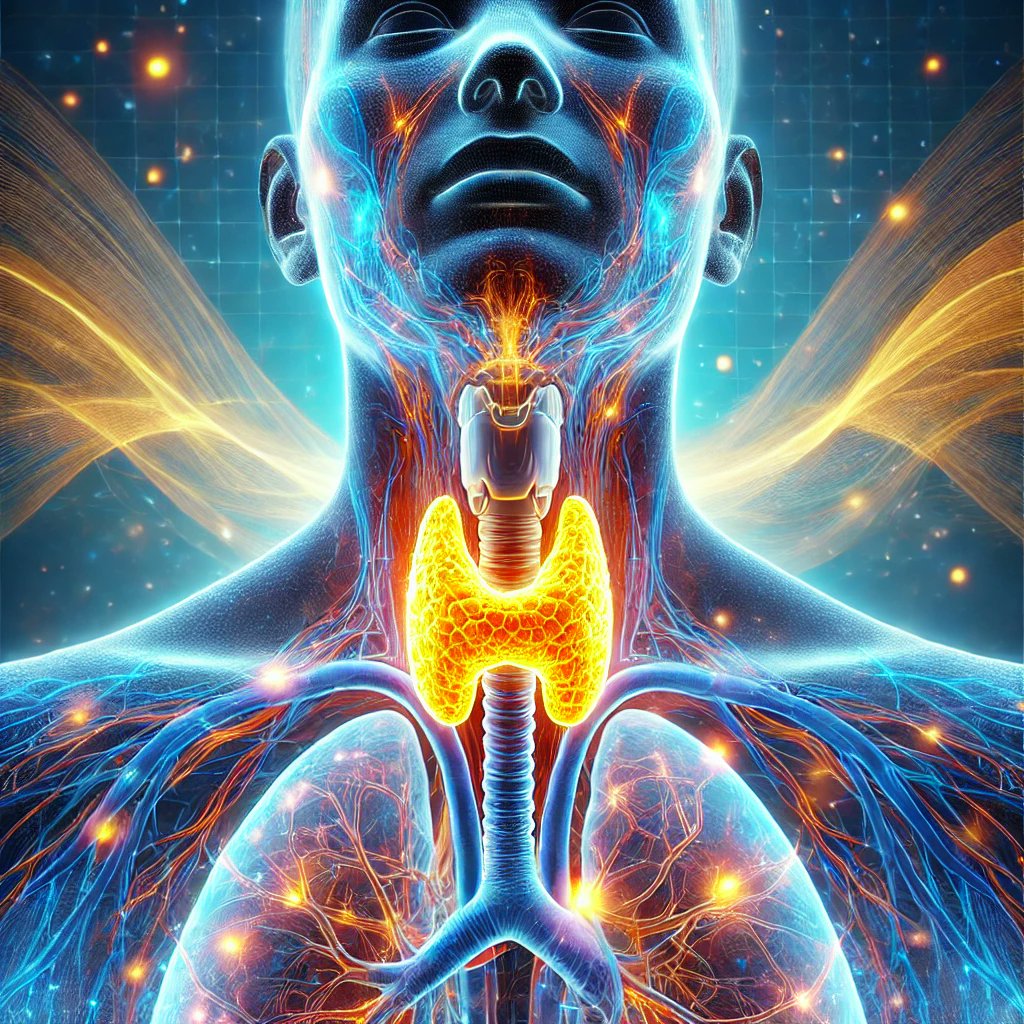
The most COMMON symptoms of poor thyroid function are:
◇ Always being COLD
◇ Constantly being TIRED (no matter how much you sleep)
◇ Poor mood.
But bad thyroid health can manifest in seemingly infinite ways.
Here are some of the symptoms documented by Broda Barnes, MD
◇ Always being COLD
◇ Constantly being TIRED (no matter how much you sleep)
◇ Poor mood.
But bad thyroid health can manifest in seemingly infinite ways.
Here are some of the symptoms documented by Broda Barnes, MD
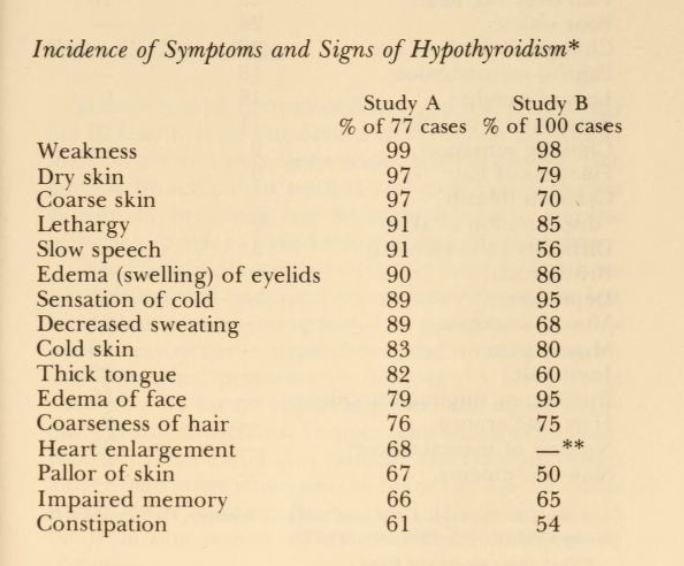
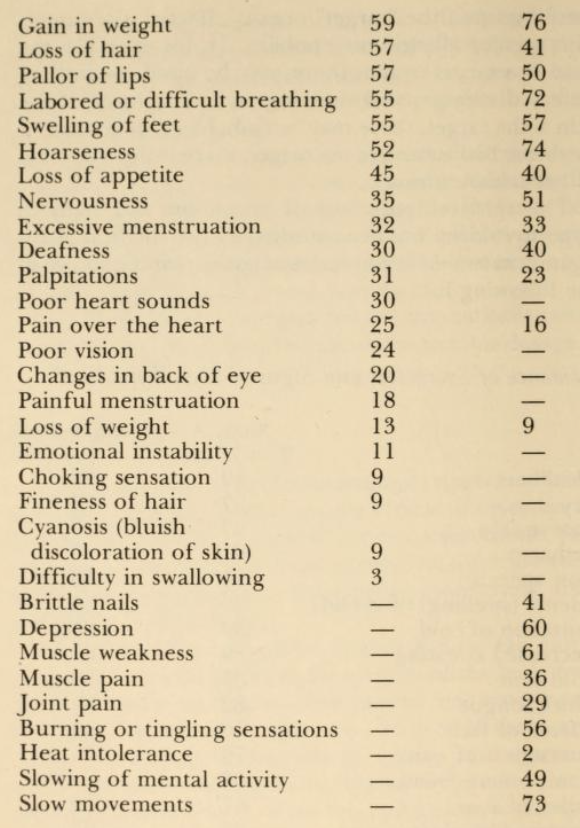
Anxiety & depression can be caused by hypothyroidism.
⬩Low T3, T4 seen in both conditions
⬩Proper thyroid hormone treatment can alleviate these
The brain needs lots of energy - when it lacks it, things go haywire
Mental & metabolic health are synonymous.
⬩Low T3, T4 seen in both conditions
⬩Proper thyroid hormone treatment can alleviate these
The brain needs lots of energy - when it lacks it, things go haywire
Mental & metabolic health are synonymous.

Gut issues are often caused by a lack of thyroid hormone.
Bacterial overgrowth (SIBO) is common in hypothyroidism, as having poor thyroid function:
◇ Lowers enzyme secretion
◇ Worsens motility
◇ Fosters pathogenic bacterial growth (impaired immunity + metabolism)
Bacterial overgrowth (SIBO) is common in hypothyroidism, as having poor thyroid function:
◇ Lowers enzyme secretion
◇ Worsens motility
◇ Fosters pathogenic bacterial growth (impaired immunity + metabolism)

I've written extensively about the thyroid / gut connection here:
View Tweet
Hypothyroidism causes low testosterone - thyroid supplementation nearly doubles it.
Hypothyroidism impairs:
• Testosterone production
• Sperm motility, quality
likely due to high prolactin - decreasing steroid output in the testes.
Treatment can resolve these issues.
Hypothyroidism impairs:
• Testosterone production
• Sperm motility, quality
likely due to high prolactin - decreasing steroid output in the testes.
Treatment can resolve these issues.

I could go on about the signs and symptoms, but if you have any health issue that you can't really seem to put your finger on or explain, you should consider the thyroid is a prime cause.
More on symptoms here:
More on symptoms here:
View Tweet
UNDERSTANDING THRYOID HORMONE PRODUCTION:
Thyroid hormone production starts in the brain, which produces thyrotropin releasing hormone (TRH).
TRH goes to the pituitary gland, producing thyroid stimulating hormone (TSH).
TSH then stimulates the thyroid gland to produce T4, and a little bit of T3.
T4 acts to suppress the release of TSH from the pituitary, to keep things balanced.
T4 is an inactive precursor hormone, it needs to be converted into T3 to truly be active.
T3 is produced from T4 in other tissues, mainly the liver.
The problem is: the standard treatment for poor thyroid function is to give people T4,
but if you have problems converting T4 into T3, then this will actually make the problem worse.
Doctors also typically only test for TSH - a low TSH signals high thyroid hormone production.
The issue here is that again this does not tell you if you have enough T3, which is the important part.
TSH can also be suppressed by other things like stress, so it can actually be very misleading.
Thyroid hormone production starts in the brain, which produces thyrotropin releasing hormone (TRH).
TRH goes to the pituitary gland, producing thyroid stimulating hormone (TSH).
TSH then stimulates the thyroid gland to produce T4, and a little bit of T3.
T4 acts to suppress the release of TSH from the pituitary, to keep things balanced.
T4 is an inactive precursor hormone, it needs to be converted into T3 to truly be active.
T3 is produced from T4 in other tissues, mainly the liver.
The problem is: the standard treatment for poor thyroid function is to give people T4,
but if you have problems converting T4 into T3, then this will actually make the problem worse.
Doctors also typically only test for TSH - a low TSH signals high thyroid hormone production.
The issue here is that again this does not tell you if you have enough T3, which is the important part.
TSH can also be suppressed by other things like stress, so it can actually be very misleading.

TESTING FOR THYROID FUNCTION:
In addition to the standard TSH, you can also test for the free and total levels of T3 and T4.
These measures are helpful, but still not necessarily all encompassing.
The hormones do not need to be "free" from their carrier proteins in order to exert their effects.
Thyroid hormones also need to bind to receptors within the cell in order to activate metabolism, and this binding can be inhibited, too.
Blood tests are not capable of measuring these processes.
In addition to the standard TSH, you can also test for the free and total levels of T3 and T4.
These measures are helpful, but still not necessarily all encompassing.
The hormones do not need to be "free" from their carrier proteins in order to exert their effects.
Thyroid hormones also need to bind to receptors within the cell in order to activate metabolism, and this binding can be inhibited, too.
Blood tests are not capable of measuring these processes.

Another test for thyroid function is reverse T3.
T4 can be converted into either T3, the active thyroid hormone,
OR reverse T3, an inactive thyroid hormone.
Testing for reverse T3 is vital for understanding the full picture.
T4 can be converted into either T3, the active thyroid hormone,
OR reverse T3, an inactive thyroid hormone.
Testing for reverse T3 is vital for understanding the full picture.

"Normal" thyroid levels are a HUGE risk.
Having just slightly high TSH (>1.48) is associated with:
• Obesity
• Insulin resistance
• High blood pressure
• High blood sugar
• High lipids
• High uric acid
• Inflammation
• Hypercoagulability
• Metabolic syndrome
SHEESH!
Having just slightly high TSH (>1.48) is associated with:
• Obesity
• Insulin resistance
• High blood pressure
• High blood sugar
• High lipids
• High uric acid
• Inflammation
• Hypercoagulability
• Metabolic syndrome
SHEESH!

Cholesterol is another marker of thyroid function.
We need thyroid hormones to break down circulating cholesterol and turn into steroid hormones.
People with bad thyroid health often have high cholesterol.
Thyroid therapy reduces cholesterol.
We need thyroid hormones to break down circulating cholesterol and turn into steroid hormones.
People with bad thyroid health often have high cholesterol.
Thyroid therapy reduces cholesterol.

There are limitations to thyroid blood tests, but they can still be helpful when a proper panel is done, in proper context.
You can get a full thyroid panel here (if you live in the US): no doctor needed, at a discount, with fully interpreted ranges. revelationdiagnostics.com/product-page/t…
You can get a full thyroid panel here (if you live in the US): no doctor needed, at a discount, with fully interpreted ranges. revelationdiagnostics.com/product-page/t…
AT HOME TESTING FOR THYROID FUNCTION.
Thyroid experts, before we were able to test hormones in the blood, used 3 main assessments:
◇ Morning temperature
◇ Pulse
◇ Achilles test
Morning temperature is taken by placing a thermometer under the arm, waiting 10 minutes, and recording the temperature, first thing in the morning.
If you are under 97.8 F (36.6 C) consistently - good chance you're low on thyroid.
A heart rate under 70 is considered to be a key sign of hypothyroidism too, though of course this can be impacted by aerobic fitness.
Stress can also raise pulse rate, but if you're at rest and not stressed, it can be a helpful measure.
Thyroid experts, before we were able to test hormones in the blood, used 3 main assessments:
◇ Morning temperature
◇ Pulse
◇ Achilles test
Morning temperature is taken by placing a thermometer under the arm, waiting 10 minutes, and recording the temperature, first thing in the morning.
If you are under 97.8 F (36.6 C) consistently - good chance you're low on thyroid.
A heart rate under 70 is considered to be a key sign of hypothyroidism too, though of course this can be impacted by aerobic fitness.
Stress can also raise pulse rate, but if you're at rest and not stressed, it can be a helpful measure.
The achilles test for thyroid health can be seen here:
View Tweet
A HUGE problem for thyroid health is STRESS.
When you're stressed, your thyroid function is low, and vice versa.
Free fatty acids, which rise during stress, impede the binding of thyroid hormone to its receptor, rendering it useless.
When you're stressed, your thyroid function is low, and vice versa.
Free fatty acids, which rise during stress, impede the binding of thyroid hormone to its receptor, rendering it useless.
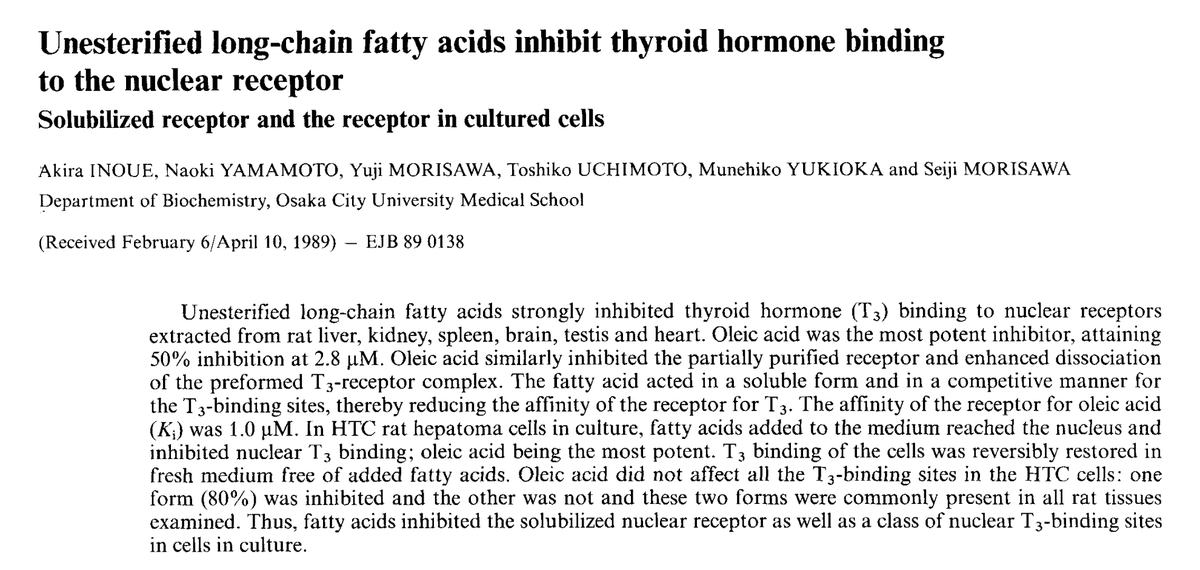
Stress hormones like cortisol and adrenaline PREVENT T4 from being activated.
Lowering any chronic stress you have is going to be a top priority for optimizing thyroid function.
Below you can read our stress masterclass for doing so:
Lowering any chronic stress you have is going to be a top priority for optimizing thyroid function.
Below you can read our stress masterclass for doing so:
View Tweet
This is known as the "euthyroid sick syndrome,"
where your thyroid is making plenty of hormones,
but you have LOW T3 and HIGH REVERSE T3.
This is induced by:
◇ Stress
◇ Malnutrition
◇ Low carb intake
◇ Inflammation
◇ Poor antioxidant status
where your thyroid is making plenty of hormones,
but you have LOW T3 and HIGH REVERSE T3.
This is induced by:
◇ Stress
◇ Malnutrition
◇ Low carb intake
◇ Inflammation
◇ Poor antioxidant status

Low carb diets lower thyroid function.
Carbohydrates and insulin help to convert T4 into T3, and away from reverse T3.
This has been routinely documented in the research.
I've written at length about this below:
Carbohydrates and insulin help to convert T4 into T3, and away from reverse T3.
This has been routinely documented in the research.
I've written at length about this below:
View Tweet

Cutting calories destroys thyroid function.
Reducing calories is known to slow down metabolism,
in part by lowering T3 levels.
You need to eat enough to have healthy thyroid function.
I've written more on the downsides of calorie cutting below.
Reducing calories is known to slow down metabolism,
in part by lowering T3 levels.
You need to eat enough to have healthy thyroid function.
I've written more on the downsides of calorie cutting below.
View Tweet

Generated by Thread Navigator
Press ⌘ + S to quick-export
auto_awesome
Image exported!
Pro export renders embedded tweets & media at 2x Retina resolution.
Upgrade — $5 for 30 days