Thread Truncated (Cap Enforced)
Only the first 20 tweets are unrolled into slides to ensure reliable PDF exporting and high server performance.
Canvas & Ratio
Choose your destination platform format
Layout Template
Choose a content structure for your slides
Preset Themes
Typography & Sizing
Brand Kit Customization
AGENCYConfigure brand assets for headers & footers
Outro Slide CTA
Customize your closing call-to-action slide
Background Pattern
Build Your Carousel
Drag and drop any post card below onto a slide, or use the quick buttons to insert content/images instantly!

The paper arrived as a 40-page PDF from UCL's Institute of Finance and Technology.
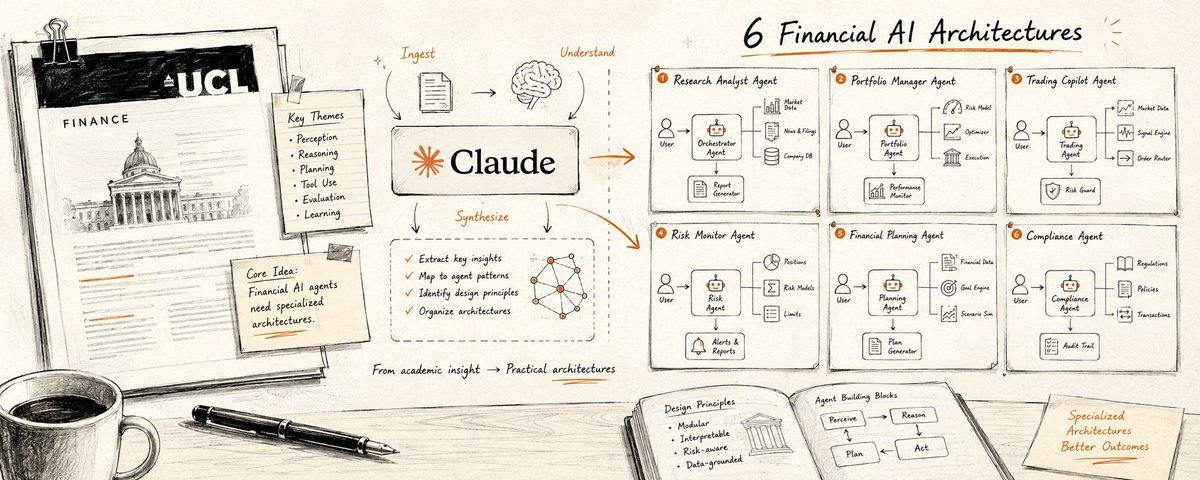
Published March 2026 by Hui Gong, updated April 22. The title: "AI Agents in Financial Markets: Architecture, Applications, and Systemic Implications." Not a news article. Not a blog post. A peer-reviewed academic framework mapping how autonomous AI systems are restructuring the full workflow of financial decision-making.
I downloaded it on a Sunday morning and fed the entire thing to Claude Opus 4.8. One instruction: tell me which agent architectures in this paper are actually buildable today with existing tools, and rank them by how accessible they are to someone running a personal research operation.
What came back was a ranked list of six. Three I could build that weekend. Three that required more infrastructure but were closer than I expected.
Here is the paper, what it argues, and the six architectures Claude identified.
## What the Paper Actually Says
The central argument is not about model intelligence. It is about architecture.
Hui Gong at UCL argues that the systemic implications of AI in finance depend less on how smart the models are than on how agent architectures are distributed, coupled, and governed across financial institutions. The paper defines three generations of financial AI and proposes a four-layer framework for understanding how modern agents are built.
<b>The three generations:</b>
• <b>Generation 1: Algorithmic finance.</b> Rule-based execution. Automated order splitting, market-making, microstructure responses. Intelligence lies in disciplined execution, not interpretation.
• <b>Generation 2: Machine learning finance.</b> Prediction automation. Return forecasting, credit scoring, fraud detection, portfolio analytics. Models produce signals, humans integrate them into decisions.
• <b>Generation 3: Agentic finance.</b> Workflow automation. Systems that perceive information, reason across it, generate decision objects, and initiate or support actions end-to-end. The human stays in the loop for oversight, not for every step.
<b>The four-layer architecture:</b>
• <b>Layer 1: Data perception.</b> Market prices, filings, earnings transcripts, macro releases, social signals, blockchain transaction flows, internal portfolio data.
• <b>Layer 2: Reasoning engine.</b> Domain LLMs, retrieval systems, forecasting models, optimisation modules, memory. Not a single model but a hybrid combining multiple capabilities.
• <b>Layer 3: Strategy generation.</b> Trade ideas, allocation proposals, anomaly alerts, hedging recommendations, compliance flags, explanatory narratives.
• <b>Layer 4: Execution and control.</b> Order management systems, exchange APIs, smart contracts, approval workflows, position limits, audit logs, emergency stops.
The paper argues that the most plausible near-term equilibrium is bounded autonomy: agents operating as supervised co-pilots, monitoring systems, and constrained execution modules embedded within human workflows. Not autonomous trading systems. Research partners with the ability to act within defined limits.
That framing is what makes the six architectures worth building now. They are not bets on what AI in finance will look like in five years. They are buildable implementations of the most plausible current equilibrium the paper describes.
<b>The paper's empirical finding that directly affects portfolio construction:</b>