Thread Truncated (Cap Enforced)
Only the first 20 tweets are unrolled into slides to ensure reliable PDF exporting and high server performance.
Canvas & Ratio
Choose your destination platform format
Layout Template
Choose a content structure for your slides
Preset Themes
Typography & Sizing
Brand Kit Customization
AGENCYConfigure brand assets for headers & footers
Outro Slide CTA
Customize your closing call-to-action slide
Background Pattern
Build Your Carousel
Drag and drop any post card below onto a slide, or use the quick buttons to insert content/images instantly!

By @mikemcg0 and myself

Elon Musk’s compensation package at SpaceX is structured around two targets. The first award vests if the company reaches a valuation of $7.5 trillion and establishes a permanent human colony on Mars of at least one million people. The second vests if SpaceX operates data centers in space that draw at least 100 terawatts of power, more than 1,000x the consumption of every data center on Earth combined. Miss both, and Musk earns nothing but the $54,080 salary he has been paid since 2019.
The board members who signed this package spent two decades watching Musk make predictions about SpaceX that sounded impossible before they came true. He said SpaceX would put humans in orbit when no private company ever had; it now flies NASA’s astronauts routinely. He said it would land and reuse an orbital rocket when the entire industry treated boosters as disposable; SpaceX has since done it hundreds of times. He said a satellite internet business could be worth tens of billions when satellite internet was a graveyard of bankruptcies; Starlink’s revenue has climbed from zero to <a target="_blank" href="https://www.sec.gov/Archives/edgar/data/1181412/000162828026036936/spaceexplorationtechnologi.htm" color="blue">$11.4 billion</a> in a few years. The predictions were often aggressive on timing but almost never wrong on direction. And the original direction, written down in 2002 as the company’s mission, was to make humanity multiplanetary. So the board tied his pay to the mission itself.
If that mission sounds like something from a science fiction novel, that might be because it is.
Iain M. Banks spent twenty-five years writing about a civilization called the Culture. It is, by most reasonable measures, the best utopian society ever imagined. Humans live alongside Minds, the superintelligent AIs that run orbital habitats the size of small worlds, in a relationship that is neither servitude nor rivalry but partnership. Nobody works who doesn’t want to. Nobody starves. The Minds handle the staggering computational load of running cities in space. Humans handle being human, which turns out to be a full-time job.
SpaceX’s three autonomous drone ships, the floating platforms in the oceans where Falcon 9 boosters land, are named after sentient starships in Banks’s novels: <i>Of Course I Still Love You, Just Read the Instructions</i>, and <i>A Shortfall of Gravitas</i>. In a 2023 interview at the UK AI Safety Summit, Musk was asked what a good AI future looks like. “The Banks Culture books are by far the best envisioning of an AI future,” he answered. “There’s nothing even close that’ll give you a sense of what is a fairly utopian or protopian future with AI.” He has been telling us, on the sides of his landing pads, exactly what he is trying to build.
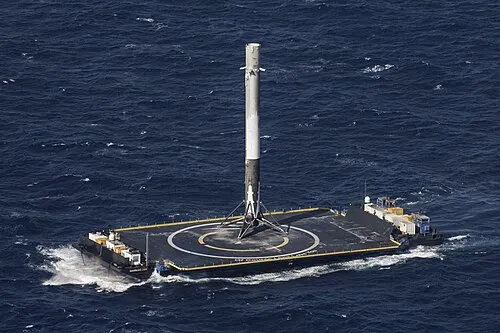
The Culture is not a frictionless paradise. Banks’s novels are full of war, intrigue, and moral complexity. It is utopian because civilization has solved the prerequisites of survival well enough that trillions of humans are free to take care of, in the words of Banks, “the things that really mattered in life, such as sport, games, romance, studying dead languages, barbarian societies and impossible problems, and climbing high mountains without the aid of a safety net.”
A future like this has four prerequisites. First is access to a meaningful fraction of a star’s energy output (orders of magnitude beyond what human civilization produces today). Second is physical intelligence at scale: machines that can build, mine, refine, and repair anything, anywhere, without a human in the loop. Third is cheap digital intelligence that exceeds biological intelligence. And fourth is a way to move mass off the planet cheaply, frequently, and reliably, because none of the above scales on Earth alone.
# Working Back from the Future
Most analyses of SpaceX work forward from the present: rockets, satellites, contracts, revenue. But to see what’s actually happening, it’s more useful to start at the destination and work backward.
<b>The Mars city.</b> The operational target is a self-sustaining city of a million people on Mars within the lifetime of people alive today. <i>Self-sustaining</i> is the hard part. It means the city has to survive if Earth stops sending ships, which requires manufacturing its own everything: food, water, air, energy, medicine, machinery, and eventually more humans. Getting a million people and millions of tons of cargo there over a few decades will take, by SpaceX’s own math, several thousand Starship flights at more than ten launches per day during each transfer window. Those windows, set by Earth-Mars orbital mechanics, are only a few weeks wide and open just once every 26 months.

<b>The Moon city.</b> This is the closer, easier dress rehearsal. The lunar south pole has ice in permanently shadowed craters and continuous solar exposure on certain ridges, which makes it the natural site for a base. But Musk has talked about something more ambitious than a research outpost. He envisions factories on the Moon building AI satellites with a mass driver shooting them into space one after another. Another idea Musk has borrowed from science fiction, a mass driver is an electromagnetic launch system that exploits the Moon’s one-sixth gravity and absent atmosphere to fling solar-powered satellites into deep space at industrial scale. The satellites could be built on the Moon itself given that lunar regolith is roughly 20% silicon and 10% aluminum by weight, the two main inputs for solar cells and satellite structure. “If you want to go beyond a mere terawatt per year,” Musk explains, “you have to go to the moon.”

<b>The orbital data centers.</b> Musk is betting that in a few years the most economically compelling place to put AI data centers will be space. The bottleneck on AI is energy, which is barely growing outside of China while demand for AI compute grows exponentially. Solar panels in orbit deliver four to ten times more power than the same panels on Earth (depending on how sunny the ground location is) because there’s no atmosphere, no day-night cycle, no clouds, and no seasons. NASA worked this out <a target="_blank" href="https://ntrs.nasa.gov/api/citations/20070005136/downloads/20070005136.pdf" color="blue">decades ago</a>, and rockets are finally cheap enough to make it real. In five years, Musk projects, SpaceX will be launching more AI compute to orbit per year than the cumulative installed base on Earth. This is why SpaceX merged with xAI in February. Rockets and intelligence are becoming the same problem.

<b>Starship</b> is the vehicle that makes everything upstream possible. Starship V3, which made its debut flight this year, is the <a target="_blank" href="https://www.scientificamerican.com/article/spacex-launches-starship-v3-the-worlds-most-powerful-and-tallest-rocket-ever/" color="blue">largest and most powerful rocket ever built</a> – taller than a 40-story building and more than twice as powerful as the Saturn V that carried astronauts to the moon. By NASA’s accounting, reaching orbit historically cost around $18,500 per kilogram. In 2010, the first Falcon 9 brought that down by about 85% to roughly $2,700. In 2018, the Falcon Heavy cut it further to about $1,400. Starship, designed to be the world’s first fully and rapidly reusable spacecraft, aims to further reduce it to $100-500 per kilogram. Spaceflight that once cost billions per launch now costs in the tens of millions.

<b>Starlink</b> is the cash flywheel that helps pay for everything else. According to SpaceX’s IPO filing, the Connectivity segment (almost all of it Starlink) brought in $11.4 billion of revenue in 2025, up roughly 50% year over year, at an adjusted EBITDA margin north of 60%. As of March 2026, the service had 10.3 million subscribers in 164 countries running on more than 9,600 satellites. Starlink started as a side project to fill the company’s own launches, and it’s becoming one of the great consumer businesses in history. When a16z was doing diligence on SpaceX in 2019, several people told us the economics would never work. The dish required antenna technology previously reserved for F-22 fighter jets and Navy destroyers that were never mass-produced for consumers. SpaceX’s first units cost about <a target="_blank" href="https://techcrunch.com/2021/11/12/starlinks-new-rectangular-satellite-broadband-dish-is-smaller-and-lighter-than-before/" color="blue">$3,000</a> to build and sold for $499. But they figured out how to drive the manufacturing costs down and prove the skeptics wrong.