Thread Truncated (Cap Enforced)
Only the first 20 tweets are unrolled into slides to ensure reliable PDF exporting and high server performance.
Canvas & Ratio
Choose your destination platform format
Layout Template
Choose a content structure for your slides
Preset Themes
Typography & Sizing
Brand Kit Customization
AGENCYConfigure brand assets for headers & footers
Outro Slide CTA
Customize your closing call-to-action slide
Background Pattern
Build Your Carousel
Drag and drop any post card below onto a slide, or use the quick buttons to insert content/images instantly!

Most developers still prompt their coding agents by hand. They type, they wait, they read the diff, they type again. <b>9</b>out of 10 builders have never written a single loop that prompts the agent for them.

No <b>automation</b>, no <b>state file</b>, no <b>verifier</b>, no <b>schedule</b>. The leverage point has moved - from <i>typing prompts</i> to <i>designing systems that prompt</i>. This is the 14-step roadmap from prompter to loop designer.
> Follow my Linkedin to get fresh AI alpha: linkedin.com/in/lev-deviatkin
This is the 14-step roadmap to make that shift - sourced from Anthropic’s engineering docs, Addy Osmani’s long-form on loop engineering, and recent measurement studies.
Three tiers: figure out if you actually need a loop, learn the five building blocks, then build the smallest one that works without hurting you.
<b>14 steps. 3 tiers. Stop prompting. Start designing.</b>
---
PART 1 <b>· The Why & The Test</b>
## 01. Loop engineering is replacing yourself <i>as the prompter</i>.
For two years, the way you got something out of a coding agent was: write a prompt, share the context, read what came back, write the next prompt. The agent was a tool and you held it the entire time. <b>That part is ending.</b>
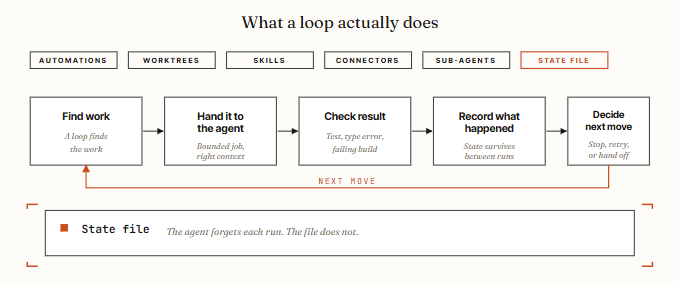
Loop engineering is building a small system that <i>finds</i> the work, <i>hands</i> it to the agent, <i>checks</i> the result, <i>records</i> what happened, and <i>decides</i> the next move - on its own. You design that system once. The system prompts the agent from then on.
Addy Osmani breaks it into six parts:

Anthropic engineers now merge eight times as much code per day as they did in 2024 - a figure Anthropic itself calls “almost certainly an overstatement of the true productivity gain.”
The number is debated. The mechanism isn’t: <b>the leverage point moved from typing prompts to designing the loop that prompts</b>.
---
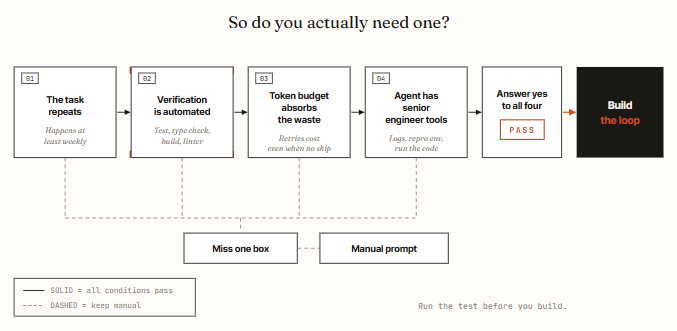
## 02. Run the 4-condition test <i>before</i> you build anything.
Loops earn their cost under four conditions. Miss one and the loop costs more than it returns. The honest take from AlphaSignal’s analysis, and the part most X-threads skip: