Canvas & Ratio
Choose your destination platform format
Layout Template
Choose a content structure for your slides
Preset Themes
Typography & Sizing
Brand Kit Customization
AGENCYConfigure brand assets for headers & footers
Outro Slide CTA
Customize your closing call-to-action slide
Background Pattern
Build Your Carousel
Drag and drop any post card below onto a slide, or use the quick buttons to insert content/images instantly!

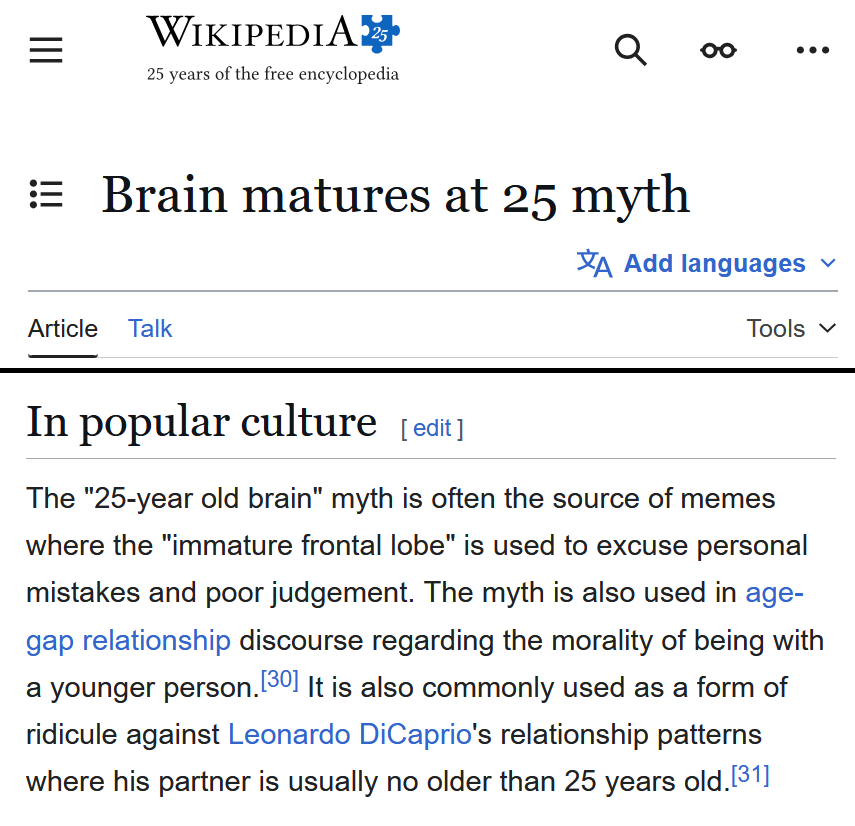
"Brains don't fully mature until age 25!" is pseudoscience weaponized by feminists to justify bad behavior. It has been refuted by mainstream academics, libtard mainstream media, and it even has a Wikipedia refutation. <a target="_blank" href="https://twitter.com/Anarseldain/status/2053967052491329971" color="blue">x.com/Anarseldain/st…</a>
The concept of a "fully mature" brain is also pseudoscience. This is a complex topic so I will attempt to simplify... Brain "maturation" = neural pathways becoming stabilized, large reduction in passive neuroplasticity (automatic rewiring), pruning of weak/unused pathways, etc.
Different brain regions "mature" at different ages, with some individual variability, e.g.: Brainstem/hindbrain = infancy Sensory & motor cortex = childhood Limbic system = adolescence Prefrontal cortex = early to mid 20s Social cognition network = early 30s Hippocampus = never.
Conversely, brain regions begin to decline at different ages/rates. The prefrontal cortex, which holes constantly ramble on about, is the first to decline - a mere half decade after it "matures"! This is why fluid IQ (raw problem-solving ability) peaks during the early 20s.
Brain maturation does not necessarily mean "more adult" behavior, it means that your brain no longer adapts automatically. If you have a dysfunctional brain when it reaches "maturity," it can be difficult to repair; I'm sure you've met many old farts who behave like little kids.
You can maintain *active* neuroplasticity via exercise, metabolic health, constant learning, etc., and in this way "repair" a dysfunctional brain but it requires conscious effort. Pathways become more efficient, whether beneficial or not, and harder (but not impossible) to change
Brains continually change throughout our lifetimes, geared toward different tasks at different stages. So, at what point do we define "full maturity"? The brain hardware + fluid IQ peak of early 20s-30s? Crystalized IQ peak of 60s-70s? "Emotional intelligence" peak of mid 40s?