Canvas & Ratio
Choose your destination platform format
Layout Template
Choose a content structure for your slides
Preset Themes
Typography & Sizing
Brand Kit Customization
AGENCYConfigure brand assets for headers & footers
Outro Slide CTA
Customize your closing call-to-action slide
Background Pattern
Build Your Carousel
Drag and drop any post card below onto a slide, or use the quick buttons to insert content/images instantly!

So excited to finally share my job market paper! The post-Floyd “Great Awokening” was driven by affluent white liberals and emphasized recognition over redistribution. Consistent with elite capture of identity politics. Feedback very welcome! Link below.
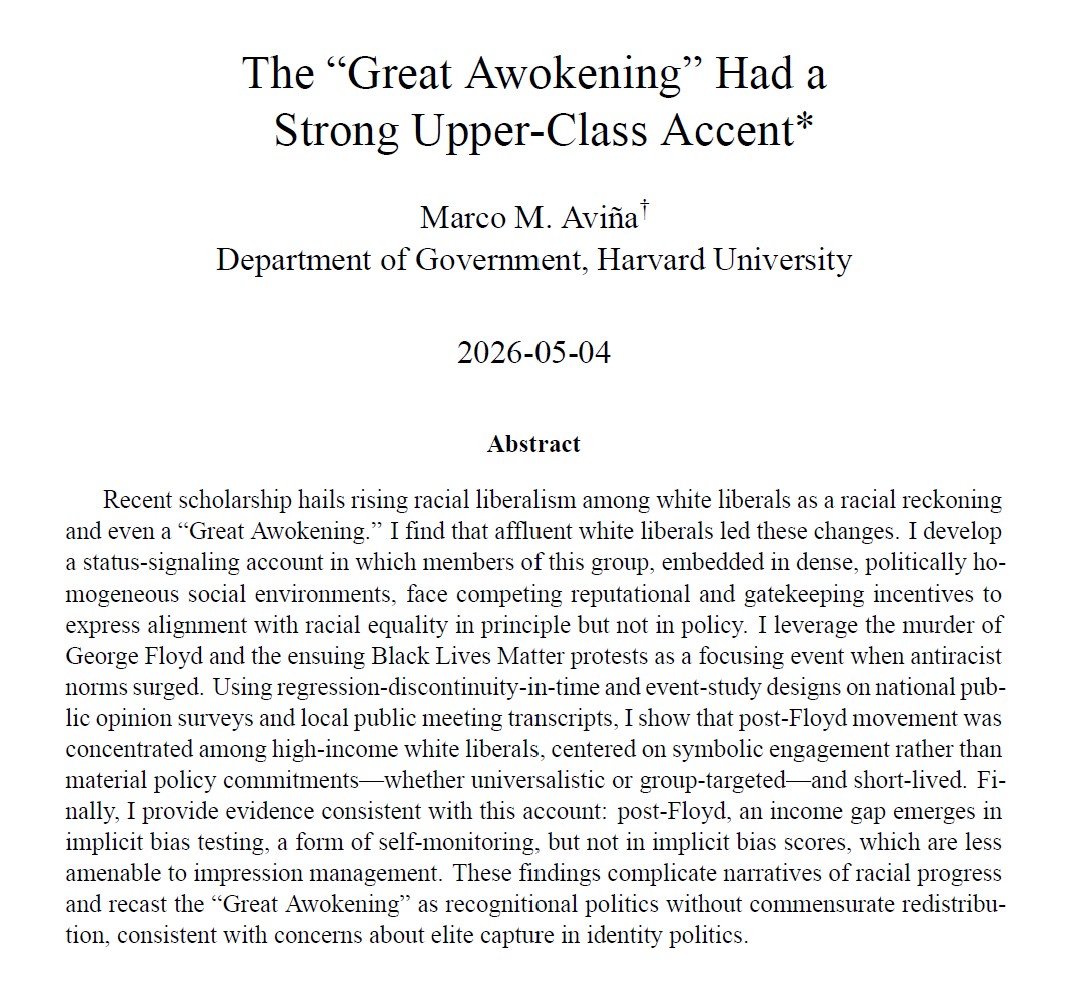
Argument: Identity politics can function as status signaling. Affluent liberals are embedded in politically homogeneous environments where the incentive is to say the right things, not support costly policy change. This leads to a politics of recognition without redistribution.
Why George Floyd? BLM attention didn’t just rise---it spiked across searches, news, Tweets, and protests. A sudden, nationwide shock to antiracist norms and attention to issues of racial inequality. Perfect for asking: who actually moved---and on what?

Survey evidence: After Floyd, affluent white liberals expressed more racially liberal views (A) and more negative views of police (B). Lower-income white liberals moved much less. And support for costly redistributive policies barely budged (C). Recognition ≠ redistribution.

Do these shifts show up beyond surveys? I turn to local public meetings to see what people say about racial politics in a higher-stakes setting. Post-Floyd discourse shifts toward recognition but not redistribution. This pattern is strongest in affluent white liberal places.

Recognition surges; redistribution doesn’t. But maybe recognition translated into redistribution over time? Using 2020–2024 panel data on white liberals, I test whether earlier recognition predicts later support for redistribution within the same respondents. It doesn’t.

Is this belief change or signaling? Using implicit bias tests, I compare who takes the test (A) to what their scores show (B). Post-Floyd, affluent liberals are much more likely to participate. But their scores barely change. Visible behavior shifts. Implicit responses do not.

But was 2020 just an anomaly? I replicate the design around the 2014 killing of Tamir Rice (Nov 22) and the Ferguson grand jury decision (Nov 24). Same pattern: racial recognition rises—especially among affluent white liberals—but support for redistribution moves much less.

Consistently across surveys, public discourse, panel data, and implicit bias tests: Affluent white liberals lead change on racial liberalism, but on symbolic rather than material terms. The “Great Awokening” was class-skewed and centered on recognition over redistribution.
Paper here: <a target="_blank" href="https://osf.io/preprints/socarxiv/np8jx_v1" color="blue">osf.io/preprints/soca…</a> Comments very much welcome!