Canvas & Ratio
Choose your destination platform format
Layout Template
Choose a content structure for your slides
Preset Themes
Typography & Sizing
Brand Kit Customization
AGENCYConfigure brand assets for headers & footers
Outro Slide CTA
Customize your closing call-to-action slide
Background Pattern
Build Your Carousel
Drag and drop any post card below onto a slide, or use the quick buttons to insert content/images instantly!

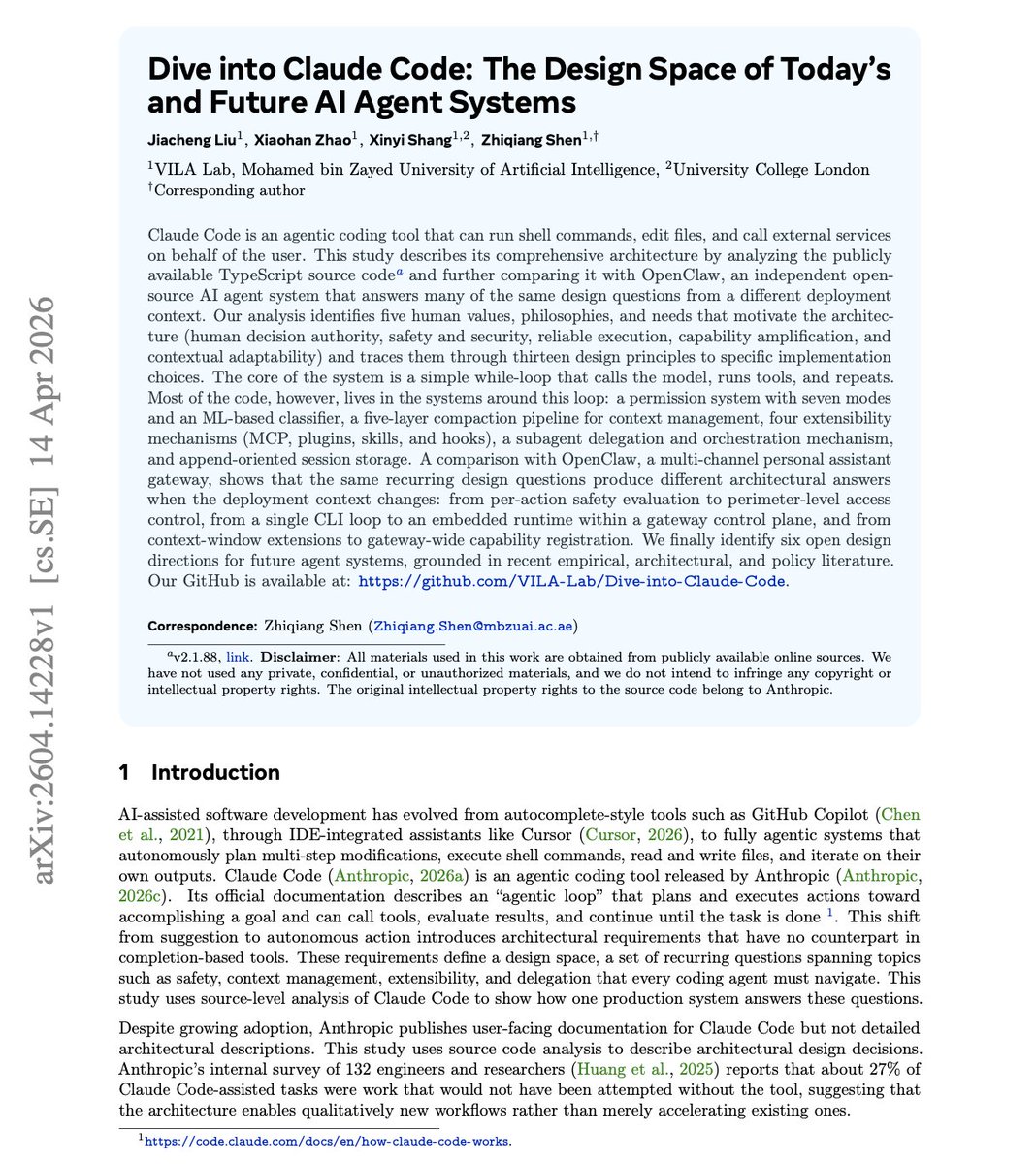
Claude Code fully dissected! Researchers from UCL reverse-engineered the leaked Claude source. What they found changes how you should think about agent design. Only 1.6% of the codebase is AI decision logic. The other 98.4% is operational infrastructure. Permission gates, tool routing, context compaction, recovery logic, session persistence. The model reasons. The harness does everything else. This is the opposite of what most agent frameworks do today. LangGraph routes model outputs through explicit state machines. Devin bolts heavy planners onto operational scaffolding. Claude Code gives the model maximum decision latitude inside a rich deterministic harness, and invests all its engineering effort in that harness. The core loop is a simple while-true. Call model, run tools, repeat. But the systems around that loop are where the real design lives: A permission system with 7 modes and an ML classifier. Users approve 93% of prompts anyway, so the architecture compensates with automated layers instead of adding more warnings. A 5-layer context compaction pipeline. Each layer runs only when cheaper ones fail. Budget reduction, snip, microcompact, context collapse, auto-compact. Four extension mechanisms ordered by context cost. Hooks (zero), skills (low), plugins (medium), MCP (high). Each answers a different integration problem. Subagents return only summary text to the parent. Their full transcripts live in sidechain files. Agent teams still cost roughly 7x the tokens of a standard session. Resume does not restore session-scoped permissions. Trust is re-established every session. That friction is the point. The bet behind all of this is simple. As frontier models converge on raw coding ability, the quality of the harness becomes the differentiator, not the model. Paper: Dive into Claude Code (arXiv:2604.14228) In the next tweet, I've shared an article I wrote on Agent Harness and what every big company is building. Do check.
The anatomy of an agent harness: <a target="_blank" href="https://x.com/akshay_pachaar/status/2041146899319971922?s=20" color="blue">x.com/akshay_pachaar…</a>