Thread Truncated (Cap Enforced)
Only the first 20 tweets are unrolled into slides to ensure reliable PDF exporting and high server performance.
Canvas & Ratio
Choose your destination platform format
Layout Template
Choose a content structure for your slides
Preset Themes
Typography & Sizing
Brand Kit Customization
AGENCYConfigure brand assets for headers & footers
Outro Slide CTA
Customize your closing call-to-action slide
Background Pattern
Build Your Carousel
Drag and drop any post card below onto a slide, or use the quick buttons to insert content/images instantly!

A complete guide to the arbitrage bot that made crypto history. How it works, why it wins 98% of trades, what the strategy actually is, and how you can build your own with a single Claude prompt.

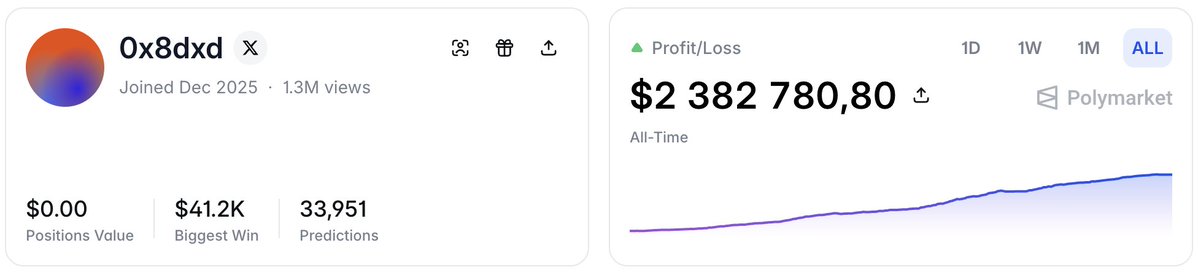
Total PnL: <b>$2 382 780,80</b>
Predictions: <b>33,950+</b>
Win rate: <b>100.0%</b>
# The wallet that made crypto Twitter stop scrolling
In December 2025, a wallet appeared on Polymarket the world's largest prediction market with a balance of $313. Nobody noticed. There was nothing unusual about a small account entering the platform. Thousands do it every week. But over the next four months, something remarkable happened: that wallet made 26,738 individual trades, maintained a 98% win rate across all of them, and turned $313 into $2,382,780.80. Every single transaction is verifiable on-chain. There's no sleight of hand here. The number is real.
The wallet's address, <b>0x8dxd</b>, was running an automated trading bot powered by Anthropic's Claude AI. When Finbold first reported the story in early January 2026 with on-chain data to back it up the crypto world had one of its periodic collective moments of disbelief. The post went viral. Threads dissecting the strategy flooded X. Within weeks, developers had reverse-engineered the approach and asked Claude to rebuild it.
This is the story of how that happened, why it works, and what you'd need to do to build something similar. It covers the full mechanism from the underlying market inefficiency that makes the strategy possible, to the code that exploits it, to the risk management that keeps it alive long enough to compound. Nothing is omitted. If you read this in full, you'll understand the arbitrage bot space better than most people currently trading on Polymarket.

The growth curve is almost impossible to look at without some degree of skepticism. That's natural. A 7,942× return in four months is the kind of number that usually appears in scam advertisements. But the difference here is the blockchain. Every trade, every position, every settlement all of it is public and immutable. The Dune Analytics dashboards that tracked this wallet showed consistent, high-frequency activity across BTC and ETH short-term price contracts. There was no single lucky bet. There were 26,738 of them.
# What Polymarket actually is and where the money comes from
To understand why this strategy works, you first need to understand Polymarket's mechanics. It's a prediction market: a platform where users trade on the outcome of real-world events. The structure is simple. For any given event will Bitcoin be higher or lower in 15 minutes? will the Fed raise rates this month? will candidate X win the election? users can buy "Yes" shares or "No" shares.
Each share trades between $0 and $1. The price reflects the collective market estimate of the probability. A contract trading at $0.73 implies the market believes there's a 73% chance the outcome resolves as "Yes." If you're right, your share settles at $1.00. If you're wrong, it settles at $0.00. The mechanism is elegant, the math is straightforward, and the markets are liquid Polymarket's weekly trading volume exceeded $2 billion in early 2026.
The platform's key category for automated trading is its short-duration crypto contracts: 5-minute and 15-minute up/down questions on Bitcoin and Ethereum. Every few minutes, a new contract opens asking whether BTC will be higher or lower at expiry. These contracts resolve quickly, provide immediate feedback, and critically they have a structural vulnerability that bots can exploit.
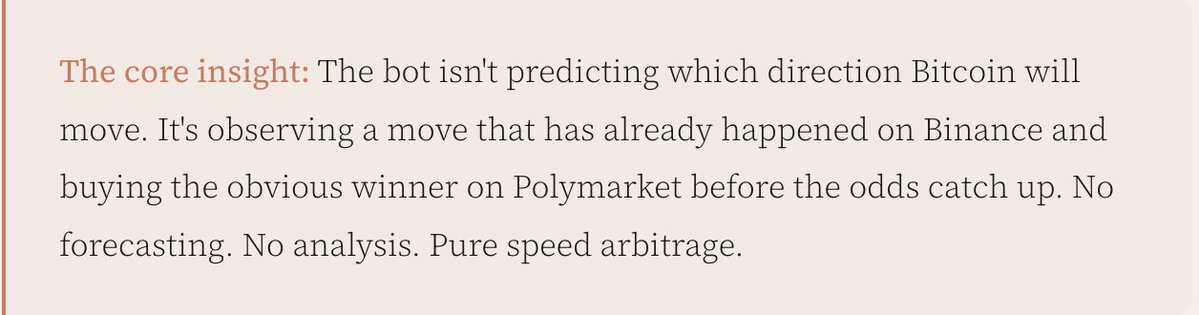
<b>Polymarket updates its contract prices slower than the underlying asset moves on centralized exchanges.</b>There is always a lag between when a price shift happens on Binance or Coinbase and when that shift is reflected in Polymarket's contract odds. In 2024, that lag averaged around 12 seconds. By Q1 2026, competition had compressed it to approximately 2.7 seconds. But even 2.7 seconds is an eternity for a machine. And in those 2.7 seconds, the outcome of a 15-minute BTC contract is effectively already known.
# The mechanism <i>how the arbitrage actually works</i>
Let's walk through a single trade, step by step, at the level of milliseconds. Understanding this sequence is the foundation of everything else.
