Canvas & Ratio
Choose your destination platform format
Layout Template
Choose a content structure for your slides
Preset Themes
Typography & Sizing
Brand Kit Customization
AGENCYConfigure brand assets for headers & footers
Outro Slide CTA
Customize your closing call-to-action slide
Background Pattern
Build Your Carousel
Drag and drop any post card below onto a slide, or use the quick buttons to insert content/images instantly!

1/ To understand the theocractic and religious-fundamentalistic ideology behind Pete Hegseth's recent rhetoric, we could do worse than turn to a short 1960 essay by political philosopher Eric Voegelin entitled: 'Ersatz Religion: The Gnostic Mass Movements of our Time' - a 🧵

2/ Voegelin (1901–1985) was an Austrian-born political philosopher who later worked in the United States. He is best known for trying to explain how and why modern political ideologies co-opt religious thematics - even when they claim to be "Christian", or even secular.

3/ Voegelin argued certain modern ideologies: - promise ultimate meaning - offer a utopian vision of salvation (a perfect society) - demand devotion - identify enemies or heretics In other words they function psychologically & structurally like religions—but without transcendence

4/ Voegelin borrowed the term “Gnosticism” (from ancient religious movements) to describe the structure of these modern political ideologies.

5/ He argued that if we understand the "ersatz" spirituality that underlies these modern political ideologies, we will be equipped to challenge them and move towards with a more robust, honest and authentic global political order.
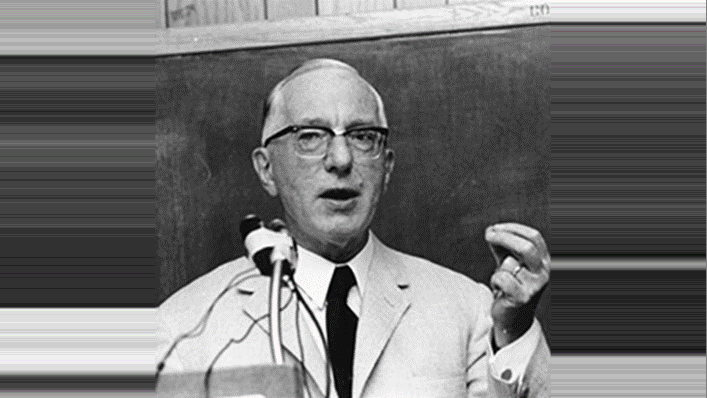
6/ For Voegelin, Gnostic movements obsure what he calls the "authentic constitution of being". He identifies this with the Metaxy (a Platonic term) - the uncertain space of the in-between where encounters with the divine send us back to the world with humility & self-evaluation.

7/ It is precisely this Metaxy that Hegseth is promising to undercut. For him, the provisionality of reality can be prematurely unified by means of unilateral power, backed up (in his case) by the mandate of the supposed Christian God. <a target="_blank" href="https://www.youtube.com/watch?v=OmGKvAp89Yg" color="blue">youtube.com/watch?v=OmGKvA…</a>

8/ By contrast, Voegelin calls us to dwell in the Metaxy, rather than escape it. To remain humble, rather than ideological. To resist Gnostic closure and its contemporary prophets.

9/ Most of all, he warns us against falling for an ersatz version of Christianity based on (what he calls) "metastatic eschatology" - to "leap" out of being in reach of some future vision of utopia, which it turns out is undergirded by a human, all-too-human political ideology.

10/ When Hegseth applies the imprecatory Psalms to his war effort and glorifies violence in God's name: “I pursued my enemies and overtook them, and did not turn back till they were consumed” - he is co-opting Christianity by means of a heresy that is as old as the early church.
