Canvas & Ratio
Choose your destination platform format
Layout Template
Choose a content structure for your slides
Preset Themes
Typography & Sizing
Brand Kit Customization
AGENCYConfigure brand assets for headers & footers
Outro Slide CTA
Customize your closing call-to-action slide
Background Pattern
Build Your Carousel
Drag and drop any post card below onto a slide, or use the quick buttons to insert content/images instantly!

🚨BREAKING: Claude has a secret mode called "First Principles Breakdown." It strips any complex topic down to its raw fundamentals like Elon Musk thinks through problems. Here's how to activate it:
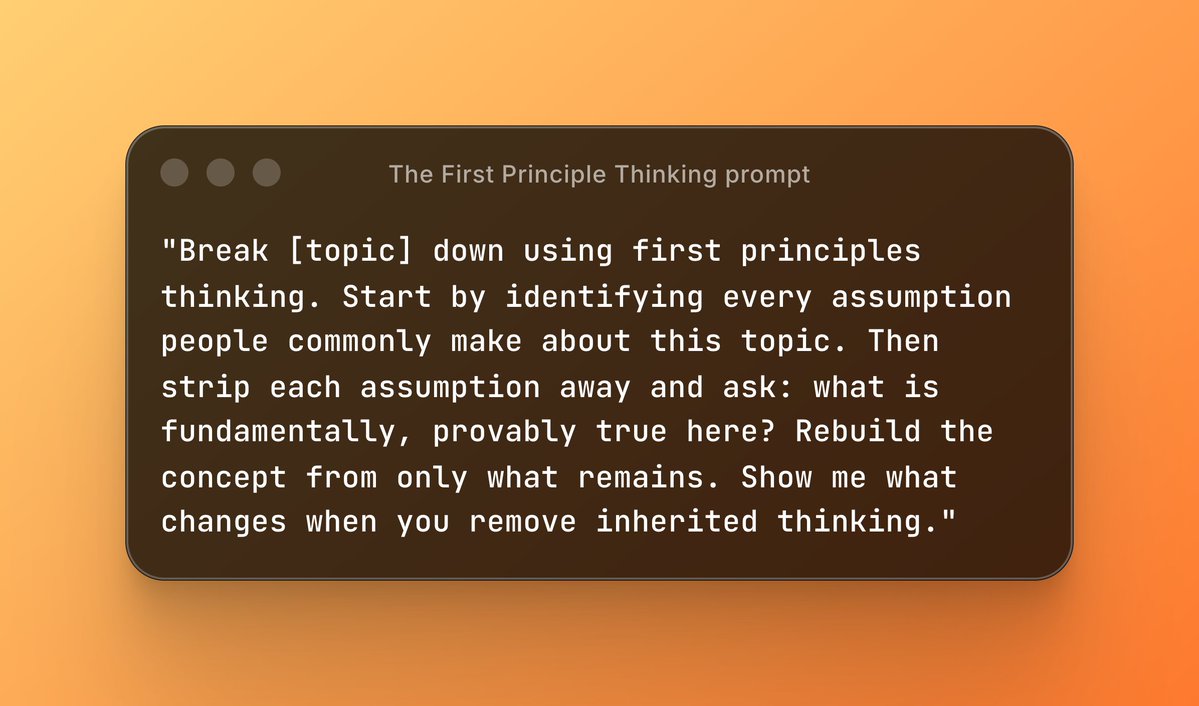
Use this exact prompt that activates First Principles mode. Copy this word for word: "Break [topic] down using first principles thinking. Start by identifying every assumption people commonly make about this topic. Then strip each assumption away and ask: what is fundamentally, provably true here? Rebuild the concept from only what remains. Show me what changes when you remove inherited thinking." That's it. The key phrase is "strip each assumption away." Without that instruction, Claude defaults to explaining what everyone already knows. With it, Claude goes layer by layer assumption by assumption until it hits bedrock. What comes out the other side is a completely different understanding of the topic.
Why this prompt works differently than just asking Claude to "explain" something. When you ask Claude to explain a topic normally, it pattern-matches to the best existing explanation it's seen. You get a clear, well-organized version of conventional wisdom. That's useful. But it's not thinking. The First Principles prompt forces something different. It makes Claude identify what's assumed versus what's proven. That's a fundamentally different cognitive operation than summarizing. Try it on something you think you understand completely. Ask Claude to break down "how a business makes money" using first principles. Watch it strip away every assumption pricing, customers, value, exchange until it hits the actual bedrock truth. You'll realize half of what you "knew" was inherited from somewhere else.
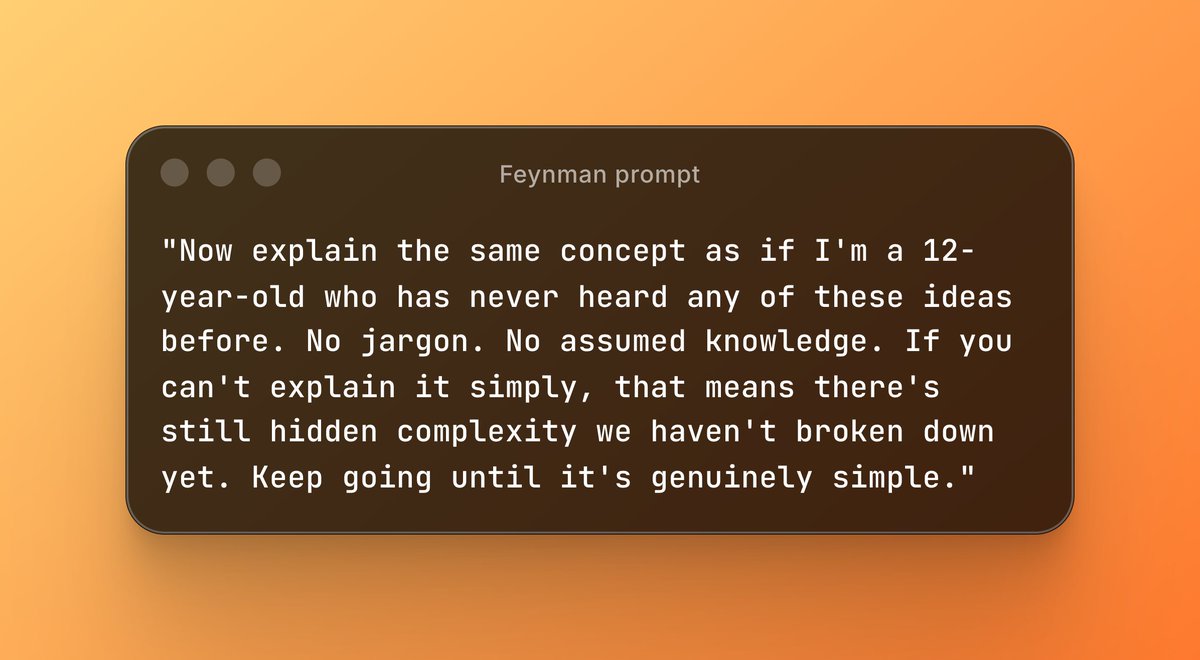
1/ The Feynman add-on - stack this on top for maximum clarity. After your first principles breakdown, run this second prompt immediately: "Now explain the same concept as if I'm a 12-year-old who has never heard any of these ideas before. No jargon. No assumed knowledge. If you can't explain it simply, that means there's still hidden complexity we haven't broken down yet. Keep going until it's genuinely simple." This is the Feynman Technique built into a prompt. Feynman believed that if you couldn't explain something simply, you didn't understand it yet. The gaps in your simple explanation are exactly where your understanding breaks down. Claude will find those gaps and keep drilling until the explanation holds. Most people stop at "I kind of get it." This prompt forces you to actually get it.
The best topics to run this on and what the output looks like. First Principles mode works best on topics that feel complex because of jargon, not because of actual complexity. Try it on these and watch what happens: → "How does compound interest actually work" → "What is inflation really" → "Why do businesses fail" → "How does machine learning learn anything" → "What makes a product go viral" I ran it on "how machine learning works." Normal explanation: training data, gradient descent, loss functions, backpropagation. First principles version: "A machine learning model is a function that takes inputs and produces outputs. We adjust its internal numbers until the outputs match what we want. That's the complete picture. Everything else is a method for doing the adjustment more efficiently." One sentence. Total clarity. That's what first principles does to complexity.
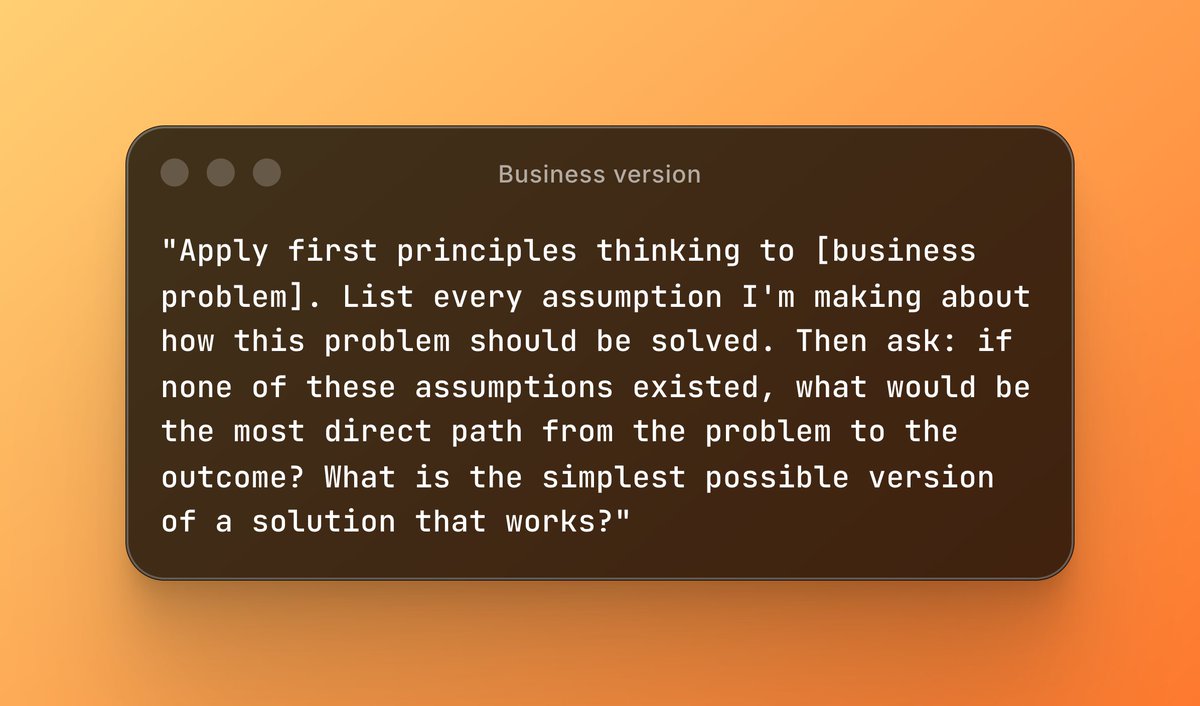
2/ The business version this one is worth actual money. Run this prompt on any business problem you're stuck on: "Apply first principles thinking to [business problem]. List every assumption I'm making about how this problem should be solved. Then ask: if none of these assumptions existed, what would be the most direct path from the problem to the outcome? What is the simplest possible version of a solution that works?" This is how Musk looked at the car industry and decided to sell directly to consumers. Everyone assumed you needed dealerships. Nobody questioned why. First principles said: customer wants car, company makes car, why is there a middleman? The assumption was so baked in that an entire industry built itself around it. Claude will do this for your business problem in 60 seconds.
3/ The learning version use this before studying anything new. Before you read a textbook chapter, watch a lecture, or start a course run this: "I'm about to learn [topic]. Before I do, break down the 5 core assumptions this field makes that beginners just accept as true. What would someone need to question to genuinely understand this subject rather than just memorize it?" This primes your brain to learn actively instead of passively. You go into the material already knowing which assumptions to interrogate. The people who get genuinely good at a subject aren't the ones who memorize the most. They're the ones who question the foundations everyone else takes for granted. This prompt tells you exactly what those foundations are before you even start.

4/ The "Musk test" the final prompt in the stack. After you've done the full breakdown, run this: "If you were starting from zero no existing industry, no conventional wisdom, no inherited approach and you only had the fundamental truths we've established, how would you build the solution from scratch? What would look completely different from how it's done today?" This is the Musk question. Not "how do we improve what exists?" "If none of this existed and we started from physics alone, what would we actually build?" The gap between your current answer and this answer is exactly where the opportunity lives. Every industry disruption in the last 20 years came from someone who asked this question seriously. Claude can help you ask it about anything.

The full First Principles stack save this. Run these in order on any topic, problem, or idea: Step 1 → "Break [topic] down using first principles. Strip every assumption. Rebuild from only what's provably true." Step 2 → "Explain it as if I'm 12. If it's not simple yet, keep going." Step 3 → "What are the 5 assumptions this field makes that beginners just accept? Which ones are actually proven?" Step 4 → "If the 3 most important assumptions turned out to be wrong, what happens?" Step 5 → "Starting from zero no industry, no convention what would you build using only the fundamentals we've established?" Each step strips another layer. By step 5 you're not thinking about the topic the way everyone else thinks about it. You're thinking about it from the ground up. That's the difference between knowledge and understanding. Claude can get you there. Most people just never ask it to.
Everyone uses Claude as a search engine with better writing. Ask it to explain. Summarize. Rewrite. That's 10% of what it can do. First Principles mode is a different tool entirely. It doesn't tell you what to think about a topic. It shows you how to think about it from the ground up, assumption by assumption, until you hit something real.
Musk uses it on rocket physics. Feynman used it on quantum mechanics. You can use it on anything. The prompt is free. The thinking is yours to keep. Save this thread.
If this helped, follow me @ihtesham2005 for more AI breakdowns that actually make sense. <a target="_blank" href="https://twitter.com/1983182860388577282/status/2034661266153955407" color="blue">x.com/19831828603885…</a>