Thread Truncated (Cap Enforced)
Only the first 20 tweets are unrolled into slides to ensure reliable PDF exporting and high server performance.
Canvas & Ratio
Choose your destination platform format
Layout Template
Choose a content structure for your slides
Preset Themes
Typography & Sizing
Brand Kit Customization
AGENCYConfigure brand assets for headers & footers
Outro Slide CTA
Customize your closing call-to-action slide
Background Pattern
Build Your Carousel
Drag and drop any post card below onto a slide, or use the quick buttons to insert content/images instantly!

Preparing for system design interviews can feel like climbing a mountain without a map. Unlike <b>coding interviews</b> where you can gain confidence by practicing data structures and algorithms on platforms like <a target="_blank" href="http://shrsl.com/483tt" color="blue">AlgoMonster</a>, <a target="_blank" href="https://www.tryexponent.com/?ref=javinpaul2" color="blue">Exponent</a>, and LeetCode, system design questions demand a mix of breadth and depth --- architecture principles, scalability patterns, trade-offs, and real-world application.
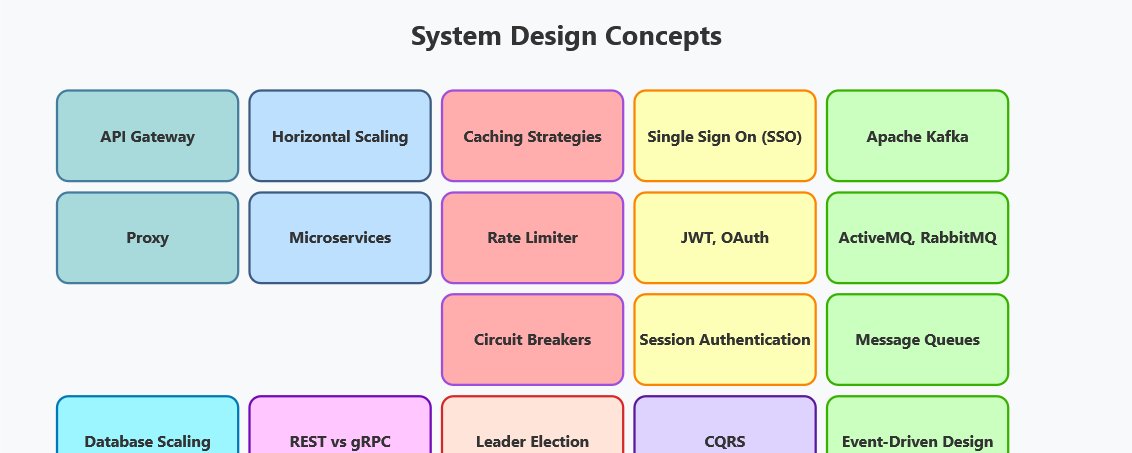
For me, this part of the interview loop was intimidating at first. I often felt lost in diagrams, unsure which concept to use where, and overwhelmed by the sheer vastness of distributed systems.
<b>The turning point came when I started breaking the subject down into core concepts.</b> Once I understood ideas like <a target="_blank" href="https://javarevisited.substack.com/p/system-design-basics-load-balancing" color="blue">load balancing</a>, <a target="_blank" href="https://javarevisited.substack.com/p/10-caching-fundamentals-for-system?utm_source=profile&utm_medium=reader2" color="blue">caching</a>, <a target="_blank" href="https://javarevisited.substack.com/p/the-complete-guide-of-database-sharding" color="blue">database sharding</a>, CAP theorem, and <a target="_blank" href="https://javarevisited.substack.com/p/system-design-basics-master-message" color="blue">message queues</a>, everything else started to click into place.
Instead of memorizing solutions, I began recognizing patterns. That's when I realized system design isn't about giving a "perfect" architecture, but about <b>reasoning through trade-offs with clarity.</b>
What really accelerated my learning was leveraging structured resources. Books and visual explanations like <a target="_blank" href="https://bit.ly/3P3eqMN" color="blue"><b>ByteByteGo's System Design Course</b></a> made the hardest concepts digestible with diagrams and case studies.
I also explored platforms such as <a target="_blank" href="https://buff.ly/4dl3eHJ" color="blue">Codemia.io</a> and <a target="_blank" href="https://www.bugfree.ai/?via=javarevisited" color="blue">Bugfree.ai</a> for hands-on interview prep and <a target="_blank" href="https://www.bugfree.ai/?via=javarevisited" color="blue">Exponent</a> for mock interviews with engineers from top companies. Each helped me move from feeling clueless to confident, especially when facing open-ended system design questions at FAANG-level interviews.
In this article, I'll share the <b>20 core concepts that completely changed how I approach system design interviews</b>. Mastering these will save you from confusion, help you build better mental models, and make those tough whiteboard sessions a lot less scary.
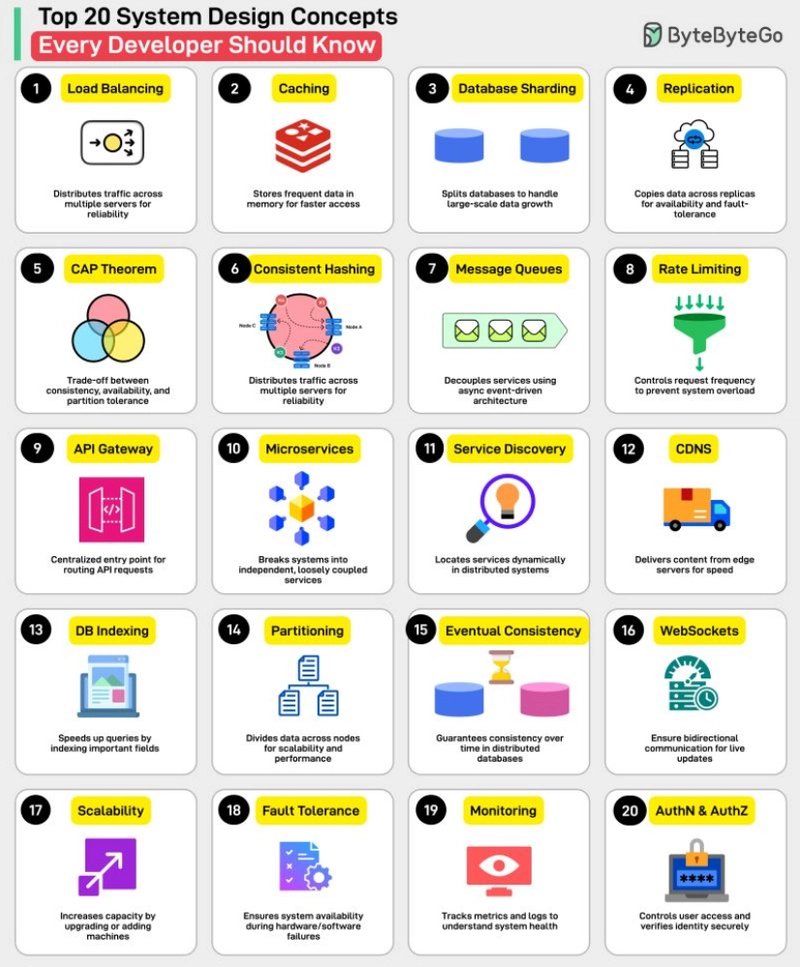
## Stop Failing System Design Interviews: Master These 20 Core Concepts First
Here are the 20 key concepts I learned and mastered by going through different System Design resources. Once you understand these concepts, half the battle is already one.
<b><a target="_blank" href="https://dev.to/somadevtoo/system-design-interviews-were-hard-until-i-learned-these-concepts-5c7d#1-load-balancing-the-traffic-director" color="blue"> </a> 1. Load Balancing: The Traffic Director</b>
Think of load balancers as smart traffic directors for your application. They distribute incoming requests across multiple servers to prevent any single server from becoming overwhelmed.
<b>Key insight:</b> There are different types --- Layer 4 (transport layer) and Layer 7 (application layer). Layer 7 load balancers can make routing decisions based on content, while Layer 4 focus on IP and port information.
<b>Real-world example:</b> When you visit Amazon, a load balancer decides which of their thousands of servers will handle your request.
Here is a nice diagram from <a target="_blank" href="https://bit.ly/3pMiO8g" color="blue">designgurus.io</a> which explains the load balancer concept along with the API gateway, which we will see in a couple of seconds.
<b><a target="_blank" href="https://dev.to/somadevtoo/system-design-interviews-were-hard-until-i-learned-these-concepts-5c7d#2-horizontal-vs-vertical-scaling-the-growth-strategies" color="blue"> </a> 2. Horizontal vs Vertical Scaling: The Growth Strategies</b>
• <b>Vertical Scaling (Scale Up):</b> Adding more power to existing machines
• <b>Horizontal Scaling (Scale Out):</b> Adding more machines to the pool
<b>Game-changer moment:</b> Understanding that horizontal scaling is almost always preferred for large systems because it's more cost-effective and provides better fault tolerance.
Here is a visual guide from <a target="_blank" href="https://bit.ly/3P3eqMN" color="blue">ByteByteGo</a> which makes this concept crystal clear