Thread Truncated (Cap Enforced)
Only the first 20 tweets are unrolled into slides to ensure reliable PDF exporting and high server performance.
Canvas & Ratio
Choose your destination platform format
Layout Template
Choose a content structure for your slides
Preset Themes
Typography & Sizing
Brand Kit Customization
AGENCYConfigure brand assets for headers & footers
Outro Slide CTA
Customize your closing call-to-action slide
Background Pattern
Build Your Carousel
Drag and drop any post card below onto a slide, or use the quick buttons to insert content/images instantly!

1/35 More plagiarism, misuse of sources and flawed argumentation in “Abraham Fulfilled: A Biblical Study of God’s Plan for Ishmael and Arabia”? (Sapience Publishing 2024). By @AbuZakariyaMPOM, @MrAdnanRashid and @ZakirHussainMDI. Read on and judge for yourself.
2/35 The authors’ claim seems to be that Mt. Paran in Deut. 33:2 is a reference to “Western Saudi Arabia” (p. 86) and ultimately “Mecca, birth place [sic] of Muhammad” (p. 90). Below I’ll take a look at the sources on. p. 82-84 of the book.


3/35 The authors further state that: “While biblical geographers differ as to the exact location of Paran, they are, however, unanimous that Paran is located somewhere within Arabia” (p. 82) and that based on sources presented on p. 83-84 it’s in the “Arabian Peninsula” (p. 84).



4/35 Sure, if we define “Arabia” and “the Arabian Peninsula” broadly to include both the Roman province of Arabia Petraea, which encompassed the Sinai Peninsula, the northwestern corner of modern Saudi Arabia and parts of modern Jordan and Israel…
5/35 and Arabia Deserta, covering much of present-day Saudi Arabia, then there is no dispute among the “biblical geographers” cited, that both Ishmael’s Paran of Gn. 21:21 and Mt. Paran of Deut. 33:2 can be located within this “Arabia”.
6/35 However, as none of the “biblical geographers” mentioned, i.e., Clarke, Strong and Cheyne (pp. 82-83) place Mt. Paran in “Western Saudi Arabia”, what exactly does it prove that they thought it was in “Arabia”?
7/35 Moreover, I’d like to point out, however, that *none* of the sources cited on pp. 82-84 place Paran of Gn. 21:21 and Deut. 33:2 anywhere near Mecca and none of the sources, except one, place it in the Hijaz, albeit although in the *northwestern* corner.
8/35 Thus, if one is so inclined one could also, from the sources presented by the authors themselves, tongue in cheek, frame it as follows: “While biblical geographers differ as to the exact location of Paran, they are, however, unanimous that Paran is not located near Mecca”.
9/35 So, what exactly does it prove for “Abraham Fulfilled”, that some scholars have proposed the *northwestern* corner of the Hijaz as a possible location for Mt. Paran of Deut. 33:2? We’re never told. The remaining “biblical geographer”, Sebeos “quoted” on p. 83 is IMHO,…
10/35 not only irrelevant, but I also believe the wording in “Abraham Fulfilled” as well as the source reference was copied more or less from Wikipedia, without the authors having actually looked it up. Compare Wiki on the left and “Abraham Fulfilled” on the right.

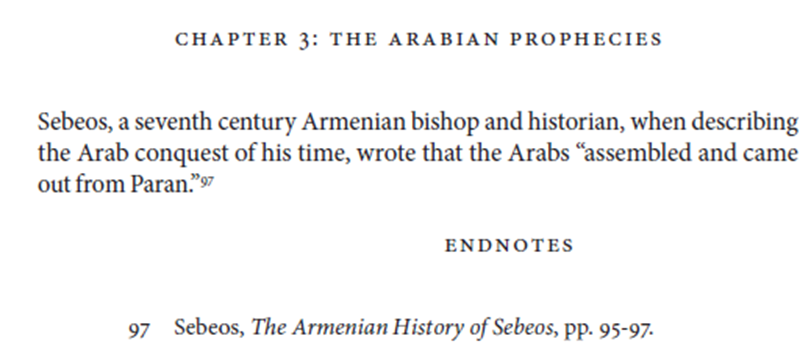
11/35. When you look up this “quote” in the sources provided by Wikipedia and Abraham Fulfilled, it isn’t found there. What is found specifically on p. 96 of “The Armenian History” is the following:
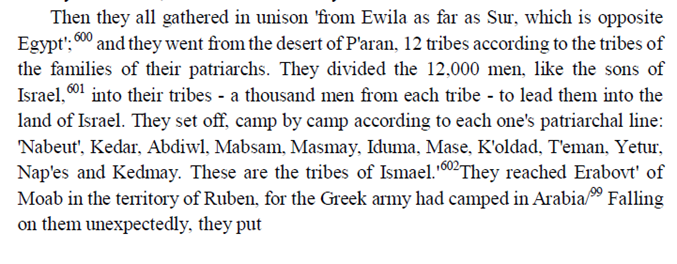
12/35 Thus, there can be little doubt, IMHO, that the authors of “Abraham Fulfilled” not only copied verbatim from Wiki, from the word “describing”, but also that they did not actually look up the source. Had they done so they might have considered this source to be completely…
13/35 irrelevant in terms of “biblical geography” as this source isn’t trying to do “biblical geography” in any historical and scientific sense, but rather seems to be simply casting contemporary history through the lens of the Bible (cf. Gn. 21:21, 25:18 Jub. 20:11-13).
14/35 On p. 83 the authors claim that “Another evidence that Paran is in Arabia is the fact that Ishmael himself has been associated with Arabia in early Jewish and Christian sources that pre-date Islam”. On pp. 83-84 the authors give five such sources.
15/35 *All* sources from antiquity that follow are also given in Carol Bakhos’ book, “Ishmael on the Border: Rabbinic Portrayals of the First Arab”,(Albany: State University of New York Press 2006). Did “Abraham Fulfilled” lift from Bakhos book?
16/35 On p. 149, Bakhos states that: ”All translations of rabbinic and Islamic texts” are her own.

17/35 The first two rabbinic texts quoted by “Abraham Fulfilled” on pp. 83-84 are given in a translation that is identical to that given in Bakhos on pp. 69-70. Compare the original translation of Bakhos on the left, with those of Abraham Fulfilled on the right.


18/35 The next text given by “Abraham Fulfilled” on p. 84, Josephus, is also given by Bakhos on p. 74. However, when one checks the source, “Abraham Fulfilled” has a small mistake also found in Bakhos Loeb’s quote (correct “circumcised”, incorrect: “circumcise”). Coincidence?


19/35 Thus, IMHO there can be little doubt that that the authors of “Abraham Fulfilled” lifted these three texts in translation from Bakhos, without as much as referencing her discussion.

20/35 The next text mentioned by Abraham Fulfilled on p. 84 is “Sozomenus”. He is also mentioned by Bakhos and on p. 95 and 166 footnote 29, Bakhos specifically notes the below and references the article, by U. Rubin.

