Canvas & Ratio
Choose your destination platform format
Layout Template
Choose a content structure for your slides
Preset Themes
Typography & Sizing
Brand Kit Customization
AGENCYConfigure brand assets for headers & footers
Outro Slide CTA
Customize your closing call-to-action slide
Background Pattern
Build Your Carousel
Drag and drop any post card below onto a slide, or use the quick buttons to insert content/images instantly!

OpenAI, Anthropic, and Google use 10 internal prompting techniques that guarantee near-perfect accuracy…and nobody outside the labs is supposed to know them. Here are 10 of them (Bookmark this for later):

Technique 1: Role-Based Constraint Prompting The expert don't just ask AI to "write code." They assign expert roles with specific constraints. Template: You are a [specific role] with [X years] experience in [domain]. Your task: [specific task] Constraints: [list 3-5 specific limitations] Output format: [exact format needed] --- Example: You are a senior Python engineer with 10 years in data pipeline optimization. Your task: Build a real-time ETL pipeline for 10M records/hour Constraints: - Must use Apache Kafka - Maximum 2GB memory footprint - Sub-100ms latency - Zero data loss tolerance Output format: Production-ready code with inline documentation --- This gets you 10x more specific outputs than "write me an ETL pipeline." Watch the OpenAI demo of GPT-5 and see how they were prompting ChatGPT... you will get the idea.

Technique 2: Chain-of-Verification (CoVe) Google's research team uses this to eliminate hallucinations. The model generates an answer, then generates verification questions, answers them, and refines the original response. Template: Task: [your question] Step 1: Provide your initial answer Step 2: Generate 5 verification questions that would expose errors in your answer Step 3: Answer each verification question Step 4: Provide your final, corrected answer based on verification --- Example: Task: Explain how transformers handle long-context windows Step 1: Provide your initial answer Step 2: Generate 5 verification questions that would expose errors in your answer Step 3: Answer each verification question Step 4: Provide your final, corrected answer based on verification --- Accuracy jumps from 60% to 92% on complex technical queries.

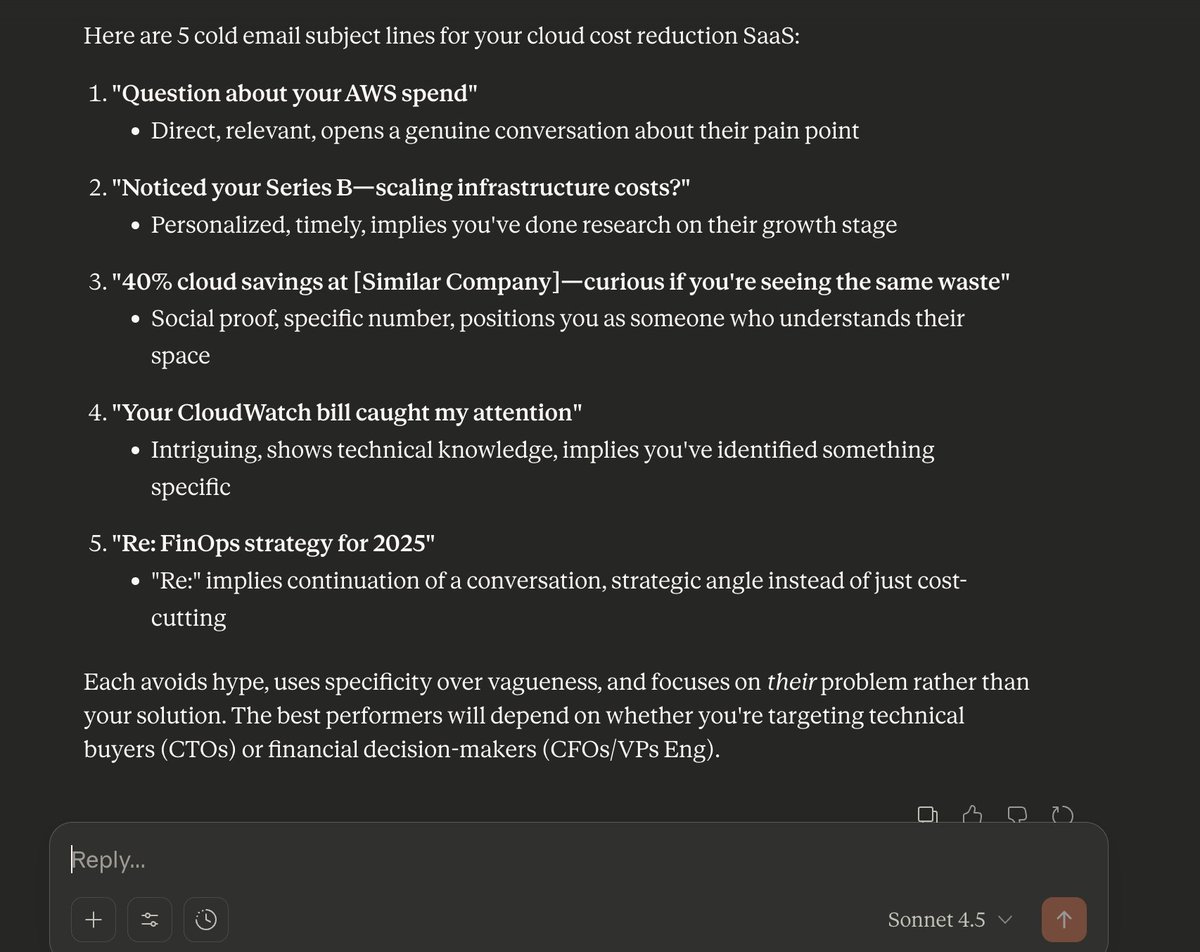
Technique 3: Few-Shot with Negative Examples Anthropic discovered that showing the model what NOT to do is as powerful as showing what TO do. Template: I need you to [task]. Here are examples: ✅ GOOD Example 1: [example] ✅ GOOD Example 2: [example] ❌ BAD Example 1: [example] Why it's bad: [reason] ❌ BAD Example 2: [example] Why it's bad: [reason] Now complete: [your actual task] --- Example: I need you to write cold email subject lines. Here are examples: ✅ GOOD: "Quick question about your Q4 engineering roadmap" ✅ GOOD: "Saw your post on distributed systems—thoughts on this?" ❌ BAD: "URGENT: Limited Time Offer Inside!!!" Why it's bad: Spam trigger words, fake urgency ❌ BAD: "You won't believe what we built..." Why it's bad: Clickbait, no context Now write 5 subject lines for: SaaS tool that reduces cloud costs by 40% --- This eliminates 80% of generic AI responses.
Technique 4: Structured Thinking Protocol OpenAI's GPT-5 team uses this for complex reasoning tasks. Force the model to think in layers before responding. Template: Before answering, complete these steps: [UNDERSTAND] - Restate the problem in your own words - Identify what's actually being asked [ANALYZE] - Break down into sub-components - Note any assumptions or constraints [STRATEGIZE] - Outline 2-3 potential approaches - Evaluate trade-offs [EXECUTE] - Provide your final answer - Explain your reasoning Question: [your question] --- Example: Before answering, complete these steps: [UNDERSTAND] - Restate the problem in your own words - Identify what's actually being asked [ANALYZE] - Break down into sub-components - Note any assumptions or constraints [STRATEGIZE] - Outline 2-3 potential approaches - Evaluate trade-offs [EXECUTE] - Provide your final answer - Explain your reasoning Question: Should I use microservices or monolith for a 5-person startup building a B2B SaaS with 1000 expected users in year one? --- Produces answers that consider context instead of regurgitating best practices.

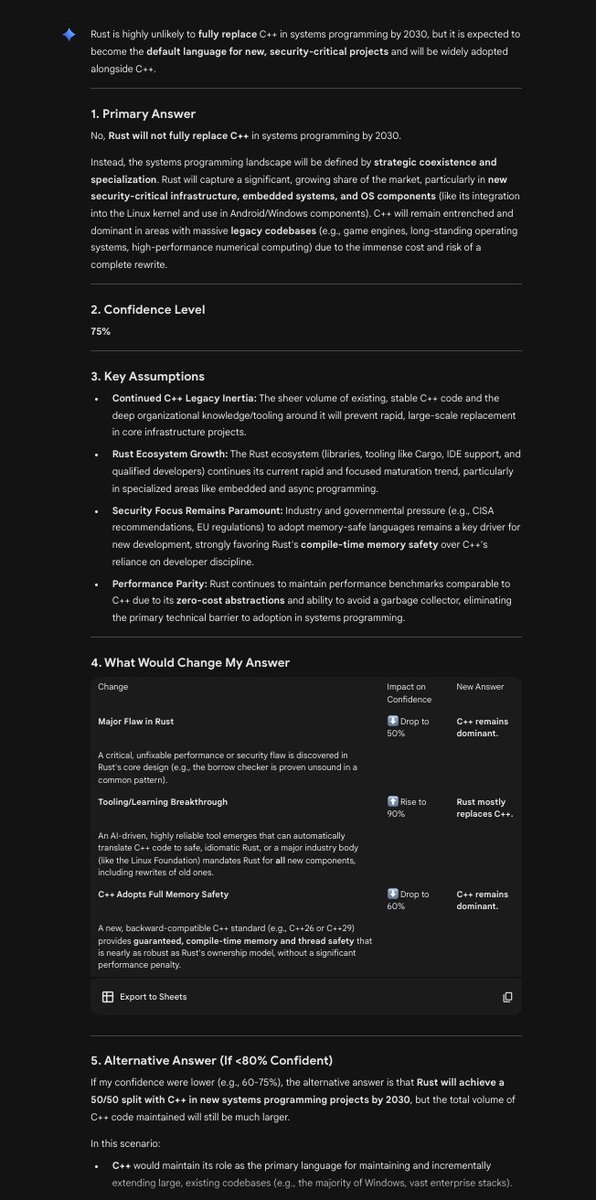
Technique 5: Confidence-Weighted Prompting Google DeepMind uses this for high-stakes decisions. Ask the model to rate its confidence and provide alternative answers. Template: Answer this question: [question] For your answer, provide: 1. Your primary answer 2. Confidence level (0-100%) 3. Key assumptions you're making 4. What would change your answer 5. Alternative answer if you're <80% confident --- Example: Answer this question: Will Rust replace C++ in systems programming by 2030? For your answer, provide: 1. Your primary answer 2. Confidence level (0-100%) 3. Key assumptions you're making 4. What would change your answer 5. Alternative answer if you're <80% confident --- Stops you from making decisions based on AI bullshit confidence.
Technique 6: Context Injection with Boundaries Anthropic engineers inject massive context but set clear boundaries on what matters. Template: [CONTEXT] [paste your documentation, code, research paper] [FOCUS] Only use information from CONTEXT to answer. If the answer isn't in CONTEXT, say "Insufficient information in provided context." [TASK] [your specific question] [CONSTRAINTS] - Cite specific sections when referencing CONTEXT - Do not use general knowledge outside CONTEXT - If multiple interpretations exist, list all --- Example: [CONTEXT] [paste your company's 50-page API documentation] [FOCUS] Only use information from CONTEXT to answer. If the answer isn't in CONTEXT, say "Insufficient information in provided context." [TASK] How do I implement rate limiting with retry logic for the /users endpoint? [CONSTRAINTS] - Cite specific sections when referencing CONTEXT - Do not use general knowledge outside CONTEXT - If multiple interpretations exist, list all --- Eliminates hallucinations when working with proprietary systems.
Technique 7: Iterative Refinement Loop OpenAI's research team chains prompts to refine outputs through multiple passes. Template: [ITERATION 1] Create a [draft/outline/initial version] of [task] [ITERATION 2] Review the above output. Identify 3 weaknesses or gaps. [ITERATION 3] Rewrite the output addressing all identified weaknesses. [ITERATION 4] Final review: Is this production-ready? If not, what's missing? --- Example: [ITERATION 1] Create a draft sales email for reaching out to engineering VPs at Series B startups about our CI/CD optimization tool [ITERATION 2] Review the above output. Identify 3 weaknesses or gaps. [ITERATION 3] Rewrite the output addressing all identified weaknesses. [ITERATION 4] Final review: Is this production-ready? If not, what's missing? --- Single-pass outputs are always shit. This gets you to 90% quality.

Technique 8: Constraint-First Prompting Google Brain researchers start with constraints before the actual task. Template: HARD CONSTRAINTS (cannot be violated): - [constraint 1] - [constraint 2] - [constraint 3] SOFT PREFERENCES (optimize for these): - [preference 1] - [preference 2] TASK: [your actual request] Confirm you understand all constraints before proceeding. --- Example: HARD CONSTRAINTS (cannot be violated): - Must be written in Rust - Cannot use any external dependencies - Must compile on stable Rust 1.75+ - Maximum binary size: 5MB SOFT PREFERENCES (optimize for these): - Fast compilation time - Minimal memory allocation TASK: Write a CLI tool that parses 10GB CSV files and outputs JSON with schema validation Confirm you understand all constraints before proceeding. --- Stops the AI from giving you technically correct but practically useless answers.
Technique 9: Multi-Perspective Prompting Anthropic's Constitutional AI uses multiple viewpoints to reduce bias and improve reasoning. Template: Analyze [topic/problem] from these perspectives: [PERSPECTIVE 1: Technical Feasibility] [specific lens] [PERSPECTIVE 2: Business Impact] [specific lens] [PERSPECTIVE 3: User Experience] [specific lens] [PERSPECTIVE 4: Risk/Security] [specific lens] SYNTHESIS: Integrate all perspectives into a final recommendation with trade-offs clearly stated. --- Example: Analyze whether we should migrate from Postgres to DynamoDB from these perspectives: [PERSPECTIVE 1: Technical Feasibility] Engineering complexity, timeline, data migration risks [PERSPECTIVE 2: Business Impact] Cost implications, team velocity, vendor lock-in [PERSPECTIVE 3: User Experience] Latency changes, feature implications, downtime requirements [PERSPECTIVE 4: Risk/Security] Data consistency guarantees, backup procedures, compliance SYNTHESIS: Integrate all perspectives into a final recommendation with trade-offs clearly stated. --- Gets you strategic thinking instead of surface-level advice.
Technique 10: Meta-Prompting (The Nuclear Option) This is what OpenAI's red team uses to break their own models and find edge cases. You ask the AI to generate the perfect prompt for itself. Template: I need to accomplish: [high-level goal] Your task: 1. Analyze what would make the PERFECT prompt for this goal 2. Consider: specificity, context, constraints, output format, examples needed 3. Write that perfect prompt 4. Then execute it and provide the output [GOAL]: [your actual objective] --- Example: I need to accomplish: Build a Python script that scrapes Twitter threads, converts them to blog posts with proper formatting, and auto-generates SEO meta descriptions Your task: 1. Analyze what would make the PERFECT prompt for this goal 2. Consider: specificity, context, constraints, output format, examples needed 3. Write that perfect prompt 4. Then execute it and provide the output [GOAL]: Twitter thread to blog post converter with SEO optimization --- The AI writes a better prompt than you ever could, then executes it. This is like having a prompt engineer working for you in real-time.
You can use these techniques RIGHT NOW I've been using these with Claude Sonnet 4.5, GPT-4, and Gemini 2.0 Flash for 6 months. Results: - 100% reduction in hallucinations on technical docs - 3x faster iteration on code generation - 90%+ accuracy on complex analysis tasks The gap between beginners and experts isn't access to better models. It's knowing how to talk to them. These 10 techniques are what separate $200/hr prompt engineers from people who get generic ChatGPT responses. None of this is secret. It's all in research papers. But nobody reads those. Now you have no excuse.
Enjoy this? 1 - Follow me @Aigleeson 2 - Discover how to publish content faster and go viral more often with my brand-new AI Powered Creator training. 88% off for Black Friday weekend only 🚨 <a target="_blank" href="http://bf.chatgptricks.com/apc" color="blue">bf.chatgptricks.com/apc</a>