Canvas & Ratio
Choose your destination platform format
Layout Template
Choose a content structure for your slides
Preset Themes
Typography & Sizing
Brand Kit Customization
AGENCYConfigure brand assets for headers & footers
Outro Slide CTA
Customize your closing call-to-action slide
Background Pattern
Build Your Carousel
Drag and drop any post card below onto a slide, or use the quick buttons to insert content/images instantly!

Thread: Multi-omics sounds cool—until you actually try it. Here's are the nuances. 1/ You’ve got RNA-seq. Methylation. Proteomics. Time to “integrate” the data. But how? And why? Let’s break it down.
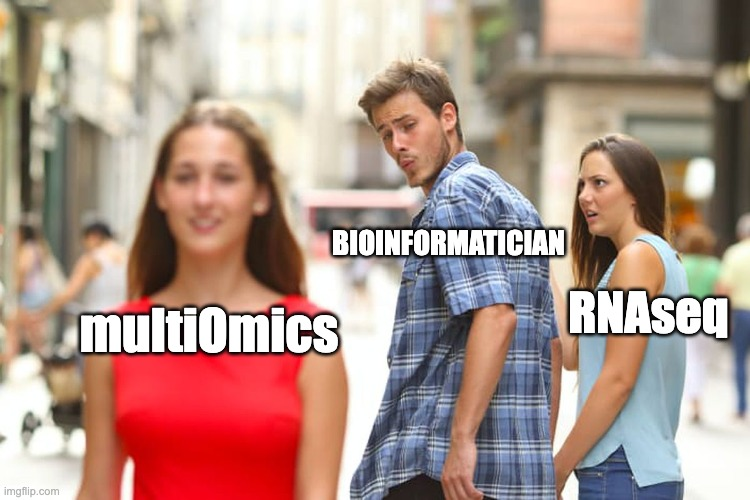
2/ Multi-omic integration sounds powerful. But it’s not magic. If you don’t ask the right question first, the answer won’t matter.
3/ Start here: Do you want shared programs across omics? Or unique signals from each modality? That choice decides your method.
4/ Unsupervised goal? Try MOFA2. Want to predict disease or treatment? DIABLO is your friend. Graph models? Great—if it performs better
5/ Real-life example: Chronic kidney disease study used both MOFA2 + DIABLO. Why? Different tools, complementary insights. Paper: <a target="_blank" href="https://www.ncbi.nlm.nih.gov/pmc/articles/PMC11949029/" color="blue">ncbi.nlm.nih.gov/pmc/articles/P…</a> Another New preprint for a different disease: <a target="_blank" href="https://www.medrxiv.org/content/10.1101/2025.05.12.25327328v1" color="blue">medrxiv.org/content/10.110…</a>
6/ Here’s what makes multi-omics hard: Your matrix is incomplete. RNA-seq for 200 samples. Proteomics for 150. Methylation for 180.
7/ You can’t just “merge” them. Naive concatenation drowns real signal. Or worse—creates phantom clusters driven by batch noise.
8/ Each modality is different: scATAC-seq is sparse Proteomics is noisy RNA-seq has 20K+ features Methylation may only cover 50K regions and over 9 million CpG sites
9/ Good methods normalize each modality, learn weights, or regularize smartly. MOFA2, DIABLO, and weighted PCA all do this.
10/ Want to see how it fails? Check this post: <a target="_blank" href="https://divingintogeneticsandgenomics.com/post/python-visium/" color="blue">divingintogeneticsandgenomics.com/post/python-vi…</a> Spatial + gene expression integration went sideways without normalization.
11/ Math is nice. But biology matters more. If you can’t map back your result to a gene, CpG, or protein—what’s the point?
12/ These methods uncover correlations, not causes. Interpret carefully. Validate everything.
13/ Use known pathways. Run orthogonal experiments. Generalize across cohorts. Don’t trust the output blindly.
14/ Resources: Tools list: <a target="_blank" href="https://github.com/mikelove/awesome-multi-omics" color="blue">github.com/mikelove/aweso…</a> Tool review: <a target="_blank" href="https://www.ncbi.nlm.nih.gov/pmc/articles/PMC7003173/" color="blue">ncbi.nlm.nih.gov/pmc/articles/P…</a> Overview: <a target="_blank" href="https://frontlinegenomics.com/a-guide-to-multi-omics-integration-strategies/" color="blue">frontlinegenomics.com/a-guide-to-mul…</a>
15/ Key takeaways: Start with the question Pick tools based on your goal Normalize per modality Validate everything Biology > black boxes Multi-omics is messy. But it’s worth it—if you know what you’re doing.
I hope you've found this post helpful. Follow me for more. Subscribe to my FREE newsletter chatomics to learn bioinformatics <a target="_blank" href="https://divingintogeneticsandgenomics.ck.page/profile" color="blue">divingintogeneticsandgenomics.ck.page/profile</a> <a target="_blank" href="https://twitter.com/433559451/status/1990423457268633897" color="blue">x.com/433559451/stat…</a>