Canvas & Ratio
Choose your destination platform format
Layout Template
Choose a content structure for your slides
Preset Themes
Typography & Sizing
Brand Kit Customization
AGENCYConfigure brand assets for headers & footers
Outro Slide CTA
Customize your closing call-to-action slide
Background Pattern
Build Your Carousel
Drag and drop any post card below onto a slide, or use the quick buttons to insert content/images instantly!

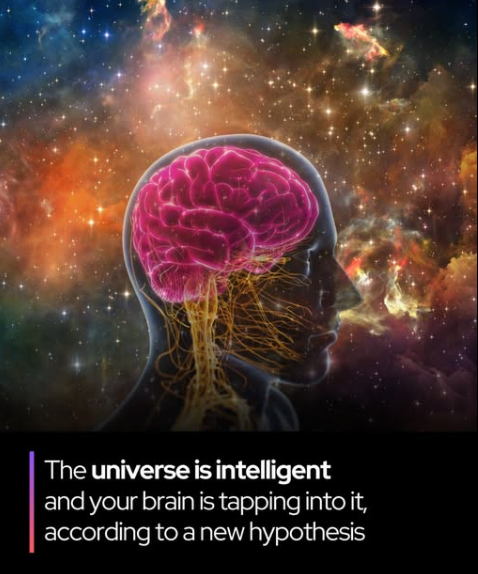
Your brain might be tuning into intelligence – not generating it. Biophysicist Douglas Youvan believes intelligence isn’t something the brain creates, but something it connects to. His hypothesis is that intelligence is a fundamental, non-local property of the universe – existing outside of biology, waiting to be tapped by structures complex enough to interface with it. This idea draws from quantum theory, where certain properties of a system remain undefined until observed. Much like Schrödinger’s cat being both alive and dead until measured, Youvan suggests that intelligence exists as potential – not locked in the brain, but in an underlying “informational substrate” of the universe. To explore this, Youvan looks at how biological and artificial systems behave. Enzymes, neurons, and even neural networks in AI often exhibit patterns that are not just reactive but predictive – suggesting they may be linking into rules or information beyond their own architecture. In particular, he notes the fractal geometry of neurons, which mirrors patterns found throughout nature, from river deltas to galaxies. These recursive structures, he argues, may be optimized to interface with information embedded in the fabric of reality. ["The Universe Is Intelligent—And Your Brain Is Tapping Into It to Form Your Consciousness, Scientist Says." Popular Mechanics, 18 April 2025]