Canvas & Ratio
Choose your destination platform format
Layout Template
Choose a content structure for your slides
Preset Themes
Typography & Sizing
Brand Kit Customization
AGENCYConfigure brand assets for headers & footers
Outro Slide CTA
Customize your closing call-to-action slide
Background Pattern
Build Your Carousel
Drag and drop any post card below onto a slide, or use the quick buttons to insert content/images instantly!

Concentric impulse is the key determinant of jump height (via take off velocity). So why does eccentric rate of force development or eccentric impulse matter?
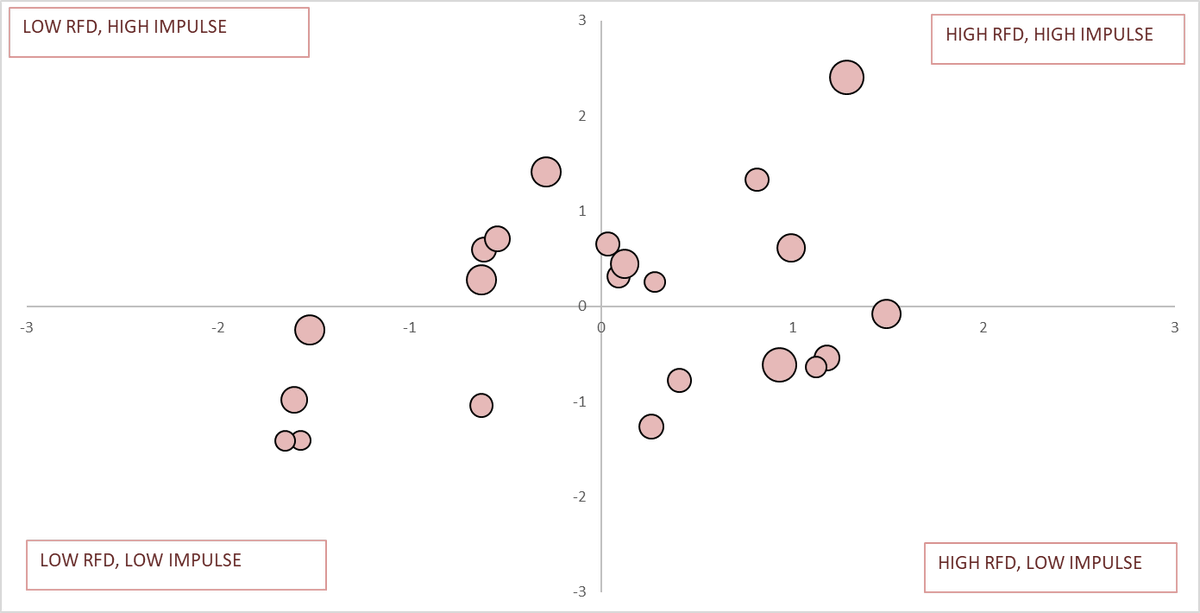
Concentric impulse is hugely influenced by what preceeds it In the eccentric phase, how fast, how deep and how much force you develop, dictates how effectively you attack the concentric phase The eccentric phase is the platform from which to launch concentric force production
The eccentric phase prepares concentric phase: High eRFD → quicker ecc-con transition, enhanced elastic contribution. High eIMP→ more stored energy & higher starting force in concentric phase Some athletes can can can exhibit both, some leverage one more than the other
A high eRFD allows athletes to hit the brakes fast, create stiffness & begin reversing momentum quickly. "Elastic" jumpers = less displacement of the CoM, fast trainsition to concentric phase. Do too much of this this however & impulse generation suffers.
Large eccentric impulse means more work in the braking phase & the athlete arrives at concentric phase w/ more active state or MU recruitment "Strong", controlled jumpers: larger RoM , more force over time. But too much impulse = too much contraction time & jump ht plateaus.
The best athletes balance the two relative to their unique profile High eRFD: rapid force onset, reflexive contributions Sufficient eIMP: enough time under tension to build up and apply force Result: efficient stretch–shortening, high take-off velocity, big jump heights