Canvas & Ratio
Choose your destination platform format
Layout Template
Choose a content structure for your slides
Preset Themes
Typography & Sizing
Brand Kit Customization
AGENCYConfigure brand assets for headers & footers
Outro Slide CTA
Customize your closing call-to-action slide
Background Pattern
Build Your Carousel
Drag and drop any post card below onto a slide, or use the quick buttons to insert content/images instantly!

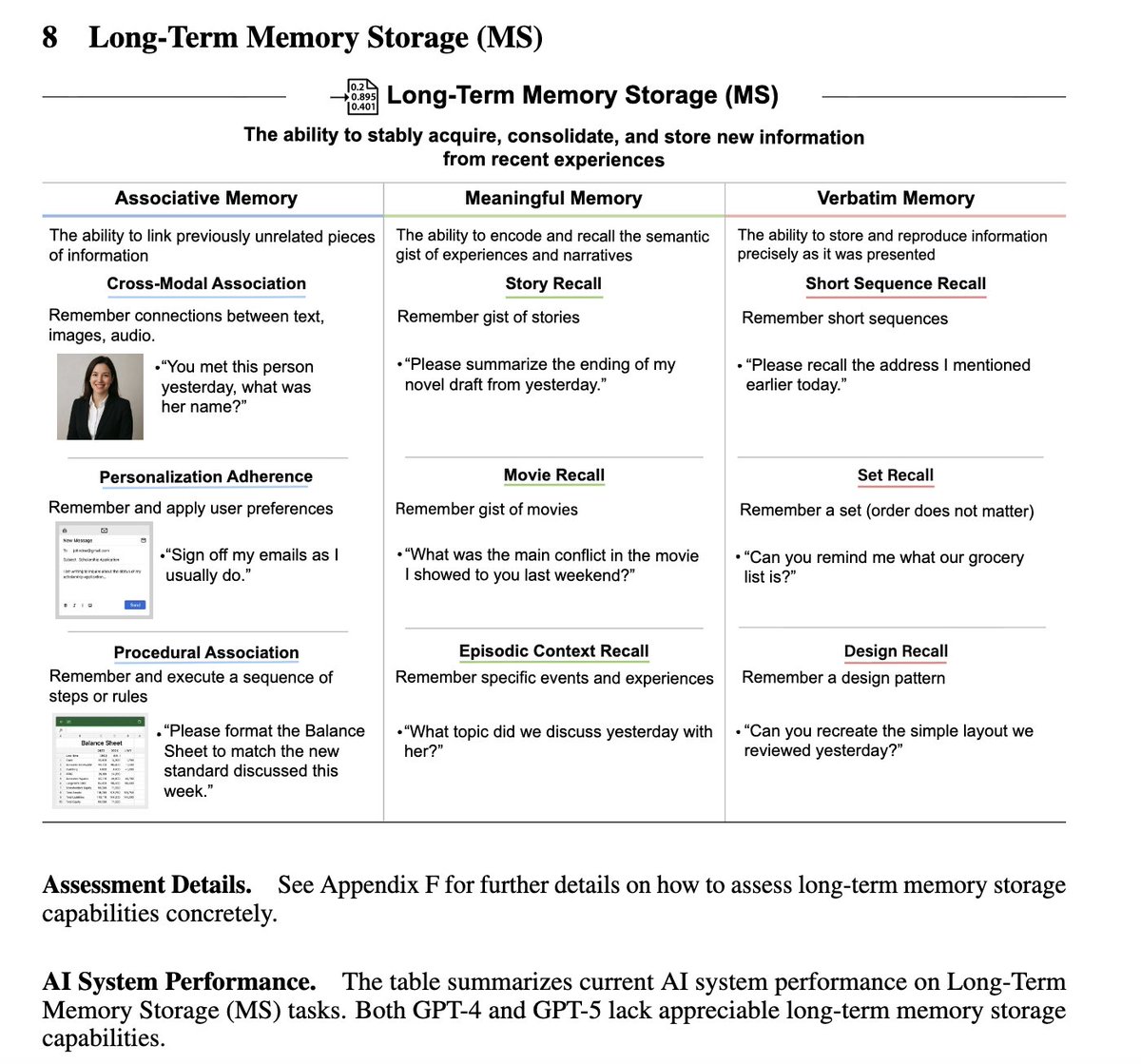
Holy shit… AGI finally has a number. 🤯 For the first time, we can actually measure how close we are to real Artificial General Intelligence thanks to a new paper from Yoshua Bengio, Dawn Song, Max Tegmark, Eric Schmidt, and others. For years, everyone’s been throwing around the term “AGI” like it’s some mystical milestone. Something vague. Something out there in the future. But this paper just pinned it down with a definition that finally makes sense. They describe AGI as: “An AI that can match the cognitive versatility and proficiency of a well-educated adult.” No hype. No “human-level” buzzwords. Just a measurable benchmark based on real cognitive science. The framework is built on the Cattell–Horn–Carroll (CHC) model — the same system psychologists use to measure human intelligence. It breaks cognition into ten abilities: reasoning, memory, math, language, perception, processing speed, and more. Then the researchers did something wild — they tested actual AI models against those same human benchmarks. And here’s what they found: GPT-4 → 27% toward AGI GPT-5 → 58% toward AGI In other words, the latest model now operates at over half the cognitive range of an average human adult. But it’s not there yet. Both models still scored 0% in long-term memory the ability to store and recall new information over time. That’s the missing piece. Continuous learning. Lifelong memory. The foundation of real general intelligence. What makes this paper groundbreaking isn’t just the data it’s the clarity. For the first time, we have a framework that turns “AGI” from a buzzword into a measurable spectrum. We can finally track progress. We can finally quantify intelligence. And right now, humanity’s best AI is sitting at 58% of the way to AGI. The countdown has officially begun.
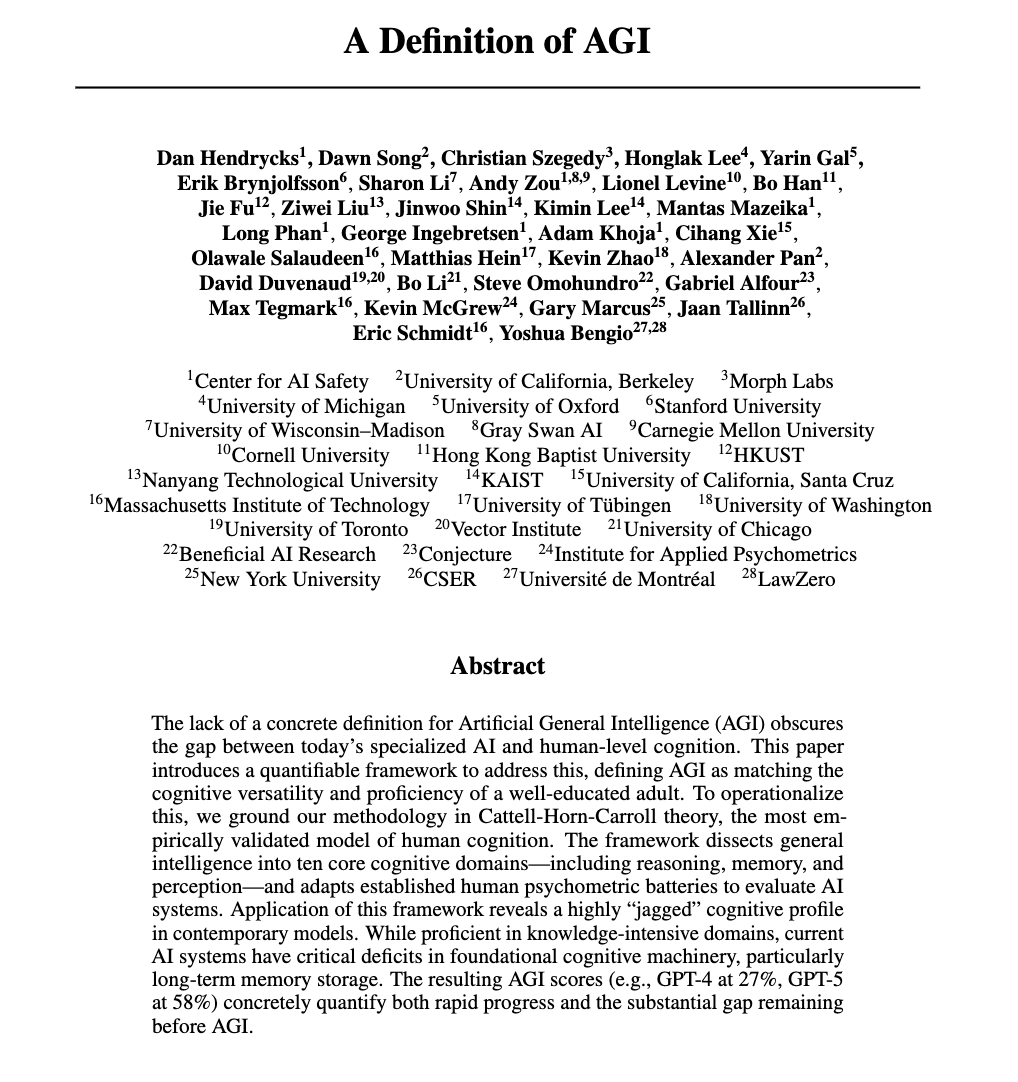
The paper starts by calling out the elephant in the room: nobody actually agrees on what AGI is. Every year the definition shifts from “better than humans at chess” to “better than humans at everything.” They argue this ambiguity has slowed progress. So they built a quantifiable definition.

Their definition is refreshingly simple: “AGI is an AI that matches the cognitive versatility and proficiency of a well-educated adult.” Not superhuman. Not godlike. Just human-level cognition across domains. This focus on versatility (breadth) and proficiency (depth) is what separates AGI from narrow AI.

To measure that, they used the Cattell–Horn–Carroll (CHC) theory the same psychometric model used in human IQ tests. It breaks intelligence into 10 “broad abilities” reasoning, memory, math, perception, etc. Then they built AI test batteries modeled after human cognition.
When they ran GPT-4 and GPT-5 through the test batteries, the results were wildly uneven. GPT-5 crushed it in reasoning and math. But both models completely failed at long-term memory scoring 0%. Basically, they can think fast… but forget everything.

That long-term memory gap is the missing piece of AGI. Humans learn through retention and recall. AIs? They just remix what’s already encoded. Without persistent memory, true understanding can’t emerge.
The paper also distinguishes between speed and intelligence. GPT-5 performs simple tasks quickly, but raw speed ≠ smarter thinking it just means faster prediction. Humans trade speed for reflection. AIs don’t yet.

What’s powerful here is that this framework lets us track AGI like a scoreboard. Instead of arguing “are we close to AGI?” we can now ask: “How much cognitive ground remains before parity?” Next frontier: memory + multimodal reasoning.
The takeaway’s clear: AGI isn’t a magic switch it’s a spectrum of cognition. And for the first time, we can measure it. Right now, humanity’s smartest model stands at 58% human. The other 42% will define the next decade. Read the full paper: <a target="_blank" href="https://www.agidefinition.ai/" color="blue">agidefinition.ai</a>