Canvas & Ratio
Choose your destination platform format
Layout Template
Choose a content structure for your slides
Preset Themes
Typography & Sizing
Brand Kit Customization
AGENCYConfigure brand assets for headers & footers
Outro Slide CTA
Customize your closing call-to-action slide
Background Pattern
Build Your Carousel
Drag and drop any post card below onto a slide, or use the quick buttons to insert content/images instantly!

Here's a THREAD 🧵on 78 places that a Trader can have an advantage over other Traders. Enjoy ↓
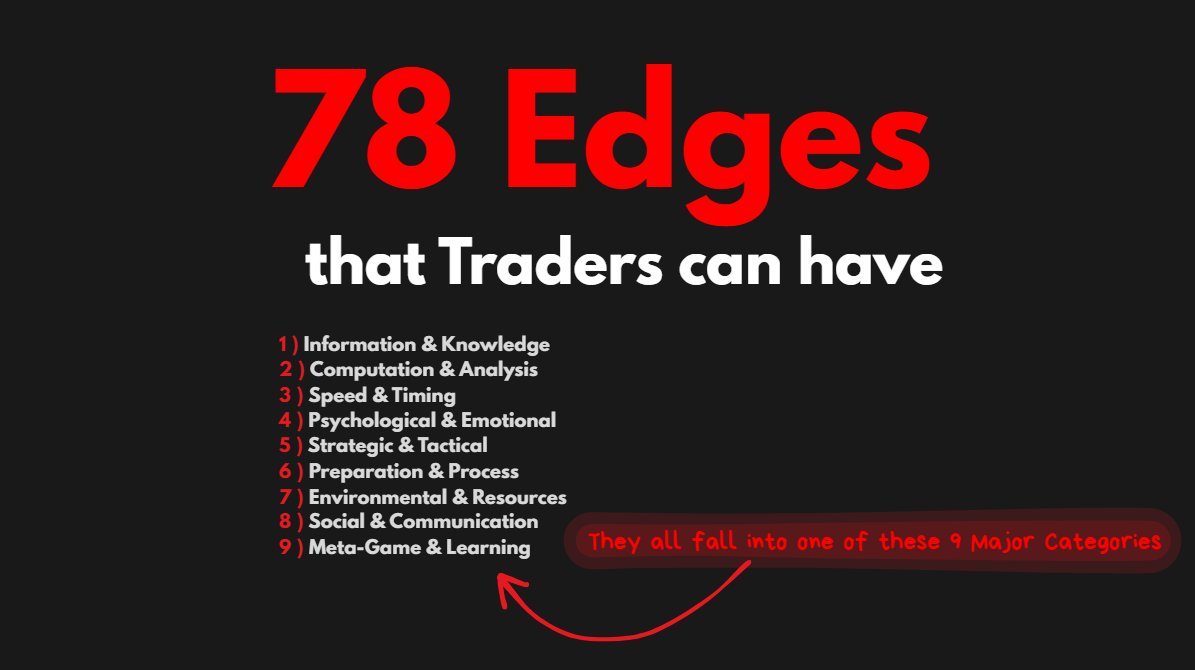
(1-9) Information & Knowledge Edges → The advantage of seeing more, seeing sooner, or seeing more clearly than competitors. --------------- 1. Having greater quantity of data than competitors. 2. Having higher quality or cleaner data (less noise, fewer errors, more consistent data). 3. Accessing data faster than others (lower latency). 4. Having exclusive data sources competitors can’t access. (insider info or proprietary info) 5. Processing raw data into insights more effectively. (how good you can look at data and find meaning from it) 6. Holding more historical data for deeper pattern recognition. (this is slightly different to point #1) 7. Identifying data relationships others don’t see (cross-market correlations). 8. Being able to filter irrelevant data faster than others. (how good u can clean data basically) 9. Integrating multiple datasets to form composite indicators.
(10–23) Analytical & Computational Edges → The advantage of thinking more accurately and quantifying trading variables better. --------------- 10. Calculating probabilities more precisely than others. 11. Modeling expected value (EV) more accurately. 12. Understanding cause-effect relationships better. 13. Running more simulations or backtests than peers. 14. Having higher computational capacity for analysis. 15. Using more advanced statistical or probabilistic reasoning. 16. Being able to compress complex systems into simple models. 17. Detecting hidden patterns faster using better tools. 18. Identifying when a variable truly matters (feature importance). 19. Performing faster hypothesis testing and refinement cycles.(how fast you can test ideas) 20. Maintaining more precise risk/reward calculations per trade. (so many traders completely ignore fees when thinking about risk) 21. Estimating distribution tails (fat-tail risks) more accurately. (so many traders just assume they'll never get slipped and don't include it when they think about risk... wild) 22. Having better understanding of randomness and variance. 23. Reducing model overfitting through superior validation processes.
(24-35) Execution & Speed Edges → The advantage of acting faster, more efficiently or cheaper than others. --------------- 24. Executing orders faster than competitors. 25. Experiencing less slippage per trade. 26. Maintaining lower average transaction costs. 27. Having higher order fill efficiency (fewer missed trades). 28. Cancelling or adjusting orders faster under changing conditions. (how fast u can tell your idea has been invalidated or how fast you can detect changes in regimes) 29. Entering/Exiting with less price impact (having less obvious footprint). 30. Reducing manual delay or mistakes through automation. 31. Maintaining lower average latency from decision to execution. (basically reducing hesitation) 32. Synchronizing multiple orders across exchanges more efficiently. (this reduce your avg. slippage per trade btw) 33. Avoiding unnecessary re-quotes or partial fills. (e.g. if N units of time pass, cancel the order. N in this case would be an "abnormal amount of time to wait to get filled) 34. Having better routing algorithms for order priority. 35. Reacting to new information faster than competitors.
(36–44) Psychological & Emotional Edges → The advantage of staying rational when others become emotional. --------------- 36. How well you can maintain emotional stability under pressure. 37. How well you can avoid impulsive or revenge trades. 38. How well you can cut losses objectively without hesitation. 39. How well you can stick to predefined risk limits consistently. 40. How well you can avoid FOMO and herd behavior. 41. How well you can detach ego from trade outcomes. 42. How confident you can remain after drawdowns. 43. How fast you can recover from silly mistakes or losses. 44. Sustaining focus (and/or screentime) for longer than competitors.
(45–59) Strategic & Market Structure Edges → The advantage of understanding how the game is built and who you’re playing against. --------------- 45. Having deeper understanding of how liquidity forms and moves. 46. Understanding incentives of different market participants. 47. Anticipating crowd behavior and reaction points. 48. Having better understanding of the variables which play a role in a market regime changing. 49. Having a better understanding when volatility expansion or contraction can occur 50. Understanding how algorithms, MM, and retail all interact with each other. 51. Anticipating Trapped Traders before they actually get trapped 52. Better understanding of which behaviors repeat across assets/timeframes and which ones are specific to a niche asset and/or specific timeframe. 53. Better understanding of when price moves are driven by forced actions (liquidations/stoploss cascades compared to voluntary actions (manually entering/exiting a trade) 54. Better recognition of when conditions favor one strategy type over another. (how well you can tell if it's a momentum or mean-reversion favored environment) 55. How fast you can detect big changes in correlation (big increases or big decreases) 56. Understanding better understanding capital rotation cycles between sectors/pairs than competitors
(57–64) Process & Routine Edges → The advantage of operating with higher consistency, structure, and feedback. --------------- 57. The consistency and the quality of your pre-trade checklist 58. How well you can review your trades 59. How well you can track your own performance. 60. The way you are setting and hitting your daily/weekly trading objectives. (hint: focus on the inputs, not the outputs) 61. The quality of your decision making on how you improve your overall process, not just your decision-making with trade execution. 62. The process for how you optimize any kind of system (not just a trading system. For example your system for collecting/storing data) 63. Tracking execution metrics (fill rate, latency, cost). 64. How well you can reduce distractions in personal life and properly focus on work
(65–67) Risk & Capital Management Edges → The advantage of surviving longer and compounding faster. --------------- 65. How good you are at sizing up and sizing down relative to volatility. 66. How well you can preserve psychological capital (basically your capacity for how much BS can you tolerate from the market before going on Tilt) 67. How much access to capital you currently have and also how good you are at acquiring/raising more capital from outside sources.
(68-78) Learning & Adaptation Edges → The advantage of improving faster than competitors. --------------- 68. How well you can identify mistakes 69. How well you can correct a mistake after identifying it. 70. How frequently you are testing new ideas 71. How good you are at measuring the quality (or output) of an iteration after executing on it. (basically after you have an idea, how good are you at testing it and figuring out if the idea is good or bad) 72. How well you can measure the improvement rate of your skill curve. (Are you just guessing that you're getting better or do you have evidence to back it up?) 73. Learning faster from feedback loops (shorter iteration cycles). 74. How good you are at killing bad ideas. 75. Your social skills + how much information, knowledge, ideas and learning resources you can extract from others.
(76 –81) Environmental & Lifestyle Edges → The advantage of maintaining physical and mental performance longer. (If you get sick less than an equally skilled competitor, you will probably beat them lol) --------------- 76. How good sleep you get (99% crypto degens are sleep deprived and addicted to energy drinks... this is the easiest thing to start with) 77. How healthy are you (in terms of how frequently do you get sick) 78. How good are you at managing burnout and also coming back from it if you happen to slip into it? (burnout isn't a bad thing... taking an eternity to recover from it is) --------------- end 🌶️