Canvas & Ratio
Choose your destination platform format
Layout Template
Choose a content structure for your slides
Preset Themes
Typography & Sizing
Brand Kit Customization
AGENCYConfigure brand assets for headers & footers
Outro Slide CTA
Customize your closing call-to-action slide
Background Pattern
Build Your Carousel
Drag and drop any post card below onto a slide, or use the quick buttons to insert content/images instantly!

🚨 BREAKING: The 2nd research proves Generative AI is lowering demand for junior staff, though senior jobs are still secure. 7.7% junior headcount decline within generative-AI adopters firms by 6 quarters, and 40% fewer junior hires per quarter in wholesale and retail. They used U.S. résumé and job posting data covering nearly 62 million workers in 285,000 firms (2015–2025). There's a clear break in timeline of befor ChatGPT and after ChatGPT: before 2022, juniors and seniors grew together, but after generative AI adoption began, seniors kept advancing while juniors fell behind in new hiring. 🧵 Read on 👇 <a target="_blank" href="https://twitter.com/rohanpaul_ai/status/1960256896373551378" color="blue">x.com/rohanpaul_ai/s…</a>

2/ Employment growth over time, split into juniors, seniors, and the total. There's a clear break before and after 2022. From 2015 through 2021, juniors (red) and seniors (blue) rise almost in parallel, both contributing to steady overall growth (gray). Starting around 2022, the lines diverge. Senior employment continues climbing strongly, while junior employment stalls and eventually dips after 2023. The total line flattens because the junior slowdown cancels out part of the senior gains. So there's a clear break: before 2022, juniors and seniors grew together, but after generative AI adoption began, seniors kept advancing while juniors fell behind.

2/ How employment gaps between Gen-AI adopters firms and non-adopters evolve for junior and senior workers. For seniors, the blue line rises steadily after 2022, meaning that firms adopting generative AI keep growing their senior staff faster than comparable firms that did not adopt. For juniors, the red line stays flat until early 2022, then begins to fall below zero after 2023, showing that junior employment in adopters weakens compared to non-adopters. The shaded areas are uncertainty ranges, but the clear split after 2023 shows a sharp divergence, with adopters holding onto or adding seniors, while juniors shrink. So the effect of adoption is not general headcount loss, but specifically a loss of juniors relative to seniors.

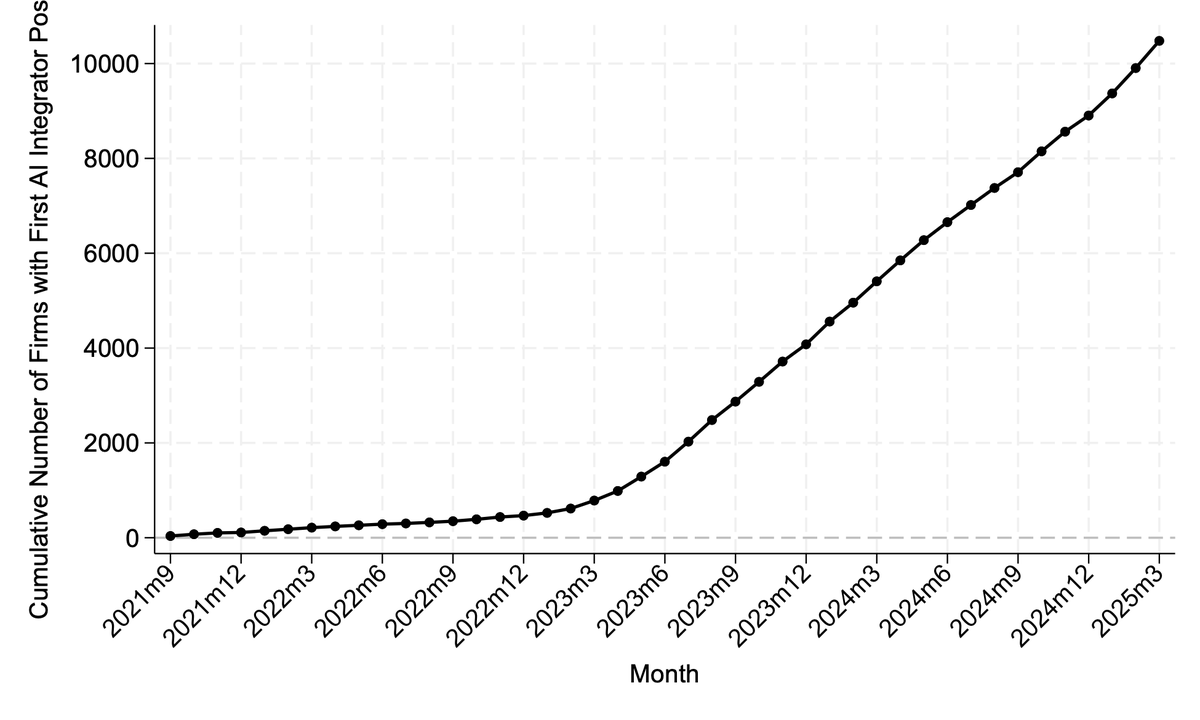
3/ The number of firms each month that post their very first “AI integrator” role. meaning a job ad explicitly asking someone to connect generative AI systems into workflows. The curve is flat through 2021 and 2022, then shoots up in early 2023, right after the public release of tools like ChatGPT. So thats when adoption really begins.

4/ Gen-AI adopters firms over time. Shows a smooth upward climb, reaching about 10,600 firms by early 2025. Since the dataset covers a large slice of U.S. job postings, that translates to roughly 3.7% of firms counted as adopters.
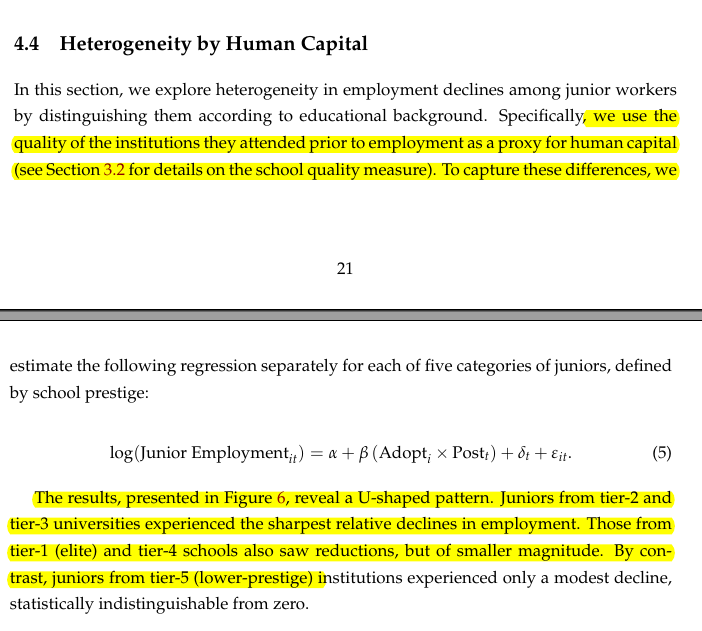
5/ 🎓 Gen-AI's effect on junior positions - Who gets squeezed by education tier The hit to juniors is U‑shaped by school tier, the middle grade Universities sees the largest declines, while elite and lower‑tier grads see smaller moves, and the very lowest tier is near zero. The salary chart right before adoption shows higher pay for elite grads and much lower pay for the bottom tier, which helps explain why the middle is most replaceable at current costs.

6/ Gen-AI's effect on junior positions - Why the U-shaped effect across school tiers ? i.e. why the middle tier schools saw the largest decline in their graduates getting hired. Graduates from elite schools are expensive. Their higher pay makes firms less likely to replace them with generative AI at current performance levels. These juniors often handle tasks that are complex, client-facing, or high stakes, which AI tools are not yet trusted to fully take over. At the bottom tier, wages are already low. Replacing them with AI does not generate much savings, so firms may just keep hiring them for routine work. The middle tiers sit in an awkward spot. Their wages are significantly higher than the lowest tier, but their work tasks are closer to the type of routine or semi-structured work that generative AI can handle. That makes them more cost-effective to substitute. So the reason the biggest squeeze happens in the middle is that their cost is high enough to invite replacement, but their job functions are not protected by either extreme complexity (like elite grads) or extreme cheapness (like bottom-tier grads).
7/ 🏭 Gen-AI's effect on junior positions - where it bites hardest across industries Every major sector shows weaker junior hiring in adopters, but wholesale and retail stands out with about 40% fewer junior hires per quarter. This lines up with tasks that generative AI can cheaply handle in those settings, like routine customer messages and documentation. Senior hiring is flat to positive across sectors, which reinforces that the squeeze is concentrated at entry levels.

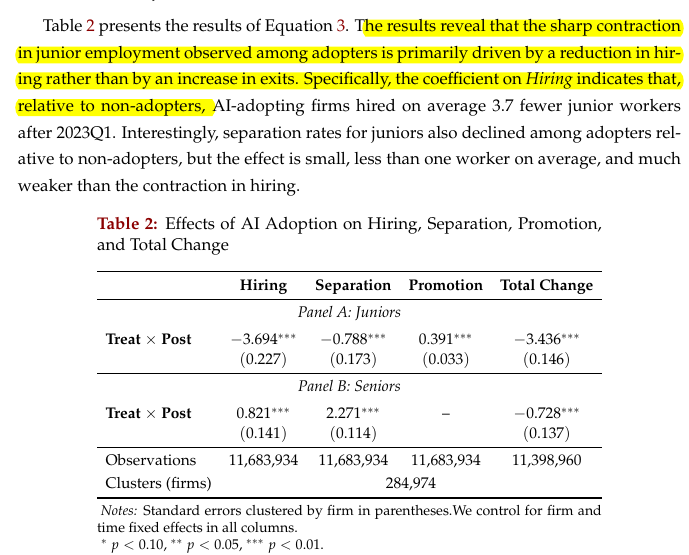
📉 As to the mechanism of Gen-AI's effect on junior positions, hiring dries up rather than exits spike The junior decline is driven by fewer new entries, not by layoffs, with adopters hiring about 3.7 fewer juniors per quarter after 2023Q1 relative to non‑adopters. Junior separations actually tick down a bit, less than 1 worker on average, which is small next to the hiring cut. Promotions of juniors rise by about 0.4 per quarter, so fewer get hired, but those inside move up more often. Before 2023, adopters averaged 17.45 junior hires per quarter, so the cut is roughly 22% of their baseline junior hiring.
The full report <a target="_blank" href="https://papers.ssrn.com/sol3/papers.cfm?abstract_id=5425555" color="blue">papers.ssrn.com/sol3/papers.cf…</a>