Canvas & Ratio
Choose your destination platform format
Layout Template
Choose a content structure for your slides
Preset Themes
Typography & Sizing
Brand Kit Customization
AGENCYConfigure brand assets for headers & footers
Outro Slide CTA
Customize your closing call-to-action slide
Background Pattern
Build Your Carousel
Drag and drop any post card below onto a slide, or use the quick buttons to insert content/images instantly!

How LLMs work, clearly explained:
Before diving into LLMs, we must understand conditional probability. Let's consider a population of 14 individuals: - Some of them like Tennis 🎾 - Some like Football ⚽️ - A few like both 🎾 ⚽️ - And few like none Here's how it looks 👇

So what is Conditional probability ⁉️ It's a measure of the probability of an event given that another event has occurred. If the events are A and B, we denote this as P(A|B). This reads as "probability of A given B" Check this illustration 👇

For instance, if we're predicting whether it will rain today (event A), knowing that it's cloudy (event B) might impact our prediction. As it's more likely to rain when it's cloudy, we'd say the conditional probability P(A|B) is high. That's conditional probability for you! 🎉
Now, how does this apply to LLMs like GPT-4❓ These models are tasked with predicting the next word in a sequence. This is a question of conditional probability: given the words that have come before, what is the most likely next word?

To predict the next word, the model calculates the conditional probability for each possible next word, given the previous words (context). The word with the highest conditional probability is chosen as the prediction.

The LLM learns a high-dimensional probability distribution over sequences of words. And the parameters of this distribution are the trained weights! The training or rather pre-training** is supervised. I'll talk about the different training steps next time!** Check this 👇

But there a problem❗️ If we always pick the word with the highest probability, we end up with repetitive outputs, making LLMs almost useless and stifling their creativity. This is where temperature comes into picture. Check this before we understand more about it...👇

However a high temperate value produces gibberish Let's understand what's going on...👇

So, the LLMs instead of selecting the best token (for simplicity let's think of tokens as words), they "sample" the prediction. So even if “Token 1” has the highest score, it may not be chosen since we are sampling.

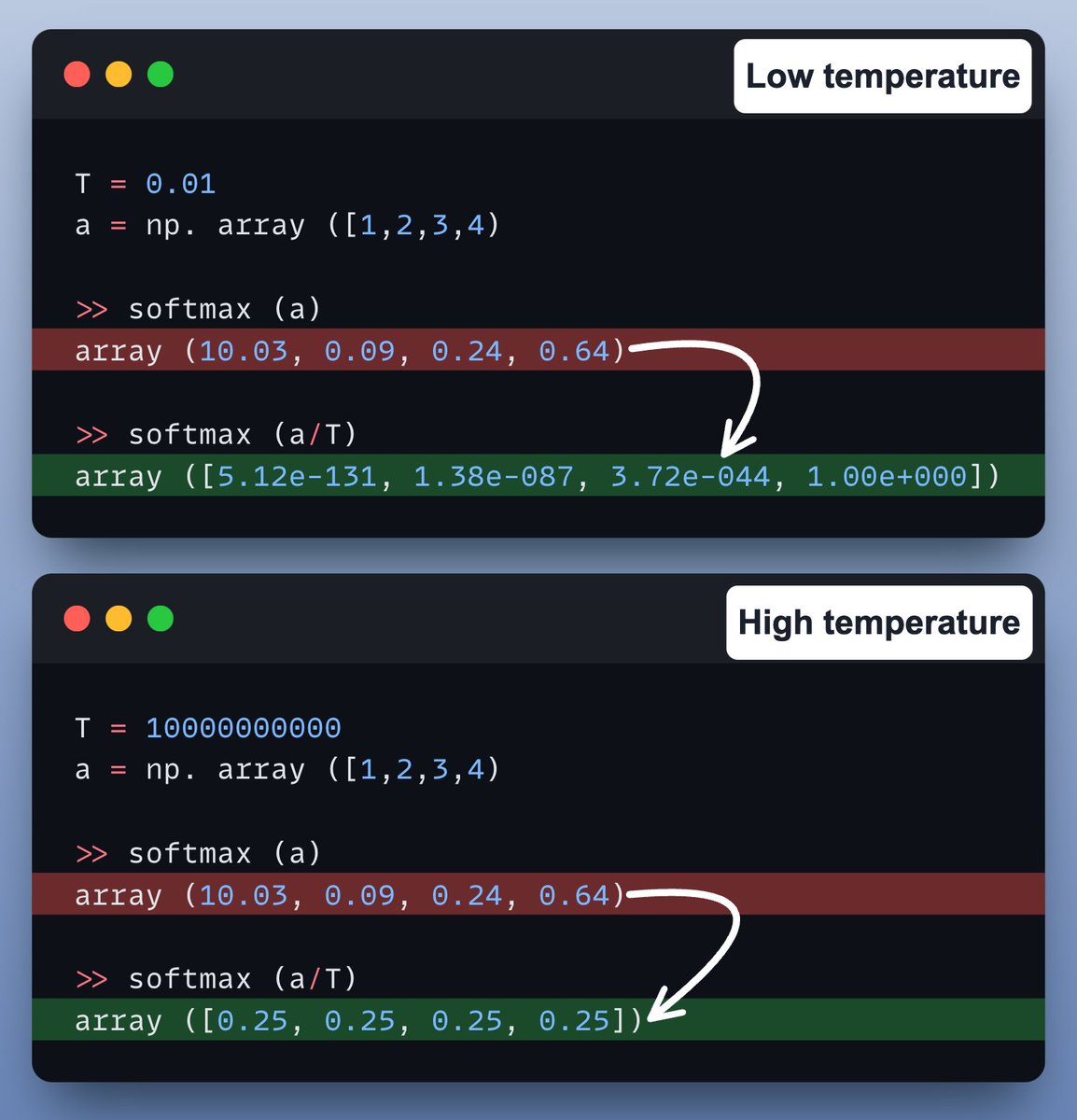
Now, temperature introduces the following tweak in the softmax function, which, in turn, influences the sampling process:

Let take a code example! At low temperature, probabilities concentrate around the most likely token, resulting in nearly greedy generation. At high temperature, probabilities become more uniform, producing highly random and stochastic outputs. Check this out👇
That's a wrap! Hopefully, this guide has demystified some of the magic behind LLMs. And, if you enjoyed this breakdown: Find me → @akshay_pachaar ✔️ For more insights and tutorials on AI and Machine Learning.