Canvas & Ratio
Choose your destination platform format
Layout Template
Choose a content structure for your slides
Preset Themes
Typography & Sizing
Brand Kit Customization
AGENCYConfigure brand assets for headers & footers
Outro Slide CTA
Customize your closing call-to-action slide
Background Pattern
Build Your Carousel
Drag and drop any post card below onto a slide, or use the quick buttons to insert content/images instantly!

I tried using orbs I tried Supply and Demand. I even tried using Elliott Waves. but trading did not click for me until I started studying the greats and noticed a pattern... Below you can steal the exact strategy that makes me 50/k month:🧵

To start off, we have to understand the point of this strategy.. The goal is to simplify trading and look for repeatable patterns to trade We want to take advantage of strong market trends & use the leverage of options for a low risk high reward approach Using big momentum swings in the markets we can catch the biggest moves to either side
studying some of the best traders I noticed that instead of day trading and taking small time frame setups... they waited for the markets to become primed for a big move
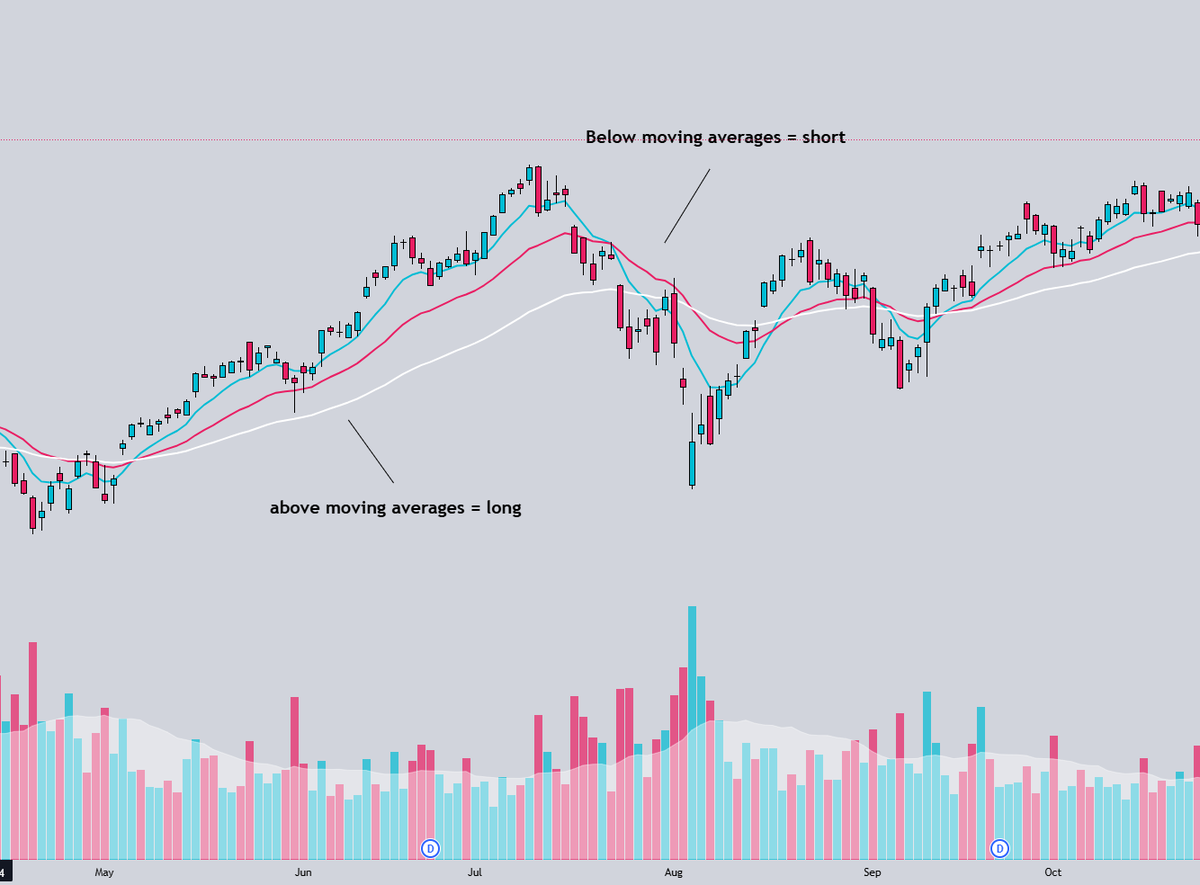
1. Finding market strength and weakness The easiest way to figure out the trend of the markets is to use EMA's Pull up a chart on <a target="_blank" href="https://tradingview.com" color="blue">tradingview.com</a> and add the 8, 21, 50 EMA's EMA's can be used as a momentum gauge for when the markets are weaker and will push lower and when markets are strong and stocks will follow through higher
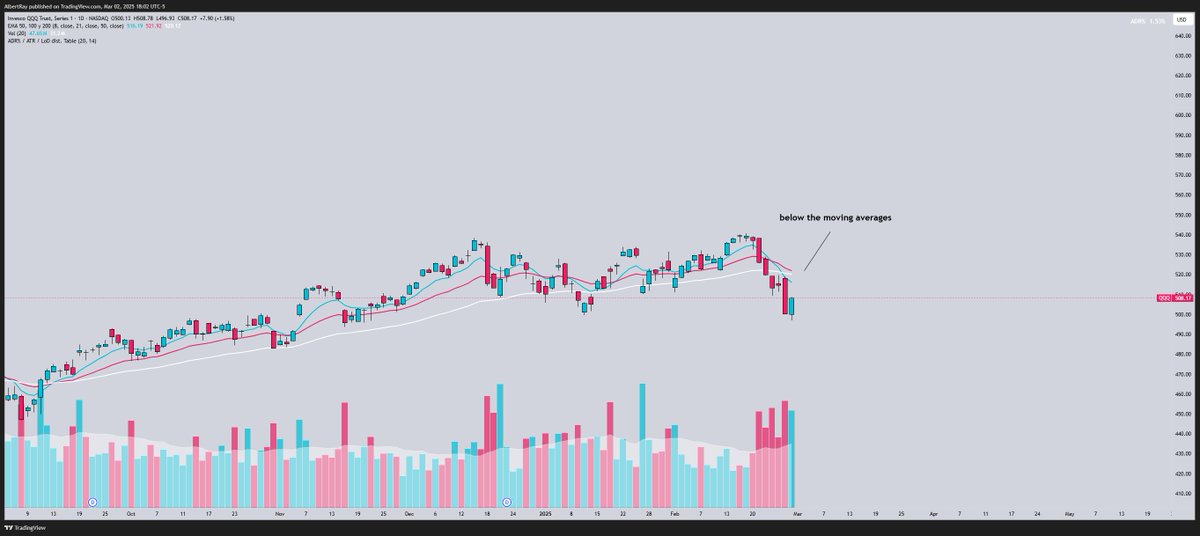
2. Framework Now that we have the EMA's on the chart, we can make some rules for when we want to be active in the markets. Use $SPY / $QQQ 1) Whenever $SPY / $QQQ are above the 8/21/50 EMA's, we want to be long with full size/conviction 2) Whenever $SPY / $QQQ are below the 8/21/50 EMA's, we want to trade stocks to the downside We can also use this on the individual names we are trading to narrow down our criteria.
once we establish which way the market is trending, we can start to scan for the strongest stocks(in an uptrend) or the weakest stocks (in a downtrend) we can see the market is now below the moving averages, so we want to look for the weakest stocks in the market that are leading weakness lower.
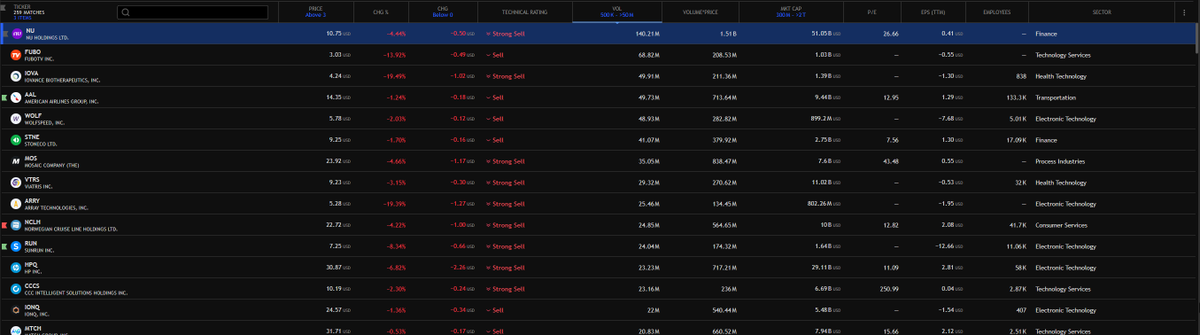
3. Scanning for leading stocks Easiest way to scan for weakness leaders is to use: <a target="_blank" href="http://tradingview.com" color="blue">tradingview.com</a> Click on screener(bottom left) We want to narrow it down to search for liquid stocks that are leading the market lower on volume Here are the parameters I use in my scan: Price: Over $3 Market cap: Over $300m+ Volume: Over 500k Relative volume: Over 1 Change: below 0 And most importantly, the 8,21,50 EMA's above price to find weakness leaders

Now we have a list of the weakest stocks in the market Sort the list by volume highest What I love about this scan is that you only get about 200-300 stocks so you can narrow it down to the leaders pretty quickly
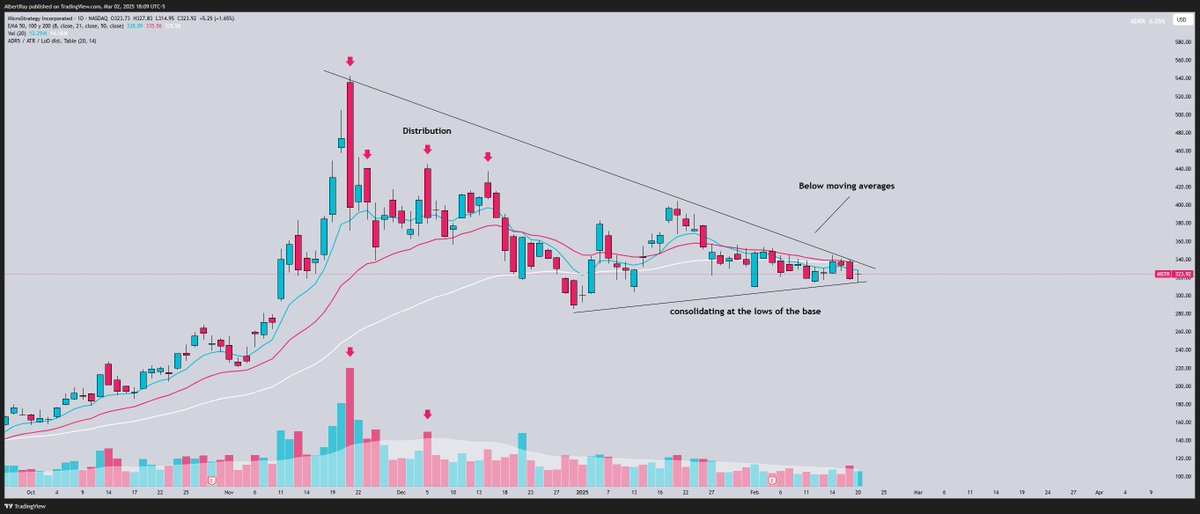
4. Setup You are now looking for a chart that is setting up in a tight base with a tight pattern forming The goal is to find names that are either just breaking down or about to breakdown out of tight bases Use this checklist 1. Tight pattern or base 2. distribution volume patterns 3. consolidating near the lows Below are some examples of setups I look for
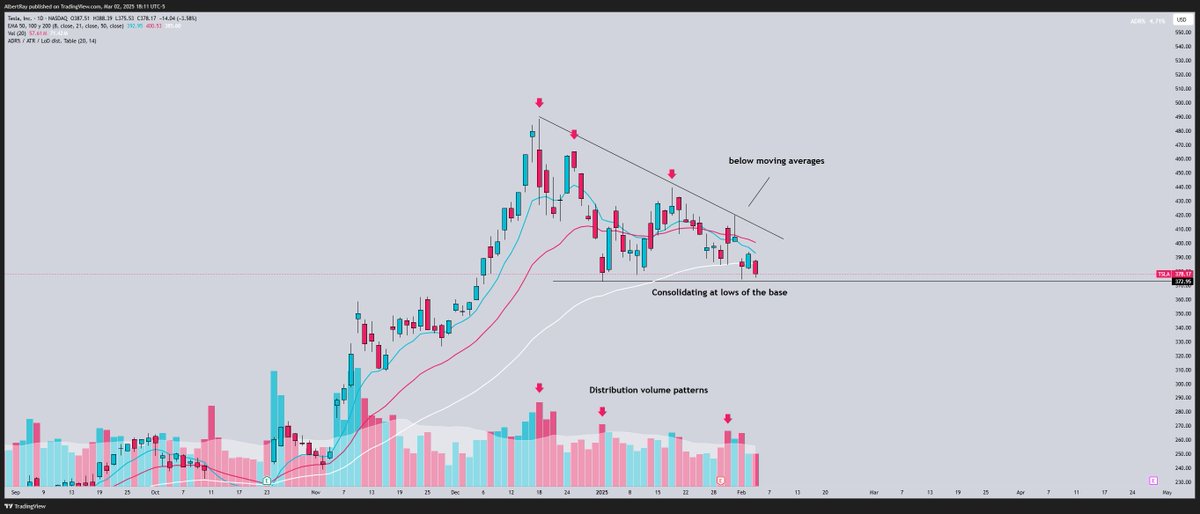
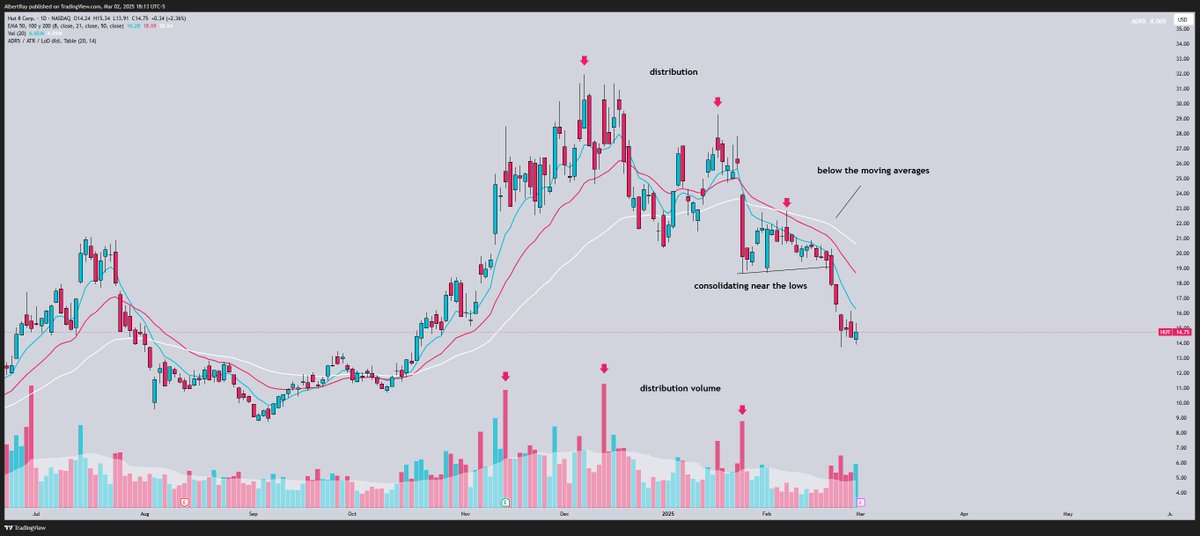
The goal is to scan through all these stocks and look for setups that match our criteria we want to find 4-5 of the best looking setups and create something called a focus list: a focus list is a more in depth watchlist consisting of a few of the best looking charts in the market. by focusing on only a few of the best setups in the markets we can stop ourselves from overtrading and focus on executing our plan.
A name that caught my attention on my scan: $ENPH The stock is breaking down out of a big base Weakness leader in weak sector solar volume decreasing in consolidation and increasing on the breakdown
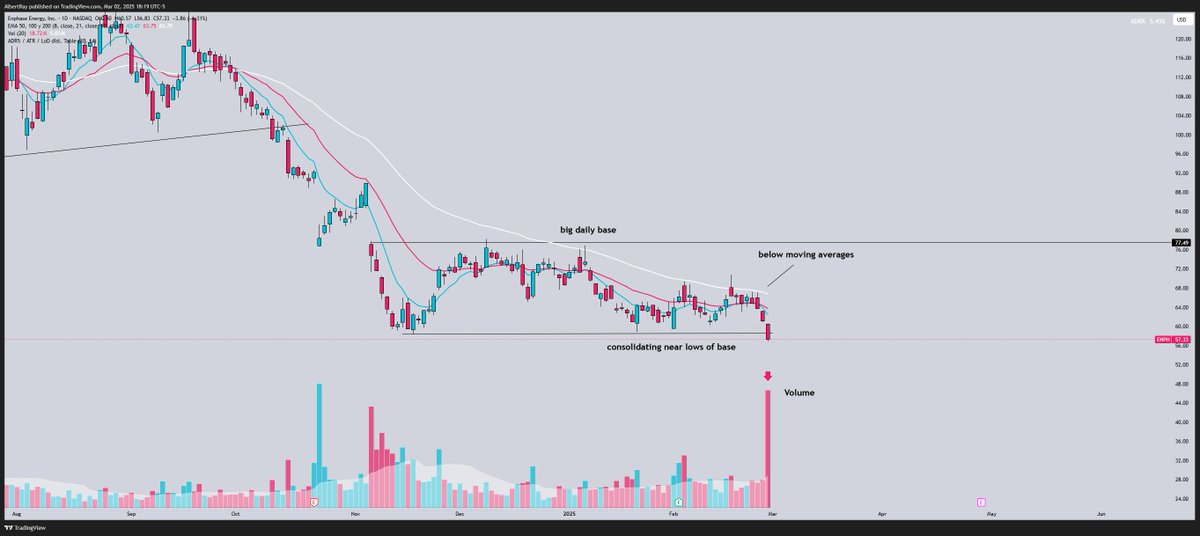
5. Entry The easiest way to enter is to find a trigger level for the breakout What i look for is the high or low of the base to break that will trigger a big move In this example, you can see the $58.5 price level has held multiple times If price breaks under that level, then we can assume a daily breakdown will occur We want to confirm the breakout with lots of volume
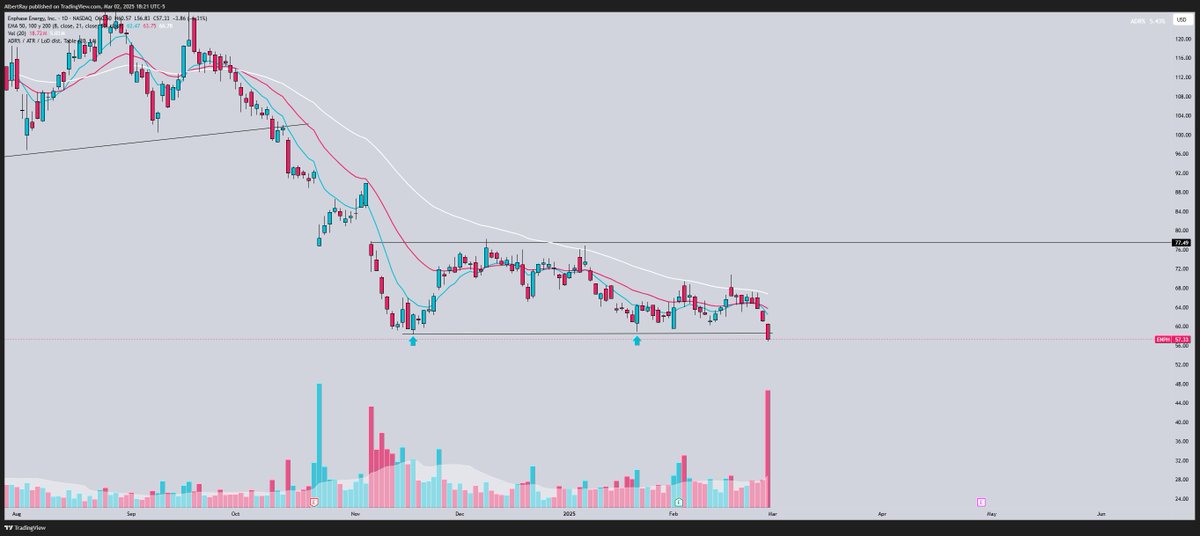
Entry is taken on a break below the trigger For confirmation, we want to see high volume on a break out of the base. For example $MSTR recent base breakdown: -Weak sector -breaking down out of a big base Enter puts at the break below the the trigger level

We can use the 5m time frame to confirm our entry.
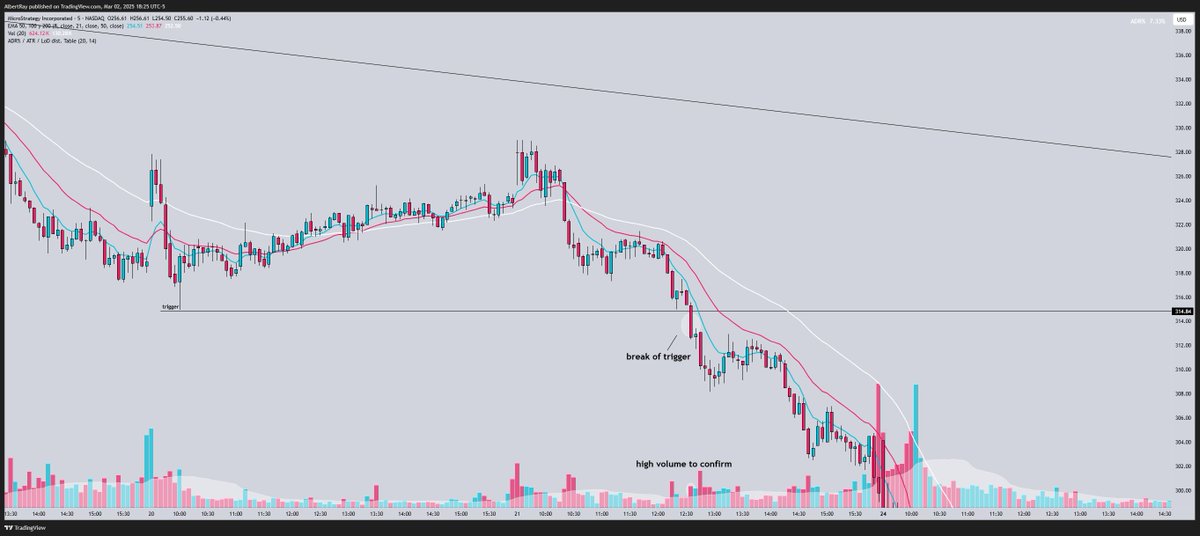
Stop loss is placed at the high of the daily candle that broke trigger to make sure that we manage our risk in case of a failed breakout

7. Targets Take profits at previous support levels My scale out strategy is 25% of the position at a time and moving up stop to break even after first trim. after third trim you leave runners with a trailing stop If markets aren't following through, I trim 50% on the first target.

This sets you up for a huge r/r trade for breakouts/breakdowns we do not want the stock to comeback to our entry level the strongest moves will lockout traders and keep running this is why my scale strategy works so well to hold winners
Like any other strategy this is not a holy grail strategy but there's a reason why some of the best traders in the world swing strong names, and buy leading stocks in leading sectors. I've personally used this strategy to catch huge trades this year: $MSTR +1000% $TSLA +500% $QQQ +500%
I post these setups every night on my twitter with trigger levels, option contracts, and targets. So you can follow along, and learn the strategy. If you enjoyed and learned something from this thread LIKE+RT❤️for more trade plans and educational threads.
I also posted a video on this exact strategy on my tiktok: <a target="_blank" href="https://www.tiktok.com/@sean.rechtman/video/7477376995488271658" color="blue">tiktok.com/@sean.rechtman…</a>