Thread Truncated (Cap Enforced)
Only the first 20 tweets are unrolled into slides to ensure reliable PDF exporting and high server performance.
Canvas & Ratio
Choose your destination platform format
Layout Template
Choose a content structure for your slides
Preset Themes
Typography & Sizing
Brand Kit Customization
AGENCYConfigure brand assets for headers & footers
Outro Slide CTA
Customize your closing call-to-action slide
Background Pattern
Build Your Carousel
Drag and drop any post card below onto a slide, or use the quick buttons to insert content/images instantly!

🚨THREAD: Russia's invasion of Ukraine was *PROVOKED* by NATO expansion and a U.S.-backed 2014 coup, according to three decades of leading U.S. military and foreign policy experts: •Ambassador George Kennan •Ambassador Jack Matlock •Senator Joe Biden •Senator Bill Bradley •Senator Sam Nunn •Senator Gary Hart •Senator Gordon Humphrey •Secretary of State Henry Kissinger •Defense Secretary Robert McNamara •Defense Secretary William Perry •Defense Secretary Robert Gates •CIA Director William Burns •CIA Director Stansfield Turner •Professor Edward Herman •Professor Noam Chomsky •Professor John Mearsheimer •Prime Minister Paul Keating •Prime Minister Malcolm Fraser In this thread, I’ll dive into their warnings, showing how this reckless policy enriched the U.S. military-industrial complex, reignited the Cold War, and pushed the world closer to nuclear catastrophe than ever before. Video: @ComicDaveSmith @joerogan

1⃣ 1997 Open Letter: NATO Expansion a "Policy Error of Historic Proportions" In June 1997, 50 U.S. foreign policy experts—including former Defense Secretary Robert McNamara and ex-CIA Director Stansfield Turner—sent President Clinton an open letter, labeling NATO’s eastward expansion a “policy error of historic proportions.” They predicted it would provoke Russia, fuel nationalism, and undermine nuclear disarmament efforts like START II, urging cooperation over confrontation.


2⃣ Senator Biden Predicts Hostile Russian Reaction (1997) That same month, Senator Joe Biden warned that NATO expansion into the Baltic states would provoke a "vigorous and hostile" reaction from Russia. All three Baltic states—Estonia, Latvia, and Lithuania—became NATO members in 2004.

3⃣ Australian PM Keating: A "Great Mistake" Echoes Historical Errors (1997) In September 1997, Australian Prime Minister Paul Keating called NATO expansion a “great mistake,” comparing it to missteps that sparked both World Wars. He argued that moving NATO to Russia's border signaled that Russia remained a potential enemy, jeopardizing continental stability. "The decision to expand NATO by inviting Poland, Hungary, and the Czech Republic to participate and to hold out the prospect to others—in other words, to move Europe’s military demarcation point to the very borders of the former Soviet Union—is, I believe, an error which may rank in the end with the strategic miscalculations which prevented Germany from taking its full place in the international system at the beginning of this century." "The great question for Europe is no longer how to embed Germany in Europe—that has been achieved—but how to involve Russia in a way which secures the continent during the next century." "And there was a very obvious absence of statecraft here. The Russians, under Mikhail Gorbachev, conceded that East Germany could remain in NATO as part of a united Germany." "But now just half a dozen years later NATO has climbed up to the western border of the Ukraine. This message can be read in only one way: that although Russia has become a democracy, in the consciousness of western Europe it remains the state to be watched, the potential enemy."


4⃣ Ambassador Matlock: A "Profound Strategic Blunder" (1997) In October 1997, Jack Matlock, the last U.S. Ambassador to the Soviet Union, warned the Senate Foreign Relations Committee that NATO expansion was a "profound strategic blunder." He argued that it would trigger the gravest security threat since the Soviet collapse by casting Russia as a foe, risking a self-fulfilling prophecy and hampering disarmament efforts. With three decades of diplomatic experience in Russia and the Soviet Union, Matlock had served in a critical Moscow post where he translated U.S.-Soviet communications during tense Cold War moments like the Cuban Missile Crisis.


5⃣ Arms Manufacturers Push NATO Expansion (1997-1998) Between 1997 and 1998, six major U.S. defense firms—Lockheed Martin, Northrop Grumman, Textron Inc., Raytheon, Boeing, and the former McDonnell Douglas—spent $51 million lobbying for NATO expansion. New members had to upgrade to NATO-compatible systems, promising massive profits. Sen. Daniel Patrick Moynihan (D-NY), an opponent of NATO expansion, remarked, "Like any other American manufacturer, they are looking for markets abroad. Most every other customer they can think of, we have forbidden them to sell anything to." "The companies that win those contracts to provide that inter-operability to the aging Soviet-made systems in Eastern Europe will benefit enormously from NATO's eastward expansion." "The Congressional Budget Office says the cost of a few nations joining NATO may reach $125 billion over 15 years, with the United States paying up to $19 billion. Critics of NATO expansion say weapons spending could create political and economic problems in Central Europe."

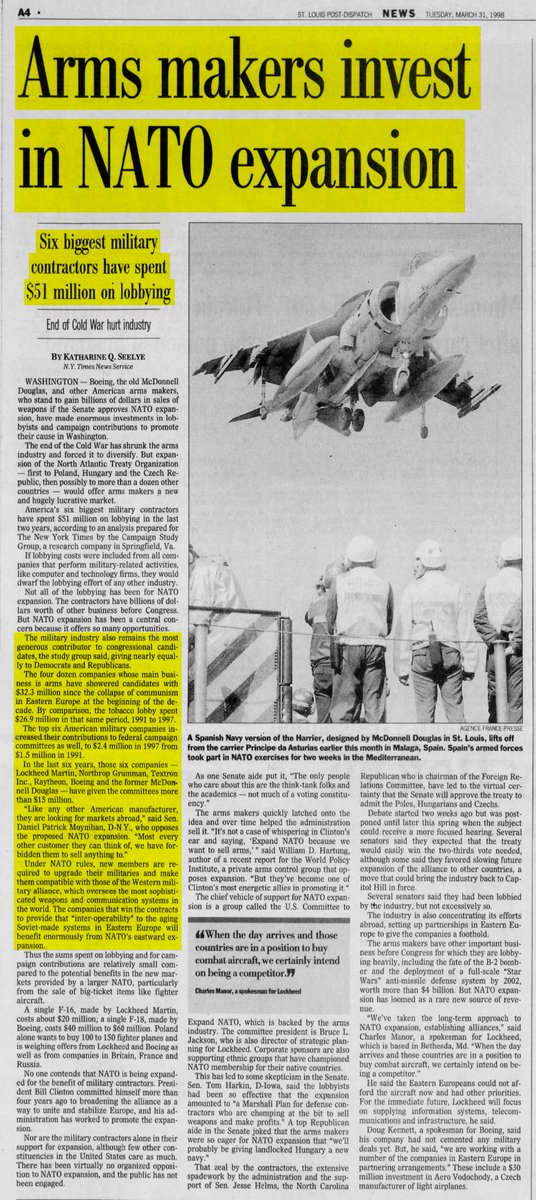


6⃣ Senators Hart and Humphrey: Expansion "Poisons" Relations (1998) In March 1998, Senators Gary Hart and Gordon Humphrey published an article in the Los Angeles Times opposing NATO's expansion, warning that the move would "poison" U.S.-Russia relations and increase the risk of nuclear war. "NATO will move right up to Russia’s border, seriously endangering the once-in-a-century opportunity for the United States to build a constructive relationship with that vast and important country..." "The United States will have responded to the peaceful dissolution of the Soviet empire with an in-your-face deployment of the NATO alliance right on Russia’s doorstep... Further, NATO’s encampment right on Russia’s borders forces Moscow to rely more heavily on its large stockpile of tactical nuclear weapons left over from Soviet days..." "NATO expansion poisons the well in U.S.-Russian relations. To contain Soviet communism, we fought two hot wars and a long cold war at an expense of perhaps $20 trillion. For 45 years, our citizens bore a heavy burden, including the risk of nuclear war. At last, we have an opportunity to build friendly relations with Russia." "NATO expansion puts that priceless opportunity at peril, risking a resumption of a dangerous confrontation between the United States and Russia, two nations that ought to be friends... NATO expansion may prove to be the most damaging mistake in international relations since the humiliation of Germany after World War I, an act of hubris most historians count as the cause of World War II."


7⃣ George Kennan: A "Tragic Mistake" Undoes Progress (1998) In April 1998, George Kennan, the architect of U.S. foreign policy during the Cold War, called NATO expansion a “tragic mistake” and “the most fateful error” of post-Cold War U.S. policy. He predicted it would provoke Russia, inflame nationalism, and derail democracy and disarmament, reigniting Cold War tensions. In a New York Times interview, he warned that NATO enlargement "would make the Founding Fathers of this country turn over in their graves." "Such a decision may be expected to inflame the nationalistic, anti-Western, and militaristic tendencies in Russian opinion; to have an adverse effect on the development of Russian democracy; to restore the atmosphere of the cold war to East-West relations, and to impel Russian foreign policy in directions decidedly not to our liking." "And, last but not least, it might make it much more difficult, if not impossible, to secure the Russian Duma's ratification of the Start II agreement and to achieve further reductions of nuclear weaponry."


8⃣ Senator Nunn: Risks of a "Paranoid Russia" (2001) In 2001, Senator Sam Nunn, then chair of the Armed Services Committee, opposed NATO expansion, warning it would provoke Russia and increase the risk of nuclear war. "We don't want Russia to feel threatened, so they deploy thousands of tactical nuclear weapons as they had before... NATO expansion aggravates the Russians. There's no question about that. It causes them apprehension." "I do not think it's in our security interest to have a paranoid Russia... NATO is a military alliance... When you expand a military alliance to the borders of your former adversary, you set in motion a certain reaction from them that is not necessarily in the security interest of the world."

9⃣ USAID Funds Ukrainian Media (2001) In 2001, USAID-backed Internews trained 1,900 journalists and supported 203 TV and 126 radio stations in Ukraine, reaching tens of millions. This effort aimed to bolster pro-western institutions, setting the stage for EU expansion and NATO enlargement. 203 TV Stations 126 Radio Stations 50M TV Audience 18M Radio Audience 1,900 Trainees

🔟 Internews Fuels "Color Revolutions" (2006) By 2006, Internews boasted of funding media that drove Georgia’s 2003 Rose Revolution and Ukraine’s 2004 Orange Revolution, aligning both nations with the West and amplifying U.S. influence.


1⃣1⃣ Senator Bradley: A "Blunder of Monumental Proportions" (2008) In 2008, Senator Bill Bradley criticized NATO expansion as a “blunder of monumental proportions,” arguing it broke promises to Gorbachev and fueled Russian authoritarianism. He called it a self-fulfilling prophecy that ensured hostility. "Baker told Gorbachev—according to the treaty and their discussions—that there would be no NATO troops in what was East Germany. I spoke with Gorbachev last summer, and he confirmed this directly to me. He said Baker assured him, 'If you agree to Germany’s reunification within NATO, NATO will not expand one inch further east.'" "I spoke with people who ran for President in Russia in 1996 and 2000, and one of them told me about campaigning in 1996. A voter approached him and asked, 'Why are the Americans expanding NATO? Isn’t that a military alliance?' The politician replied, 'Yes, it is.' The voter said, 'Russians might not understand puts and calls, but they certainly understand tanks.'" "We kicked them when they were down. By expanding NATO, we created the very issue that allowed the authoritarianism now resurgent in Russia to claim it was justified. I think it was a blunder of monumental proportions." "It was a self-fulfilling prophecy driven by certain irredentist East European types in the Clinton administration who believed Russia would forever be the enemy. They thought, 'We must protect ourselves for when Russia becomes aggressive again,' thereby ensuring it happened."

1⃣2⃣ Ambassador Burns: Ukraine in NATO Crosses "Redlines" (2008) In 2008, U.S. Ambassador to Russia William Burns (later CIA Director) warned that Ukraine’s potential NATO membership crossed Russia’s “brightest redlines.” In a leaked cable titled “Nyet Means Nyet: Russia’s NATO Enlargement Redlines,” Burns cautioned that Ukraine joining NATO could split the country apart, spark violence or even civil war, and push Russia to step in militarily. In his memoir, Burns elaborated on Russia’s deep concerns about NATO’s expansion, writing: "Ukrainian entry into NATO is the brightest of all red lines for the Russian elite (not just Russian President Vladimir Putin). In more than two-and-a-half years of conversations with key Russian players, from knuckle-draggers in the dark recesses of the Kremlin to Putin's sharpest liberal critics, I have yet to find anyone who views Ukraine in NATO as anything other than a direct challenge to Russian interests."


1⃣3⃣ U.S. Invests $5 Billion in Ukraine’s "Democratic Aspirations" (2013) In December 2013, Assistant Secretary of State Victoria Nuland revealed that the U.S. had invested $5 billion since 1991 to support Ukraine’s democratic and European ambitions, laying the groundwork for later interventions. "Since Ukraine's independence in 1991, the United States has supported Ukrainians as they build democratic skills and institutions as they promote civic participation and good governance, all of which are preconditions for Ukraine to achieve its European aspirations." "We've invested over five billion dollars to assist Ukraine in these and other goals that will ensure a secure and prosperous, and democratic Ukraine."

1⃣4⃣ Nuland and Senators Rally Maidan Protesters (2013-2014) In December 2013, Nuland and Senators John McCain and Chris Murphy rallied Maidan protesters alongside Svoboda leader Oleh Tyahnybok. A leaked February 2014 call showed Nuland plotting Ukraine’s new government, favoring Arseniy Yatsenyuk—who became Prime Minister post-coup. During the call, she described Tyahnybok, who provided the extremists that escalated the violence, as one of the opposition leaders they were working with.

1⃣5⃣ Ukraine’s 2014 Coup and Eastern Secession (2014) In February 2014, Ukraine's democratically elected government was overthrown in a violent coup after President Viktor Yanukovych refused to sign an agreement with the European Union and a loan from the International Monetary Fund (IMF). Crimea (97%), Luhansk (96%), and Donetsk (89%) voted to secede in referendums deemed illegitimate by the West. Shortly after the visit of CIA Director John Brennan to Kyiv in April 2014, Ukraine's new government launched an "anti-terror operation" against those regions. By Russia's invasion in 2022, over 14,000 people had been killed in this proxy war between East and West. Documentary: @ChrisToddNolan

1⃣6⃣ U.S. Allies with Controversial Svoboda Leader (2014) In 2014, Nuland, Biden, McCain, and others collaborated with Svoboda’s Oleh Tyahnybok, whose party—once called the Social-National Party—had neo-Nazi ties. Despite his anti-Semitic past, Svoboda fueled Maidan violence and gained key posts after the coup. Svoboda, originally named the Social-National Party until 2004 (a nod to the Nazi National-Socialist Party), had a controversial history. Tyahnybok was expelled from Viktor Yushchenko’s government in 2004 after a speech urging Ukrainians to resist a “Muscovite-Jewish mafia.” In 2005, he wrote letters calling for action against “organized Jewry’s criminal activities.” In 2013, the U.S. State Department barred him from entering the country due to his ranking on the Simon Wiesenthal Center’s top 10 anti-Semites list. Despite this, Tyahnybok met with Nuland, Biden, McCain, and Kerry in 2014, supplying agitators who fueled the Maidan Square violence. A leaked call revealed Nuland naming him as a key figure in their plans for Ukraine’s new government. After the coup, Arseniy Yatsenyuk gave Svoboda three cabinet posts, a Deputy Prime Minister role, governorships of three provinces, and the Chairman of Parliament position as a reward for their support.


1⃣7⃣ Senator Murphy: U.S. Role in Yanukovych’s Fall (2014) In February 2014, Senator Chris Murphy, who stood next to Senator John McCain in Maidan Square rallying anti-government protestors, admitted that the U.S. had played a significant role in the 2014 ousting of Ukrainian President Yanukovych through sanctions and threats. He argued that continued U.S. support, including the presence of Senate and State Department members in Ukraine, had helped facilitate this regime change. He saw the coup as a chance to cement U.S. influence and economic ties, including benefits for Connecticut, if Ukraine joined the EU and participated in a new U.S.-Europe trade agreement, which would have generated billions in opportunities. "I think it was our role, including sanctions and threats of sanctions, that forced, in part, Yanukovych from office. Now, the question is, what can we do to support this new government?" "With respect to Ukraine, we have not sat on the sidelines. We have been very much involved. Members of the Senate have been there. Members of the State Department have been on the Square. "The Obama administration passed sanctions. The Senate was prepared to pass its own set of sanctions, and as I've said, I really think that the clear position of the United States has, in part, been what has helped lead to this change in regime."

1⃣8⃣ Former Australian PM Fraser: NATO Provoked Crisis (2014) In March 2014, Malcolm Fraser argued that NATO’s expansion and missile systems in Poland and the Czech Republic provoked Russia, triggering the Ukraine crisis. He warned this could push Russia and China closer, threatening Western security. "The move east, despite the negotiations held with Gorbachev, was provocative, unwise and a very clear signal to Russia: we are not willing to make you a co-operative partner in the management of European or world affairs; we will exercise the power available to us and you will have to put up with it." "The message was re-emphasised years later, when President Bush sought to place elements of the anti-ballistic missile system in Poland and the Czech Republic. America said this was aimed at Iran. Russia would not have believed that. The west was acting as though the cold war still persisted." "What happened a while ago in Georgia, and what is happening now in Crimea, grows directly from those early mistakes made by the west. The west has been angling over the years to draw Ukraine into Nato. It has been doing whatever it could to support a pro-European government in the Ukraine, and to oppose or to bring down a pro-Russian government." Fraser warned that the West’s inability to recognize these tensions could drive Russia and China into a closer strategic alliance, posing a threat to the security of the United States, NATO, and their allies.


1⃣9⃣ Defense Secretary Gates: Expansion a "Mistake" (2014) In his 2014 memoir, Robert M. Gates, former Secretary of Defense and CIA Director, called NATO expansion a "mistake" that carelessly disregarded Russia’s core national interests. He argued that U.S.-Russia relations after the Cold War were "badly mismanaged," marked by "unnecessary provocations." Gates criticized efforts to draw Ukraine into NATO as incredibly reckless.

