Canvas & Ratio
Choose your destination platform format
Layout Template
Choose a content structure for your slides
Preset Themes
Typography & Sizing
Brand Kit Customization
AGENCYConfigure brand assets for headers & footers
Outro Slide CTA
Customize your closing call-to-action slide
Background Pattern
Build Your Carousel
Drag and drop any post card below onto a slide, or use the quick buttons to insert content/images instantly!

male-only reproduction just happened. scientists in china created living mice from two fathers. no mother involved 1/
in a new paper published in @CellPressNews, chinese scientists were able to generate bi-paternal mice that developed to adulthood. but there’s a catch: the mice had growth abnormalities, most didn’t survive, and the ones that did lived shorter lives. 2/

@CellPressNews this was achieved by hacking 20 key genes that normally block male-only reproduction. by editing imprinting genes, they bypassed the need for an egg entirely. 3/

@CellPressNews why does this matter? this is the first time fully grown, functional (but infertile) bi-paternal mammals have been produced. it breaks a fundamental rule of biology: the need for a mother. it challenges everything we know about mammalian reproduction. 4/
how did they do it? they systematically deleted imprinting genes responsible for embryonic failure. they used embryonic stem cells from sperm, editing them to erase their ‘paternal’ programming. they combined two sperm-derived cells into a single embryo and implanted them into a surrogate. 5/
@CellPressNews the result? only ~12% of the embryos made it to birth. most died early due to severe growth defects. the survivors had organ abnormalities and shortened lifespans. 6/
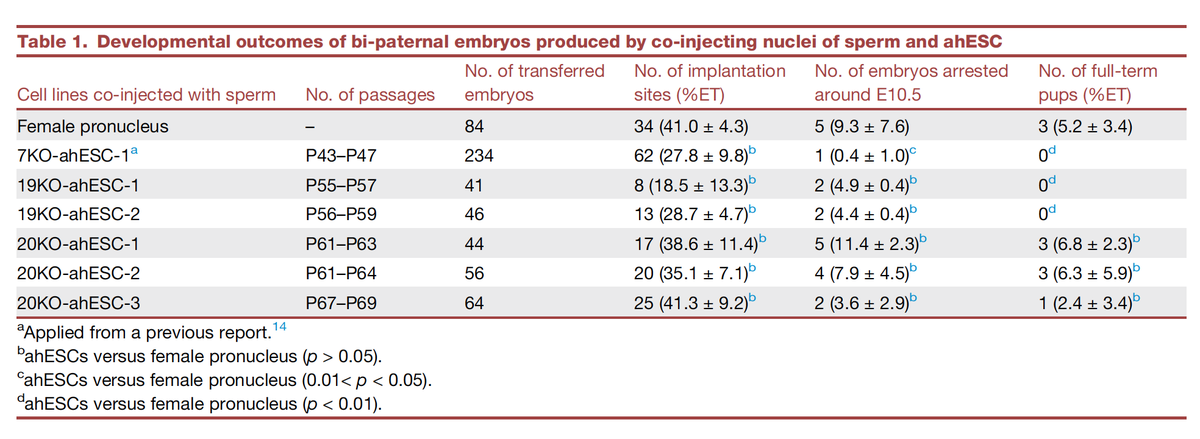
@CellPressNews despite correcting imprinting errors, these mice were far from normal. they still showed growth issues and early death. meaning: there’s more going on in embryonic development than just imprinting. 7/
@CellPressNews does this mean human male-only reproduction is next? not so fast. the barriers in human imprinting are even more complex. the efficiency is still terrible: out of 210 embryos, only ~25 were born, and just 7 made it to adulthood. 8/
@CellPressNews this is either the first step toward artificial reproduction beyond sex, or a genetic dead end. either way, biology is getting hacked. what happens when we start editing humans the same way? 9/9
@CellPressNews link: <a target="_blank" href="https://doi.org/10.1016/j.stem.2025.01.005" color="blue">doi.org/10.1016/j.stem…</a>