Thread Truncated (Cap Enforced)
Only the first 20 tweets are unrolled into slides to ensure reliable PDF exporting and high server performance.
Canvas & Ratio
Choose your destination platform format
Layout Template
Choose a content structure for your slides
Preset Themes
Typography & Sizing
Brand Kit Customization
AGENCYConfigure brand assets for headers & footers
Outro Slide CTA
Customize your closing call-to-action slide
Background Pattern
Build Your Carousel
Drag and drop any post card below onto a slide, or use the quick buttons to insert content/images instantly!

Academia is women’s work now. That spells it’s doom. A 🧵 about status arenas, male flight, why dudes rock, and the death spiral of academia. 1/22

There’s a large gap between male and female enrolment, across all racial groups. The enrolment gap has increased steadily since the 1970s. There;s also a gap in graduation rates – men are much more likely to drop out –which compounds the effect of the enrolment gap. Recently, universities reached the threshold of 60% 2/22


The enrolment gap now extends all the way to the doctoral level: doctoral programs remained majority male much longer than the other degree levels, all the way until 2005, but have also seen the greatest decline, plummeting from 90% in 1970 to 44% as of 2021. Across all programs, at all academic levels,American universities recently reached the threshold of 60% of the student body being female. This will be a disaster for academia. Why? 3/22

Numerous professions have switched from male to female dominant over the last century, e.g.high school teaching, interior design, veterinary medicine, bank tellers. Research indicates that at between 30% and 60% female involvement, an occupation is coded as feminine, and men exit in droves. (Pan, 2010, Gender Segregation in Occupations: The Role of Tipping and Social Interactions) 4/22

Morton Schapiro, an economist and former president of Northwestern University, was interviewed in a recent Freakonomics podcast on the subject of the plummeting male participation in higher ed, and confirmed that this 60% threshold for male flight is being seen in academia, too: “There’s sort of a cliff you can fall off once you become 60-40 female-men. It becomes exponentially more difficult to recruit men.” 5/22

So what is the reason for male flight? Are the boys scared of cooties? Is it misogynistic bigotry against women? Most men probably can’t quite verbalize why female spaces feel uncomfortable, it is simply an instinctive realization that one is in the wrong place. There are good reasons for this. Men in female-coded professions pay a steep romantic penalty, with reduced lifetime odds of getting married as compared to men in male-coded or gender-neutral professions. Women in male-coded professions pay no such price. Men don’t care what women do. At all. <a target="_blank" href="https://onlinelibrary.wiley.com/doi/abs/10.1111/jomf.12657" color="blue">onlinelibrary.wiley.com/doi/abs/10.111…</a> 6/22

Why do women punish men who work in female professions? It’s very simple, really. Social status is a significant component of female attraction. Men gain status by competing with other men. As such, male-coded professions serve as status arenas. Those who enter and succeed within them demonstrate their superiority according to some set of traits – determination, discipline, ambition, intelligence, strength, what have you – which women find valuable and attractive. 7/22

Competition with women does not demonstrate these traits at all, because it is usually too easy. Getting in a fight with a woman is a lose/lose proposition: if you lose the fight, you got beaten up by the girl; if you win the fight, you beat up a girl. No one is impressed by this. Men are exquisitely sensitive to this. If they compete in an environment dominated by women, there is nothing for them to win, and a great deal to lose. 8/22

This is also one of the reasons why ‘women’s work’ is intrinsically low-status, although really it would be better to say ‘zero-status’, since women’s work is orthogonal to the male status hierarchy – not so much below it, as outside of it. A female kindergarten teacher isn’t really higher or lower status than a garbage man or a stock broker, because neither the garbage man nor the stockbroker care that she’s a kindergarten teacher; they mainly care that she’s young, pretty, and not a ho. The kindergarten teacher, however, cares a great deal about which guy gets paid to come home smelling like rotten bananas, and which one brings home a high six-figure income. 9/22


A natural consequence of this is that once an occupation becomes women’s work, it ceases to be capable of providing prestige (and in fact, confers negative prestige on men who enter it), and also drops in income – this is the source of the infamous ‘wage gap’ feminists love to complain about. But this makes sense! If a man gets paid less, this hurts his romantic prospects, whereas it doesn’t hurt a woman’s; so men will push much harder for higher wages than women will. 10/22

Here I interrupt this thread to point out that there’s a much more detailed, and better written, version of this, which if you respect yourself you will prefer. You can find the link on my pinned post. 11/22

So, there’s a 60% tipping point of female involvement at which men abandon an occupation, at which point that occupation gets coded as women’s work, drops in prestige, and resources are restricted. Universities recently reached this level. We should expect that society will then start seeing academia as much less important, and become much less willing to lavish money upon it. One sign of this would be that institutes of higher education should start closing all over the place due to bankruptcy. Oh, hey, look at that! 12/22

About a decade ago Clayton Christensen, a professor at the Harvard Business School, predicted that before this decade is out half of America’s colleges and universities would go tits up. His prediction is right on schedule. Christensen doesn’t blame the presence of too many women, of course; that would be impolite. But the largest enrolment declines have been seen among men; there are good reasons to ascribe this to male flight; and one of the known consequences of male flight is a collapse in prestige, followed by a restriction in the resources society is inclined to provide to a devalued institution. 13/22

A recent Gallup poll revealed that the confidence of Americans in higher ed has plummeted over the last decade or so. This is something I’ve written about before, and there are obviously more reasons for this than just academic work being women’s work ... but again, that decline is confidence, which is really a decrease in prestige, is exactly what you’d expect. 14/22


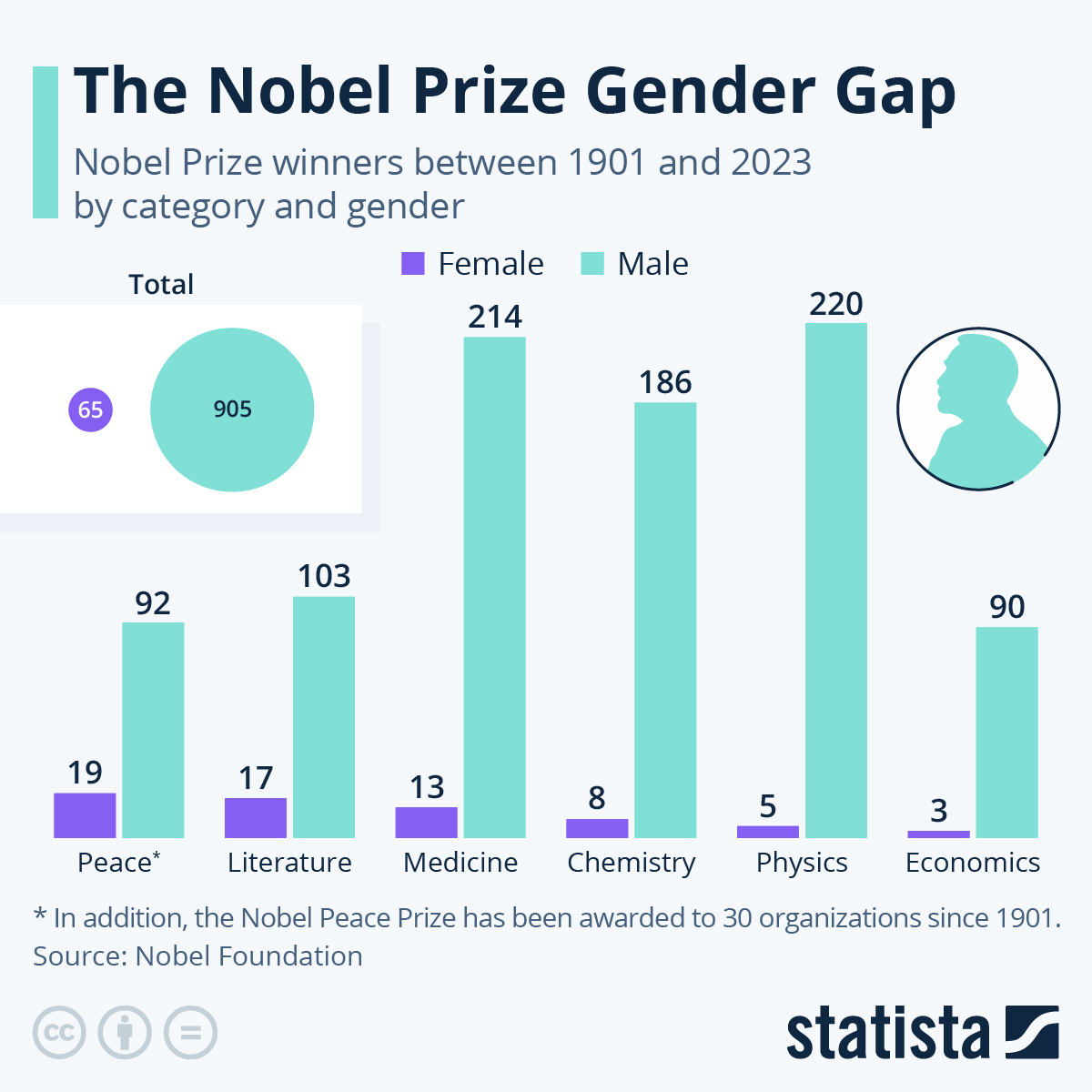
Male flight is likely to make academia a lot less productive, too. The overwhelming majority of Nobel prize winners are men, which feminists blame on muh patriarchy, but is really because the combination of traits that creates a genius are much more likely to be found in men: high outlier IQ (greater male variability hypothesis) + the personality traits of high openness/low agreeableness/low conscientiousness. Geniuses are smart, weird jerks, and most smart, weird jerks are men. And after male flight kicks in, guys like that will have no interest in working in the academy. 15/22
Successful female academics tend to have exactly the opposite personality profile of the cantankerous autistic genius, conforming instead to the ‘head girl’ archetype: just bright enough to do perfectly adequate work, high in agreeableness (they want that pat on head from teacher), high in conscientiousness (they do their homework on time), and low in openness (conformity enforcers). This means they tend to do rather safe, boring, ‘ordinary’ science - tyingup loose ends in dangling theoretical postulates,addingan additional decimal place of precision to a pre-existing result,selecting tastefulcolour schemes for the visualization of scientific data. The scientific equivalent of quilting, needlework, and interior decorating. When they’re not doing that, they can be found clucking away in their nests on diversity and inclusion committees and running around the department with their ears perked up checking for compliance with this season’s lexicon of fashionable words. 16/22

Not only do men tend to do more interesting work than women – they do more of it.This very funny thread from @epkaufm turned this up in, of all places, a Nature paper trying to torture its data into providing empirical support for diversity hiring (their data refuted their own case, but as diversity hires they were too dumb or dishonest, or both, to notice). <a target="_blank" href="https://x.com/epkaufm/status/1846148338321699325" color="blue">x.com/epkaufm/status…</a> 17/22

If female scholars are less productive, produce less interesting research, and tend to be preoccupied with enforcing consensus, we should see signs of that. Sure enough,disruptive science has been declining for generations. There are more reasons for this than just women being around – the bureaucratization of science is probably the biggest factor, as can be seen by the decline starting in the early 50s, long before women entered the academy in large numbers. But the presence of risk-averse, consensus-obsessed women in large numbers isn't helping. 18/22

Meanwhile, science funding – yes, even in the NSF – is being directed towards frivolous DEI-themed non-research. A recent Senate committee went through a bunch of NSF grants and found that over a quarter of them were given to diversity nonsense. This is due to a top-down policy imposition by the “Biden” regime, but the girlbosses are largely thrilled about this – it lets them play mother hen to their surrogate children in the designated victim classes, which is much more emotionally rewarding than determining the electron orbital structure of excited rubidium atoms. 19/22

Is there a way for academia to pull out of this death spiral? There is! Women are not homogeneously distributed in academia. They absolute dominate in education, health sciences, psychology, but STEM, not so much. There are obvious reasons for this – natural disposition, inherent talents. Male flight from the soft disciplines is almost certainly a factor, as well. If universities left well enough alone, let nature take its course, STEM departments could persist as pockets of patriarchy within otherwise female-dominated institutions. Engineering students don’t feel like they’re in competition with the theatre kids or the psych girls. Let STEM stay male and universities could retain viable status arenas in which men would feel comfortable competing with one another (while being otherwise happily embedded in rich romantic hunting grounds). But, while this would require them to merely do nothing, universities will absolutely not do it. 20/22
