Canvas & Ratio
Choose your destination platform format
Layout Template
Choose a content structure for your slides
Preset Themes
Typography & Sizing
Brand Kit Customization
AGENCYConfigure brand assets for headers & footers
Outro Slide CTA
Customize your closing call-to-action slide
Background Pattern
Build Your Carousel
Drag and drop any post card below onto a slide, or use the quick buttons to insert content/images instantly!

@thomas_chaney and I updated our working paper on "Trade and the End of Antiquity" (which recently got some airtime here). A short re-cap: 1/n

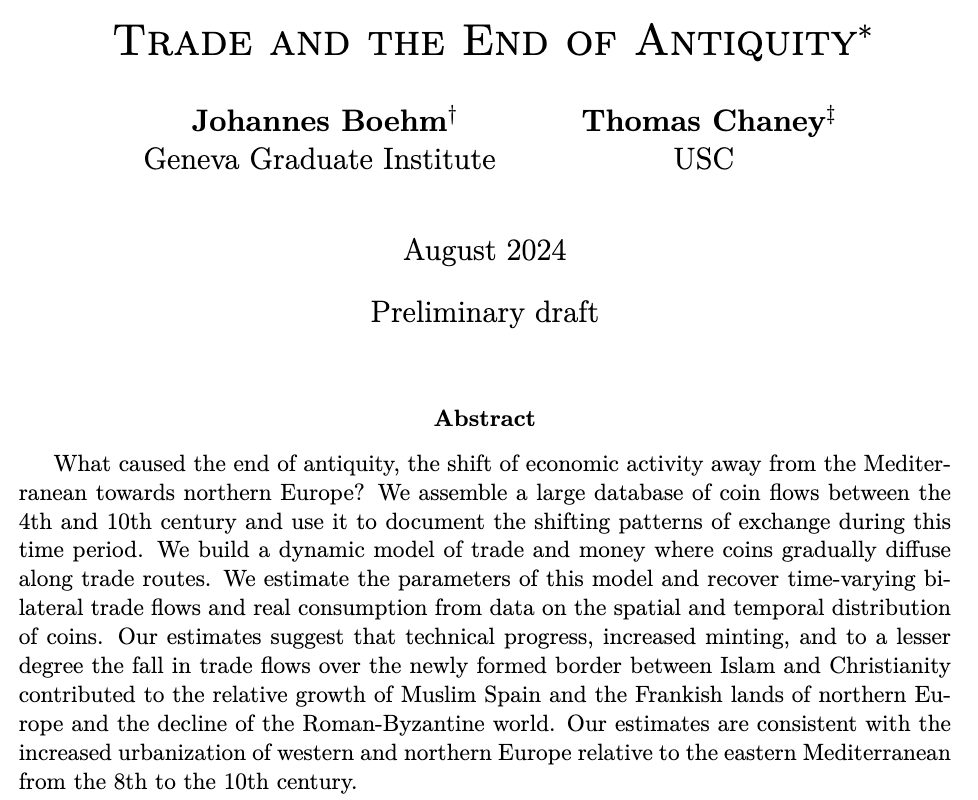
We use archaeological data on the flows of coins to study what happened around the Mediterranean between the 4th and 10th century, a time when economic activity shifted away from the Mediterranean (the "End of Antiquity").
We find that coin flows exhibit very similar properties as modern-day trade flows (gravity); not too surpising given that coins were the main medium of exchange for long-distance trade.

The patterns of coin flows change sharply around the time of the Arab conquests (yep, border effects!) in line with a trade disruption. Pirenne's famous thesis (Arab conquests => End of Antiquity) comes to mind! But could trade have been really that important?

As trade economists know, "trade data" is useful beyond studying trade flows: you can back out eg. relative productivity.
We build on work by the late Jonathan Eaton (& Kortum & Dekle) and propose a model where real per capita consumption can be decomposed into technology, trade openness, and trade deficit. Under some assumptions we can identify each term from the coin data.

Estimating the model, we find large declines in real consumption in the Roman-Byzantine heartlands in the eastern Mediterranean, and increases in the Frankish lands. We see the "End of Antiquity" in our estimates!

The decomposition tells us that Byzantium's decline is due to a decline in openness, but even more so declines in productivity and seigniorage. For most other regions, including the ascent of Francia, it's mostly productivity changes that are driving things.
Finally, we compare our estimated changes with data on relative urbanization based on city sizes (like much else, these measures are very rough... all this is >1000y ago). We were surprised that they lined up quite closely!

Full draft is here: <a target="_blank" href="https://jmboehm.github.io/coins.pdf" color="blue">jmboehm.github.io/coins.pdf</a> n/n
tagging @jp_koning @florianederer @pseudoerasmus cause you tweeted about it (thanks!)