Canvas & Ratio
Choose your destination platform format
Layout Template
Choose a content structure for your slides
Preset Themes
Typography & Sizing
Brand Kit Customization
AGENCYConfigure brand assets for headers & footers
Outro Slide CTA
Customize your closing call-to-action slide
Background Pattern
Build Your Carousel
Drag and drop any post card below onto a slide, or use the quick buttons to insert content/images instantly!

Why does Paris look the way it does? Well, until the year 1853 it was a diseased and overcrowded Medieval city — then the biggest urban renovation in history was announced. This is the story of how Paris was transformed into the world's most popular city...

First: the context. King Louis-Philippe of France was overthrown in 1848 and Louis-Napoleon, nephew of Napoleon Bonaparte, was elected President of the Second Republic that same year. Three years later he staged a coup and became Emperor Napoleon III — France's final monarch.

For centuries — ever since the Dark Ages — Paris had been one of Europe's biggest and most important cities. But by the 19th century, as famously described in the works of Victor Hugo, Paris had become overcrowded and ravaged by disease — the urban poor were suffering.

So Napoleon III formed a grand ambition to totally rebuild the city and turn Paris into a modern metropolis. The first man he appointed as "Prefect of Seine" to carry out his plans wasn't up to the task. And so Napoleon turned to a civil servant called Georges-Eugène Haussmann.

Haussmann was talented, determined, and possessed an uncanny ability for overcoming any obstacle in his way. And, crucially, he shared Napoleon's vision for a new, bright, clean, and beautiful Paris — a city where working people could lead decent lives. As the Emperor said:

So, starting in 1853, Haussman was given free rein by Napoleon to redesign and rebuild Paris. The core of this plan was a system of boulevards radiating out from the Arc de Triomphe, interwoven with smaller streets and squares. Light, space, transport, and a sense of grandeur.
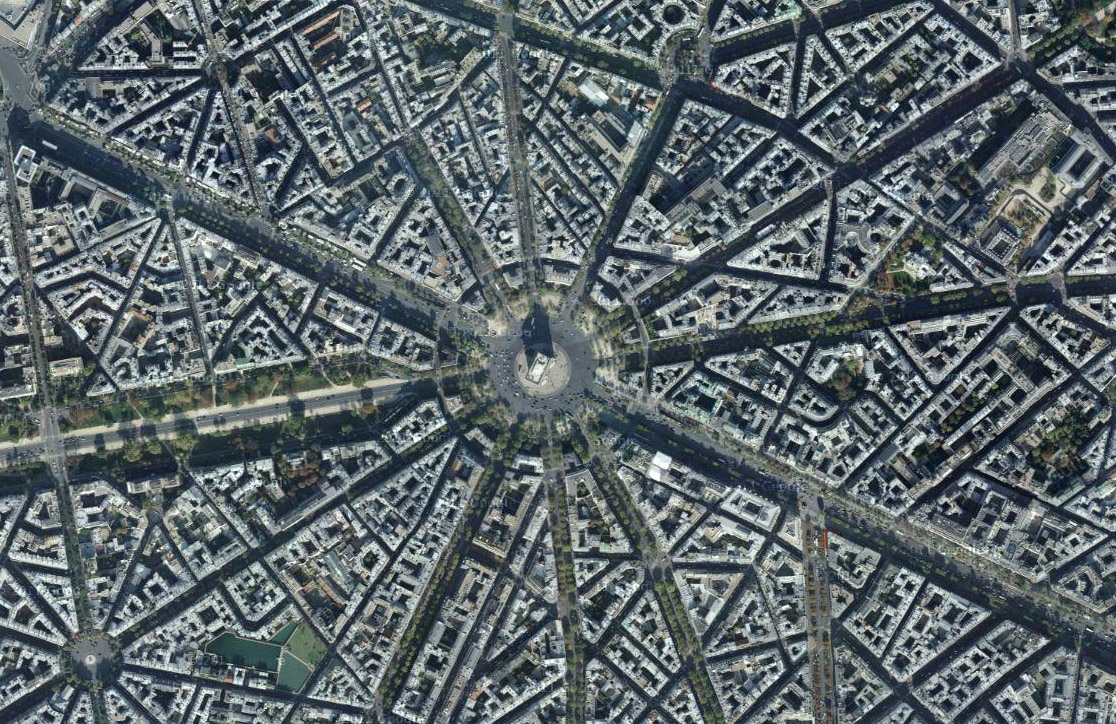
They also annexed suburbs around Paris, increasing the number of arrondissements from 12 to 20 and the city's population from 400,000 to over 1.5 million. This was an act of urban planning on a scale never seen before — only Barcelona's contemporaneous "Eixample" is comparable.

They demolished about 20,000 buildings containing 120,000 lodgings or apartments, and replaced them with 34,000 new buildings containing over 215,000 apartments and lodgings. They also demolished hundreds of streets — this is what a typical Parisian street once looked like...

...to be replaced by spacious boulevards. Whereas the older streets had been as little as 5 metres wide, the new ones were at least 12 metres and 24 in some places. Captured perfectly in Camille Pissarro's four paintings of the Boulevard Montmartre, from the 1890s.

Haussmann also led the construction of new sewers, aqueducts, street lighting, and other public infrastructure. A reminder of his and Napoleon's concern for the working classes of Paris and their living conditions. Paris was being dragged out of the Middle Ages.

As part of this vast construction programme many other large-scale projects were commissioned, including new town halls for the arrondissements. The Paris Opera House, the Gare du Nord, and the Church of St Augustine are just three other examples. A city reborn.

Napoleon, inspired by London, wanted to fill Paris with public parks. So Haussmann created the Bois de Boulogne in the west, the Bois de Vincennes in the east, the Parc des Buttes-Chaumont in the north, and the Parc Montsouris in the south. 600,000 trees planted in 17 years.

But the most distinctive feature of Haussmann's renovation is the so-called "Haussmann Building". He imposed strict regulations about how the newly constructed buildings along Paris' boulevards must look — including their height, width, and external architecture and decoration.
