Thread Truncated (Cap Enforced)
Only the first 20 tweets are unrolled into slides to ensure reliable PDF exporting and high server performance.
Canvas & Ratio
Choose your destination platform format
Layout Template
Choose a content structure for your slides
Preset Themes
Typography & Sizing
Brand Kit Customization
AGENCYConfigure brand assets for headers & footers
Outro Slide CTA
Customize your closing call-to-action slide
Background Pattern
Build Your Carousel
Drag and drop any post card below onto a slide, or use the quick buttons to insert content/images instantly!

🧵 A Mega thread about making manga. I'll be including links to resources and examples as needed below. PLEASE feel free to add your own or ask questions: Let's GO.

1/xx: There is no one thing that defines what manga is or is not, especially in the indie/doujin spaces. Every circle is a little different, so bear in mind none of these are rules, just guidelines! The only stupid question is the one you don't ask (cause you never get an answer)
2/xx: Let's start with Paneling, ie: Komawari. It's a bit different than western comics, but a lot of what I'm about to show can also apply to western comics or manga-inspired comics. It's the essence of panel flow in manga. So how does it work?

3/xx: Most manga is made up of either Sandangumi (2x3) or Yondangumi (2x4). One could argue that yondangumi is a variation of yonkoma, but that's not a debate for today. aha 2x4 grids tend to be associated with older manga, like 2000s and older. 2x3 are more modern usually.
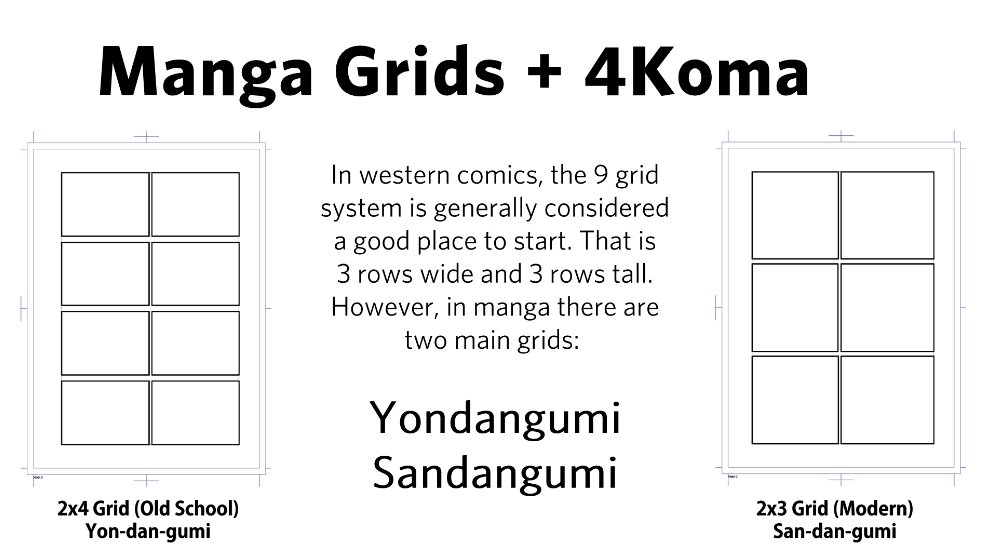
4/xx: 4Koma or yonkoma are typically 1x4, but you can see them with 2 rows of 1x4 on a page. These are read with the first column top to bottom and then the second column top to bottom. Make sure to know which you are looking at!
5/xx: There are "basic" panel layouts like you would see in western comics, and all layouts stem from these original 6, just with more panels on them. But what about... panel limits? How do you know how many to use for any given situation?

6/xx: This brings us to a concept called "Rough" and "Dense" pages (and sizes of panels.) Rough = Fewer, larger panels. Larger panels generally take more time for the eye to scan, then slow down time and are great for impactful moments!
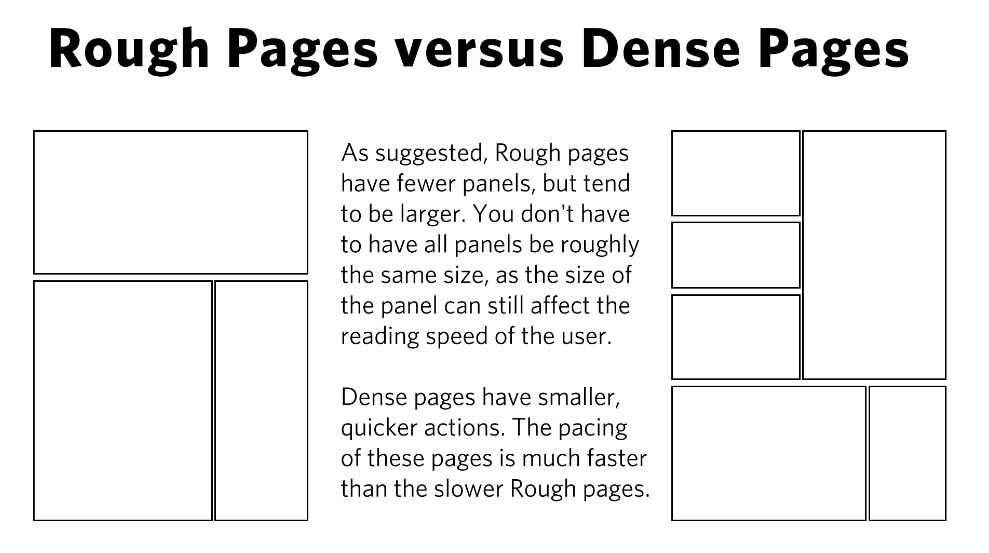
7/xx: Dense pages have more panels, but you CAN have too many. Generally, whatever grid you use you should consider your "upper limit". 2x4 = 8panel limit and 2x3 = 6panel limit. You can do, honestly, whatever you like, but if your panels get too small, they may be unreadable.

8/xx: There are lots of common panel types that you'll run into. A lot of these have western equivalents. These are the basics, so let's look into them!

9/xx: Nanamegoma are are equal to oblique or diagonal panels in the west. These are great for channeling action, funneling energy, or creating a power imbalance in characters in a visual sense. These have non-90' angles and are marked in green below.

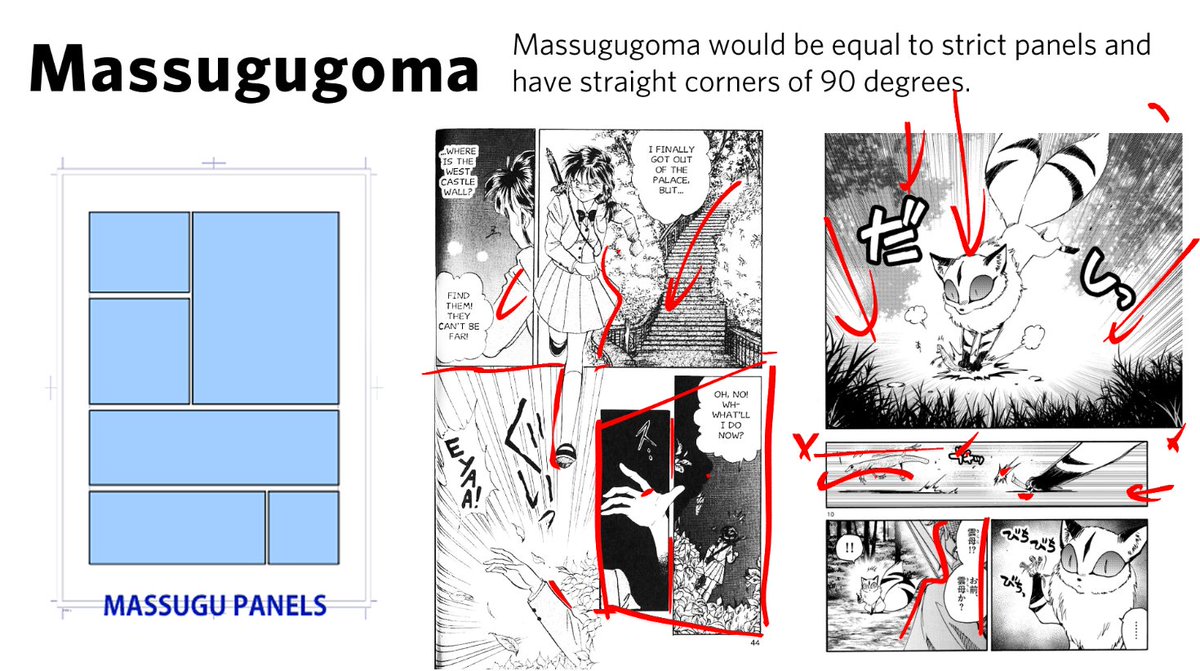
10/xx: Massugugoma are the opposite and are alike to static or strict panels. These don't have to be boring, but can be livened up with dynamic action inside (YashaHime) or creative staggering and breakout panels (where art is outside the panel) like this Fushigi Yuugi page.
11/xx: Additionally, The page turn set up is vital. I STRONGLY suggest you plan your pages in 2-pg spreads, it helps you plan hikigoma and mekurigoma better. Hikigoma refers to the last panel of a two page spread and mekurigoma refers to the first panel of the new 2pg spread Ex>>
12/xx: In this spread from JJK, you can see the action is stopped, metaphorically (reading direction RtL) and literally (enemies) in the mekurigoma. Using the movement, the reading flow/action of the scene is redirected and leads perfectly into a new spread through the hikigoma.

13/xx: Reading direction is incredibly important as you need to understand the psychological pull it has on the reader. In the west, usually: LtR - progress. Characters face TO THE RIGHT to insinuate progress, plot moving on, and good. Bad guys move literally in opposition, RtL.
14/xx: You see this in film and animation all the time, though you can break this rule if given a good enough reason. The 180 rule can ALSO be broken at will if for a good enough reason. These are "Visual Narrative" concepts, which I wrote more about here: <a target="_blank" href="https://globalcomix.com/news/details/210/creator-tips-and-tricks-visual-narrative-principles" color="blue">globalcomix.com/news/details/2…</a>
15/xx: Moving on, here's an example of Naname/Massugu/Page turn working together. 1: Menos beats up Aros. He's facing left to right, as he stopped Aros's mission. My Hikigoma is Ren drawing her bow to alert the reader someone is there! She fires and Menos stops, alarmed.

16/xx: 2: Ren also faces left to right, she's a bad guy, and stops time for a moment as she talks to Menos, almost mocking him. 3. Menos has that 4th panel all to himself, but Ren invades his space w/ the breakout panel and grows closer to the reader in each panel on this page.

17/xx: This is to say you should plan your layouts with the reader's reaction in mind. A good comic or manga manipulates the reader and they don't even know it, which I spoke about a lot in this thread earlier this month: <a target="_blank" href="https://x.com/artcrumbss/status/1745966258372440501?s=20" color="blue">x.com/artcrumbss/sta…</a>
18/xx: Moving on, the concept of "Ma" is listening quietly to a conversation, not preparing your answer as you listen. After they finish, then you consider your response, and reply. In western culture, we are quick to respond without this "ma", but it's everywhere in manga!

19/xx: My favorite fight in manga is Jin and Yusuke in the Dark tournament in YuYu Hakusho. I've broken down the page here for your enjoyment, but you can see how nanamegoma, ma, massugugoma, and a new panel type called Misegoma work together to build tension.
