Thread Truncated (Cap Enforced)
Only the first 20 tweets are unrolled into slides to ensure reliable PDF exporting and high server performance.
Canvas & Ratio
Choose your destination platform format
Layout Template
Choose a content structure for your slides
Preset Themes
Typography & Sizing
Brand Kit Customization
AGENCYConfigure brand assets for headers & footers
Outro Slide CTA
Customize your closing call-to-action slide
Background Pattern
Build Your Carousel
Drag and drop any post card below onto a slide, or use the quick buttons to insert content/images instantly!

Why do the Somali have such thin bodies and large foreheads? This physical type is often explained as an adaptation to desert heat, but occurs in no other desert population outside Africa. The real culprit is milk anemia, a disease common in pastoralists and, once, in Europeans.

There are other African peoples, all pastoralists, that share many aspects of the Somali “look”. The type goes by many names: Hamitic, Cushitic, Ethiopid. Because they are often tall, the Belgian anthropologist Jean Hiernaux categorized them as “Elongated African".
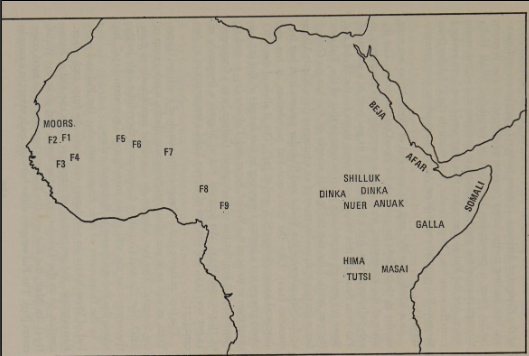
The “F”s on Hiernaux’s map stand for Fulani, another pastoralist people. The Fulani have a striking physical resemblance to East African herders; many I think, could pass as Somali. There is though no close genetic link between them, something Hiernaux guessed 60 years ago.

Early European explorers were so impressed with the Fulani (and charmed by the good looks of their women) that they assumed they were either mostly Caucasian or related to East Africans. Neither is true: Fulani are 3/4th West African. The "Somali" type has evolved more than once.

Maybe more than twice. In the hottest Saharan depths live the Tuareg, another pastoralist people. They are mostly North African by descent, but all the same Carleton Coon thought the closest physical comparison to be found was with the Somali. This keeps happening: Somalification


Some old anthropologists classified the Fulani and Somali as part of the same race, called “Ethiopoid”, as here on the great Human Phenotypes site. What made this mistake understandable was that the Fulani and Somali share not only a build but a coloring: a kind of chocolate red.

When the Turkana first encountered the Maasai, Rendille, and Borana they called them "red people". JR Wilson-Haffenden's book on the Fulani is subtitled "Red Men of Nigeria". The skin color of the Somali has been called bronze, copper, caramel.

The few anthropologists who have studied the issue have all come to the same conclusion: the lean physical type of the “Red Africans” is an adaptation to desert heat. Jean Hiernaux theorized that there are two types of Black African: those adapted to wet and dry environments.


The biophysicist Paul Baker theorized that desert heat imposes a higher degree of stress on the body that typical African wet heat does. World War II-era studies of heat stroke deaths seem to show that lean men are less likely to perish in these environments.


The difficulty with this explanation is that there are other desert peoples outside Africa and none look Somali. The Sonoran Desert is 15+ degrees warmer than Mogadishu in the summer and yet its indigenous peoples, like the Cochimi, do not have bulging foreheads or petite bodies.

What really separates our Red Africans from other desert peoples is their dependance on domestic animals. African pastoralists subsist on a diet very rich in milk, so much so that the Tuareg, Fulani, Tutsi, and Beja have rates of lactose tolerance only exceeded by west Europeans.

In their writings on “Elongated Africans" Hiernaux and Baker didn’t even attempt to explain why desert environments would produce large foreheads in, say, Somalis. But I know of a condition induced by milk consumption which can swell the size of the forehead: the Bahima disease.

In 1962 British doctors in Uganda made note of a number of young patients who had arrived in recent months with swollen foreheads and iron deficiency. The children were all part of the same minority group: the Bahima, close relatives of the Tutsi.


The large foreheads were produced through overproduction of red blood cells in the marrow of the skull. Ruling out malaria or sickle cell disease, the researchers concluded that this iron deficiency came about through excessive drinking of cow’s milk early in life.


Cow's milk can produce anemia not only because it is low in iron, but because its calcium actively interferes with iron metabolism. The addition of milk or cheese to common meals is enough to reduce iron absorption by 50-60%.

Milk anemia was so common among the Bahima that their healers had a standard practice to treat it: they branded circular scars on the head. It may have been common elsewhere: I have seen images of Fulani and Rendille that have the same tower shaped skulls described in the paper.


The authors of the Bahima paper speculated that perhaps this early anemia is related to the ethnic qualities of Tutsi skulls, as though they all suffer from a mild form of the disease. I think though that, being common, natural selection has come to expect it, to fix it in place.

Moreover, the persistence of anemia throughout the lifespan would help to explain the gaunt, “Somali” physique as a body type designed, not to survive desert heat, but to function on a bare minimum of iron.

Some researchers write about milk anemia as though it were a disease only suffered by children, because they reason that only at a young age can cow’s milk be so important in the diet. But among the Tutsi milk could represent >50% of dietary calories even in adulthood.


But even that is not much compared to what you see in Somalia. There were once nomads in that country who would subsist_entirely_ upon camel’s milk, 5 liters worth a day, something I didn’t think was possible.
