Canvas & Ratio
Choose your destination platform format
Layout Template
Choose a content structure for your slides
Preset Themes
Typography & Sizing
Brand Kit Customization
AGENCYConfigure brand assets for headers & footers
Outro Slide CTA
Customize your closing call-to-action slide
Background Pattern
Build Your Carousel
Drag and drop any post card below onto a slide, or use the quick buttons to insert content/images instantly!
This is a wonkish thread about information, prices and decentralization. It touches on topics often discussed in economics, but with a revisionist take that might have relevance beyond economics, in particular about AI and control of information.
The most celebrated work of Friedrich Hayek in economics is not his polemical (and influential) book Road to Serfdom, <a target="_blank" href="https://www.amazon.com/Road-Serfdom-Documents-Definitive-Collected/dp/0226320553/but" color="blue">amazon.com/Road-Serfdom-D…</a> a short article on the use of knowledge (information) in society: <a target="_blank" href="https://siliconflatirons.org/documents/initiatives/IRLEdaytwo/Hayek_Knowledge_in_Society.pdf" color="blue">siliconflatirons.org/documents/init…</a>
Hayek’s argument offers an original and ingenious “computational” critique of central planning. His basic premise is that there is a huge amount of dispersed knowledge in society about a very large number of goods and services (e.g., people’s preferences).
Hayek argues that the market system efficiently aggregates information via the price system. Prices will adjust when there is excess supply or demand for some goods, and when this process stops, the relevant economic aspects of this dispersed information is taken into account.
He then posits that central planning wouldn’t work because it would be impossible to collect and compute the right allocation of resources. Central planning is doomed because it fails to leverage this dispersed knowledge in society.
This argument has always struck me as somewhat unsatisfactory. Where is the control of information? The bigger problem with central planning is that if the planner could collect all of that information, she could do lots of bad things with it.
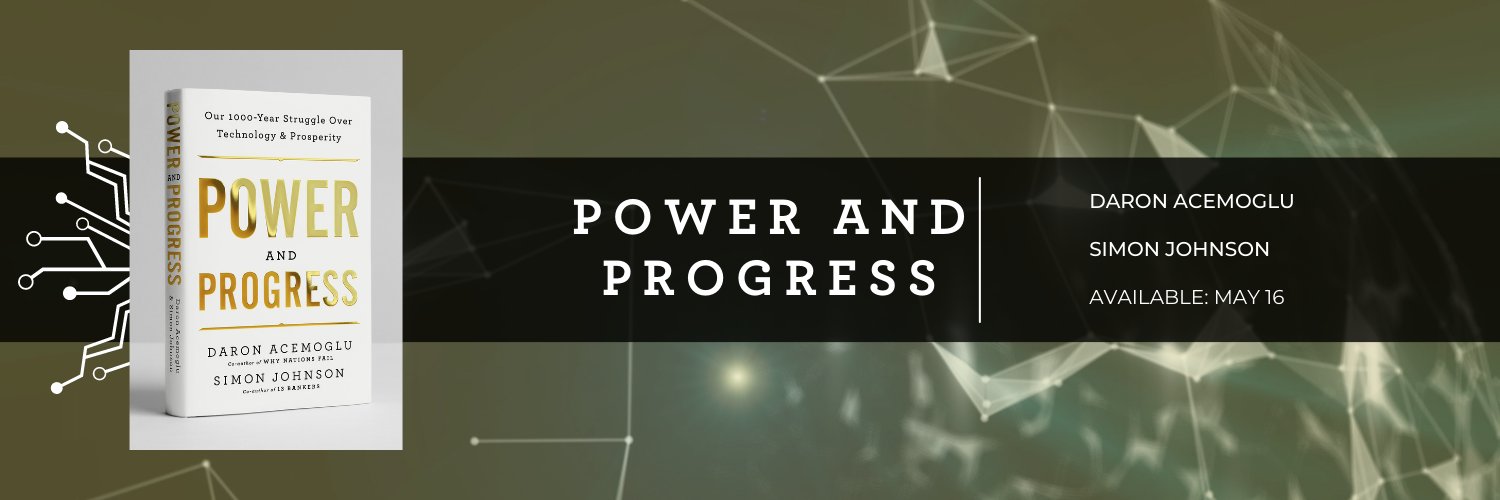
Some may recognize this concern as closely related to the argument in my book with @baselinescene: <a target="_blank" href="https://www.amazon.com/Power-Progress-Thousand-Year-Technology-Prosperity/dp/1541702530/Control" color="blue">amazon.com/Power-Progress…</a> of technology and control of information are vital.
Coming back to Hayek’s argument, there was another aspect of it that has always bothered me. What if computational power of central planners improved tremendously? Would Hayek then be happy with central planning?
Impossible to know the answer to this, but some believe that advances in AI are taking us towards this type of supercharged computational power. In my mind, this does not make central planning anymore attractive (whether it is in the hands of the Communist Party or Google).
But lately, I have also come to realize that there was another implicit step in Hayek’s argument that is equally problematic, and becomes even more troublesome in the age of AI.
Hayek equates the price or the market system with decentralized use of dispersed information. Is he justified? I don’t think so and this again most apparent in our current tech environment.
Digital technologies and AI, at least in the way that they have developed, have created a tendency for power and information to be concentrated in the hands of a handful of companies, such as Google, Facebook and Microsoft.
We can no longer presume that (unfettered) markets and decentralization are “stablemates”. (And some may say that we should have never presumed this, but that’s another debate on which I don’t need to take a position here).
So is decentralization doomed? I don’t think so. Regulated markets and democratic control of technology could restore decentralization, and in fact they may be the only way of restoring decentralization in the age of AI.
Take the example of what is taking place in Taiwan, under the leadership of their current digital minister Audrey Tang, @audreyt, including new platforms to share government data and tools of direct democracy. E.g.: <a target="_blank" href="https://www.wired.co.uk/article/global-neighbourhoods-digital-democracy" color="blue">wired.co.uk/article/global…</a>
This provides one illustration of how the right type of government encouragement can foster greater decentralization of technology and decision-making. Perhaps this will be a better guide for decentralization in the age of AI than the unfettered market process.