Thread Truncated (Cap Enforced)
Only the first 20 tweets are unrolled into slides to ensure reliable PDF exporting and high server performance.
Canvas & Ratio
Choose your destination platform format
Layout Template
Choose a content structure for your slides
Preset Themes
Typography & Sizing
Brand Kit Customization
AGENCYConfigure brand assets for headers & footers
Outro Slide CTA
Customize your closing call-to-action slide
Background Pattern
Build Your Carousel
Drag and drop any post card below onto a slide, or use the quick buttons to insert content/images instantly!

At 40, Jim Simons left a famed math career to launch the most successful hedge fund ever: Renaissance Tech. Even though it only won 51% of trades, the fund made 66%/yr for 30yrs (Simons worth = $25B). It's a story of genius, but also of how hard it is to beat markets. THREAD🧵

1/ The crown jewel of RenTech is The Medallion Fund (launched in 1988). ◻️ From 1988-2018, it posted a return of 66%/yr (39% after fees) ◻️$1 invested in 1988 is now worth $14m+ ◻️ Cumulative profit = $100B+ even with an avg. fund size of only $4.5B

2/ Before creating what Bloomberg calls the “greatest money-making machine ever”, Simons was a legendary mathematician.

3/ While at Stony Brook, Simons started trading commodities (with money staked by former MIT classmates). The side investing was good enough that Simons -- also going through a divorce -- decided to leave academia and launch his own money management firm in 1978: Monemetrics.
4/ At the time, there were 2 main investment approaches: ◻️ Fundamental (understanding and forecasting an asset based on key drivers) ◻️ Technical analysis (studying price charts) Simons’ strategy was to place a “fundamental lens” on currencies (eg. supply and demand).
5/ While Monemetrics found moderate success, Simons called the emotional swings of day-trading “gut-wrenching”. He wanted something more systematic and set out to create a 3rd approach: using complex math models to find signals that predicted price movements.
6/ Simons, a former codebreaker, said: "There are patterns in the market, I know we can find them." The job wasn’t for MBAs. It was for PHDs and scientists. His first hires were former colleagues from Stony Brook and NSA. In 1982, he renamed the firm Renaissance Technologies.
7/ It took years, but they created a 3-step process to find "statistically significant moneymaking strategies" (AKA signals): 1⃣ Find an anomalous pattern in historic pricing data 2⃣Be statistically significance, non-random and consistent over time 3⃣Be somewhat explainable
8/ These signals were called "tradeable effects". While many are now common in quant funds, RenTech did them first and better:

9/ In 1988, the single trading model -- it would remain *one* model -- officially became The Medallion Fund (named after one of Simon's math awards). The 1st fund was $20m. Early returns were OK... 1988: +16% 1989: +1% ...but then: 1990: +78% 1991: +54% 1992: +47%
10/ By 1993, Simons stopped accepting outside money to The Medallion Fund. He also jacked up the fees for investors, including employees. Basically everyone agreed to the new terms:

11/ At the same time, Simons made personnel moves that would define RenTech for decades. He hired a number of scientists and PHDs from IBM’s Thomas Watson Research Centre. Its speech recognition unit yielded RenTech's future Co-CEOs: linguists Rob Mercer and Peter Brown.
12/ As an IBM colleague observed “speech recognition and translation are the intersection of math and computer science.” Mercer and Brown actually pitched IBM to apply computational stats to manage its $28B pension. IBM said "no" and they (along with others) joined Simons.
13/ The IBM move opened up the world of tradable assets. To that point, Medallion had notched near all gains on currency/commodity futures. After bringing in algorithm and coding skills from IBM, it added 1000s of equities to its model, allowing the fund to scale up in size.
14/ The fund never got too big, though. The short-term nature of its strategies limits how much money can be deployed. Today, the fund is capped at ~$10B with annual profit distributions to partners (now restricted to its 300+ employees...1/3rd are PHDs).
15/ The capped fund size and the fact that the money barely compounds makes the total cash generated — $100B+ profits — all the more remarkable. Net of its massive 5/44 fees, the 1988-2018 annualized return for Medallion is a crazy 39% (vs. crazier gross return of 66%).

16/ Interestingly, the Fund only won 50.75% of its trades. An army of top PHDs are basically a coin flip. Markets are hard AF (most should buy and hold). Per Mercer: “We’re right 50.75% of the time . . . but we’re 100% right 50.75% of the time. You can make billions that way.”
17/ How was The Medallion Fund able to pull it off? Let's break down 9 reasons: ◻️ Simons the manager ◻️ Culture for top talent ◻️ Never override the computer ◻️ Data edge ◻️ Great execution ◻️ “Don’t ask why” ◻️ Stealth trading ◻️ Extreme diversification ◻️ Leverage
18/ SIMONS THE MANAGER From his Stony Brook U. days, Simons has long experience managing intellectual egos. His academic credentials and trading chops earn universal respect. Per Bloomberg: Simons is the “benevolent father figure” that inspired “super nerds to stick together.”
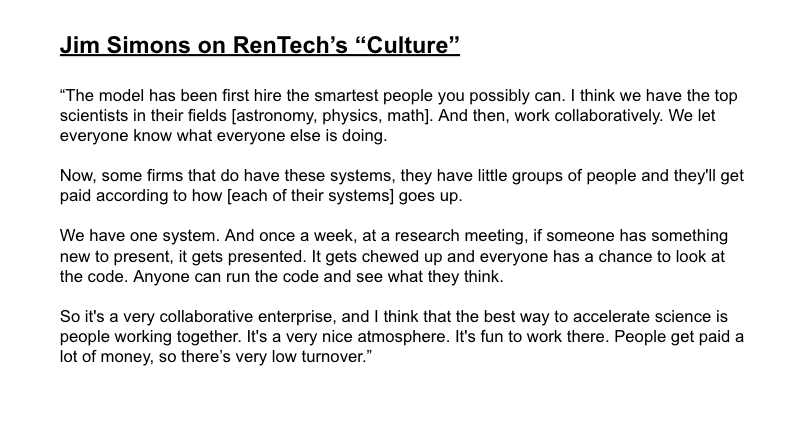
19/ CULTURE FOR TOP TALENT A big part of Simons' job was creating a place for top scientists to want to work: