This volume cheat sheet is from my @sportsmithhq course on "true" plyometrics
There's 4⃣ primary factors to establish plyo training volume:
- exercise intensity & training phase
- surface
- exercise variety
- athlete level
Here's how they influence plyo training volume
👇👇👇


Exercise intensity plays a key role in determining volume.
Plyos will range from low to high intensity, and as intensity increases, volume should generally decrease to maintain quality over quantity.
Training phase largely determines the intensity of exercises utilised
Plyos will range from low to high intensity, and as intensity increases, volume should generally decrease to maintain quality over quantity.
Training phase largely determines the intensity of exercises utilised

Surface is a powerful modulator of intensity
Stiffer surface 🟰 higher impact intensity & this may require volume reduction. Softer surfaces increase CT & dampen reflex SSC contributions
Soft surfaces increase muscular contribution to plyos & allow for tolerable higher volumes
Stiffer surface 🟰 higher impact intensity & this may require volume reduction. Softer surfaces increase CT & dampen reflex SSC contributions
Soft surfaces increase muscular contribution to plyos & allow for tolerable higher volumes

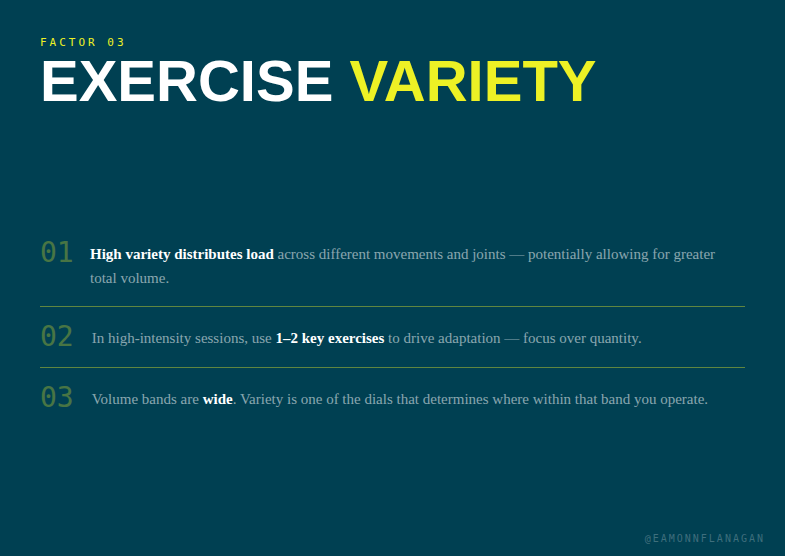
High exercise variety distributes load across different movements and joints, potentially allowing for greater volume.
But in sessions focused on high-intensity outputs, it may be effective to use one or two key low-volume exercises to drive adaptation.
But in sessions focused on high-intensity outputs, it may be effective to use one or two key low-volume exercises to drive adaptation.
The athlete's level includes training history, strength & fiber type.
It is critical in finding appropriate volumes.
Well-trained athletes may tolerate higher volumes, but explosive athletes generate high outputs per action, necessitating lower volume to manage fatigue & risk
It is critical in finding appropriate volumes.
Well-trained athletes may tolerate higher volumes, but explosive athletes generate high outputs per action, necessitating lower volume to manage fatigue & risk

An athlete's injury history can also be considered here.
We should be very cautious with the implementation of high intensity plyometrics with athletes with contraindicating injury histories and volume reduction can be one way to mitigate risk.
We should be very cautious with the implementation of high intensity plyometrics with athletes with contraindicating injury histories and volume reduction can be one way to mitigate risk.
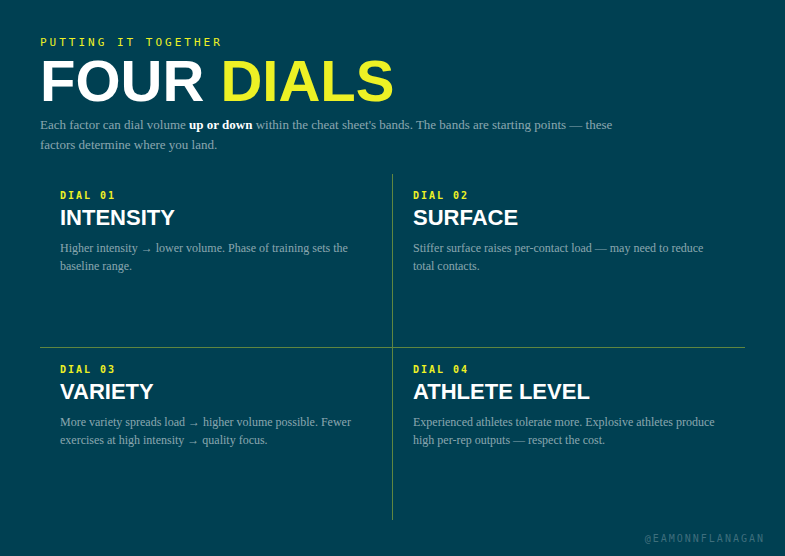
These influencing factors are like dials on a stereo.
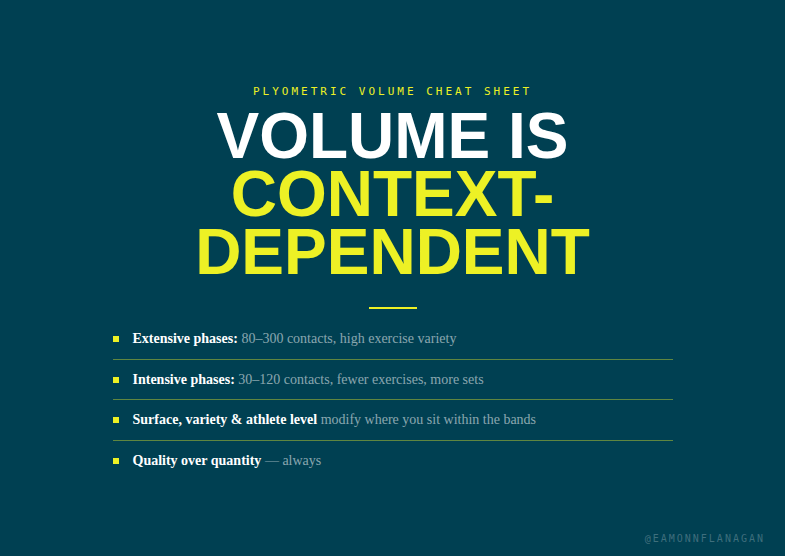
For each we can dial up, or down, our prescribed volume. These volume guidelines are wide bands, and these influencing factors determine whether we should operate at the higher or lower end of these thresholds.
🦘
For each we can dial up, or down, our prescribed volume. These volume guidelines are wide bands, and these influencing factors determine whether we should operate at the higher or lower end of these thresholds.
🦘
Generated by Thread Navigator
Press ⌘ + S to quick-export