Sukuna & Musashi: The Two Paths of Walking Alone
Thoughts on how Sukuna shares the share character archetype (and backstory fragments) as Miyamoto Musashi and how that influences the story🧵


Preface
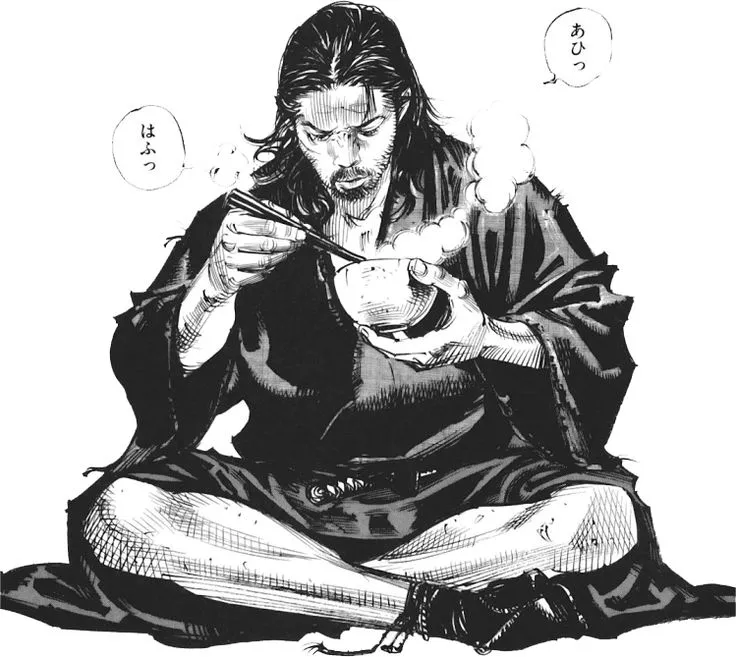
To begin, I do think a lot of their shared attributes are plausibly unintentional but still worth mentioning as a thematic mirror. A vast reason is that since Musashi is a massive household name in Japan and remains influential in the country today, it wouldn't be that unlikely that Gege would at least nod to him symbolically.
Having said that, there's just a lot of parallels I noticed, namely, their pasts, and I do think it's worth going over at least a brief overview.
To begin, I do think a lot of their shared attributes are plausibly unintentional but still worth mentioning as a thematic mirror. A vast reason is that since Musashi is a massive household name in Japan and remains influential in the country today, it wouldn't be that unlikely that Gege would at least nod to him symbolically.
Having said that, there's just a lot of parallels I noticed, namely, their pasts, and I do think it's worth going over at least a brief overview.
Preface (2)
In terms of JJK, Sukuna is the strongest of his time. He is associated with slashing, constantly searching for stronger foes, given an acquired name, forced to forge his own "way," and was called a "demon"/"unwanted child." This entire description essentially reminds me of Musashi and reminds me how they went through an insanely similar path.
Nevertheless, I'm not outright asserting that Gege intentionally made Sukuna have symbolism for Musashi, just pointing out some cool characteristics from reflecting on JJK and various Musashi-related works and how Sukuna's backstory would benefit from a similar exploration.
In terms of JJK, Sukuna is the strongest of his time. He is associated with slashing, constantly searching for stronger foes, given an acquired name, forced to forge his own "way," and was called a "demon"/"unwanted child." This entire description essentially reminds me of Musashi and reminds me how they went through an insanely similar path.
Nevertheless, I'm not outright asserting that Gege intentionally made Sukuna have symbolism for Musashi, just pointing out some cool characteristics from reflecting on JJK and various Musashi-related works and how Sukuna's backstory would benefit from a similar exploration.

1. Origins
From historical records, Miyamoto Musashi is actually not his name from birth, many know this, but that was an acquired name he was given on his path to adulthood and journey of strength.
To add, Sukuna also has a similar dilemma. His real name remains a mystery. The name we know him by is a combination of a title and a mythological moniker, which is similar to Musashi, who had to be given a name which is fundamentally separates his past.
From historical records, Miyamoto Musashi is actually not his name from birth, many know this, but that was an acquired name he was given on his path to adulthood and journey of strength.
To add, Sukuna also has a similar dilemma. His real name remains a mystery. The name we know him by is a combination of a title and a mythological moniker, which is similar to Musashi, who had to be given a name which is fundamentally separates his past.


Origins (2)
Adding to the name change was his backstory: Musashi’s mother was absent from his earlier years; in many texts, it is said she either abandoned him or passed away after complications from giving birth to him.
This connects to Sukuna since his mother had similar conditions; the situation between his mother was that she either likely died (one likely cause is starvation) or abandoned him from a young age, causing Sukuna to undergo a similar situation that both had to forge their own paths.
Adding to the name change was his backstory: Musashi’s mother was absent from his earlier years; in many texts, it is said she either abandoned him or passed away after complications from giving birth to him.
This connects to Sukuna since his mother had similar conditions; the situation between his mother was that she either likely died (one likely cause is starvation) or abandoned him from a young age, causing Sukuna to undergo a similar situation that both had to forge their own paths.

Origins (3)
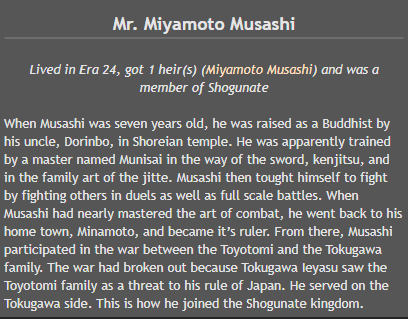
Musashi was raised by Buddhists after his orphanage, taken in by his uncle, who was a monk.
His uncle raised him at a temple, where he educated him in Buddhism, meditation, reading, and writing.
While his uncle attempted to instill spiritual values and mental discipline, Musashi grew up to be a rebellious, boisterous person with an intense passion for martial arts, which reminds me of Sukuna in a way.
Musashi was raised by Buddhists after his orphanage, taken in by his uncle, who was a monk.
His uncle raised him at a temple, where he educated him in Buddhism, meditation, reading, and writing.
While his uncle attempted to instill spiritual values and mental discipline, Musashi grew up to be a rebellious, boisterous person with an intense passion for martial arts, which reminds me of Sukuna in a way.
Origins (4)
Basically, a theory came up about Sukuna being raised by Monks (By Prumice), which asserts that Sukuna is likely raised by Buddhist monks because of his abandonment, how it lines up with outcast individuals during the Heian Era, and how his mindset reflects anti-Buddhism.
Thread Here:
reddit.com/r/JuJutsuKaise…
Basically, a theory came up about Sukuna being raised by Monks (By Prumice), which asserts that Sukuna is likely raised by Buddhist monks because of his abandonment, how it lines up with outcast individuals during the Heian Era, and how his mindset reflects anti-Buddhism.
Thread Here:
reddit.com/r/JuJutsuKaise…
2. The Way of Walking Alone
One of the core tenets of Musashi's philosophy is "The Way of Walking Alone"/Dokkōdō, it is a deeply stoic text that reflects his overall mindset and detachment from worldly desires, fame, and comfort to completely master his craft. He walked alone to find a disciplined peace with the universe.
The reason this connects to Sukuna is because of the exact same premise: absolute isolation and detachment from societal standards, but in a different way.
Of course, many of these rules (view attachment) are shared by Sukuna's ideology as well, but I noticed something interesting.
If he was raised by monks, he learned all the notions of Buddhism (Enlightenment, detachment, understanding the soul) and weaponized them for evil.
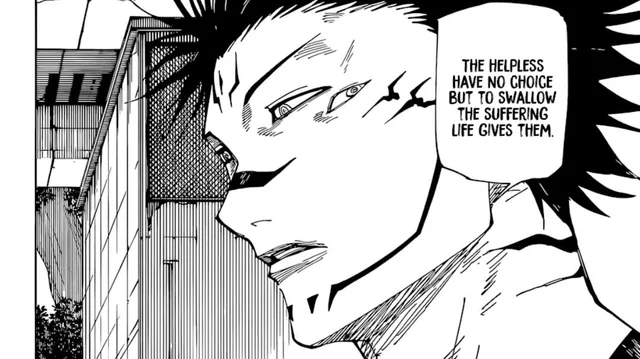
While Buddha detached himself from the world to achieve peace, Sukuna detached himself from empathy to satisfy his appetite. Sukuna "walks alone" not because he is seeking a higher truth, but because everyone else is too weak to stand beside him. As he famously tells Jogo, he burns whatever he wants, when he wants, simply to pass the time until he dies.
One of the core tenets of Musashi's philosophy is "The Way of Walking Alone"/Dokkōdō, it is a deeply stoic text that reflects his overall mindset and detachment from worldly desires, fame, and comfort to completely master his craft. He walked alone to find a disciplined peace with the universe.
The reason this connects to Sukuna is because of the exact same premise: absolute isolation and detachment from societal standards, but in a different way.
Of course, many of these rules (view attachment) are shared by Sukuna's ideology as well, but I noticed something interesting.
If he was raised by monks, he learned all the notions of Buddhism (Enlightenment, detachment, understanding the soul) and weaponized them for evil.
While Buddha detached himself from the world to achieve peace, Sukuna detached himself from empathy to satisfy his appetite. Sukuna "walks alone" not because he is seeking a higher truth, but because everyone else is too weak to stand beside him. As he famously tells Jogo, he burns whatever he wants, when he wants, simply to pass the time until he dies.

3. Ego
In Musashi’s life, he was feared as a demon and internalized himself as one. He was not really just seen as a swordsman or really a human at all; they viewed him as a being who would use complex tactics, psychological prowess, and overwhelming force to slaughter his opponents.
Sukuna is that concept but on an apocalyptic scale; he has the highest overall battle IQ, psychological prowess, and force within JJK enormously.
Both Sukuna and Musashi essentially internalized the title of a demon even though they are both essentially human, leading them to further detach from human emotion and psychologically mutate themselves.
In Musashi’s life, he was feared as a demon and internalized himself as one. He was not really just seen as a swordsman or really a human at all; they viewed him as a being who would use complex tactics, psychological prowess, and overwhelming force to slaughter his opponents.
Sukuna is that concept but on an apocalyptic scale; he has the highest overall battle IQ, psychological prowess, and force within JJK enormously.
Both Sukuna and Musashi essentially internalized the title of a demon even though they are both essentially human, leading them to further detach from human emotion and psychologically mutate themselves.

Ego (2)
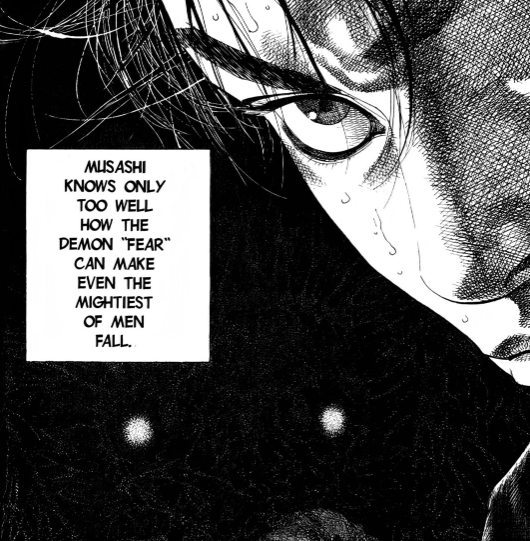
In Vagabond, Musashi is constantly wrestling with the "demon" inside him, often feeling that to be the strongest, he must abandon his humanity, and it affects his ego deeply.
Sukuna took the step Musashi resisted: becoming the "demon". He physically and psychologically mutated himself into a calamity that Musashi tried to keep from influencing him.
In Vagabond, Musashi is constantly wrestling with the "demon" inside him, often feeling that to be the strongest, he must abandon his humanity, and it affects his ego deeply.
Sukuna took the step Musashi resisted: becoming the "demon". He physically and psychologically mutated himself into a calamity that Musashi tried to keep from influencing him.
Ego (3)
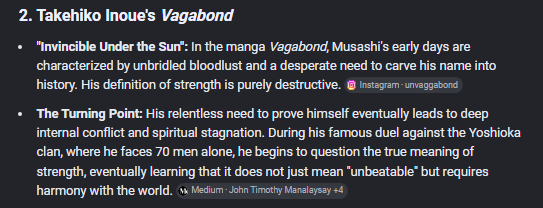
We notice how both of their egos unravel them throughout their respective stories. Musashi, in the earlier chapters, starts to go after any foe to boast his strength (often targeting ones from Hozoin School or anyone he could find that challenges his strength) To Musashi, if he isn't winning, he doesn't exist.
Sukuna shares this exact sentiment; he fights most like Musashi. They both fight for the purpose of boasting their strength, a concept Musashi refers to as "Invincibility Under the Sun"
We notice how both of their egos unravel them throughout their respective stories. Musashi, in the earlier chapters, starts to go after any foe to boast his strength (often targeting ones from Hozoin School or anyone he could find that challenges his strength) To Musashi, if he isn't winning, he doesn't exist.
Sukuna shares this exact sentiment; he fights most like Musashi. They both fight for the purpose of boasting their strength, a concept Musashi refers to as "Invincibility Under the Sun"
Ego (4)
I believe Sukuna's "Invincible Under the Sun" mentality is what unravels him and leads him to be eventually defeated, Musashi realizes that its just a lonely prison that forces him to keep killing until he is inevitably killed, but Sukuna fails to realize that himself.
Sukuna's ego unravels in the opposite direction. He claims to be completely detached and above it all, but the moment someone threatens his status as the strongest (like Gojo or Yuji), his composure cracks. His ego is so massive that he cannot accept a world where he isn't the absolute center of gravity, proving that his "detachment" is a lie, and that he is completely addicted to his own supremacy.
Musashi eventually learned to put the sword down to save his humanity but Sukuna doubled down and died because of the "Sun" mentality.
I believe Sukuna's "Invincible Under the Sun" mentality is what unravels him and leads him to be eventually defeated, Musashi realizes that its just a lonely prison that forces him to keep killing until he is inevitably killed, but Sukuna fails to realize that himself.
Sukuna's ego unravels in the opposite direction. He claims to be completely detached and above it all, but the moment someone threatens his status as the strongest (like Gojo or Yuji), his composure cracks. His ego is so massive that he cannot accept a world where he isn't the absolute center of gravity, proving that his "detachment" is a lie, and that he is completely addicted to his own supremacy.
Musashi eventually learned to put the sword down to save his humanity but Sukuna doubled down and died because of the "Sun" mentality.


4. Masteries
Both Musashi and Sukuna have a interesting, yet distinctive approach to their respective combat strategies.
Musashi viewed the strategy of combat as an art form, he wrote his seminal work "The Book of Five Rings" to break down dueling into elemental phases (Earth, Water, Fire, Wind, Void.)
Sukuna used a diverse artistic standpoint, leaning into culinary ideas. His innate techniques, Cleave and Dismantle, are cutting tools; he utlizes fire; and he views humans as "ingredients" to be chopped up and consumed. Both figures view combat not as a brawl, but as a highly disciplined mastery over life and death.
Both Musashi and Sukuna have a interesting, yet distinctive approach to their respective combat strategies.
Musashi viewed the strategy of combat as an art form, he wrote his seminal work "The Book of Five Rings" to break down dueling into elemental phases (Earth, Water, Fire, Wind, Void.)
Sukuna used a diverse artistic standpoint, leaning into culinary ideas. His innate techniques, Cleave and Dismantle, are cutting tools; he utlizes fire; and he views humans as "ingredients" to be chopped up and consumed. Both figures view combat not as a brawl, but as a highly disciplined mastery over life and death.

5. Conclusion
Overall, Sukunas archetypal connection to Musashi is interesting, whether it's a homage or just Gege pulling from the cultural memory of Japan’s most reverned samurai, Sukuna genuinely feels like a dark reflection of Musashi, showing us a unique angle if he let his philosophy ruin his mentality childhood burden.
Overall, Sukunas archetypal connection to Musashi is interesting, whether it's a homage or just Gege pulling from the cultural memory of Japan’s most reverned samurai, Sukuna genuinely feels like a dark reflection of Musashi, showing us a unique angle if he let his philosophy ruin his mentality childhood burden.
Generated by Thread Navigator
Press ⌘ + S to quick-export