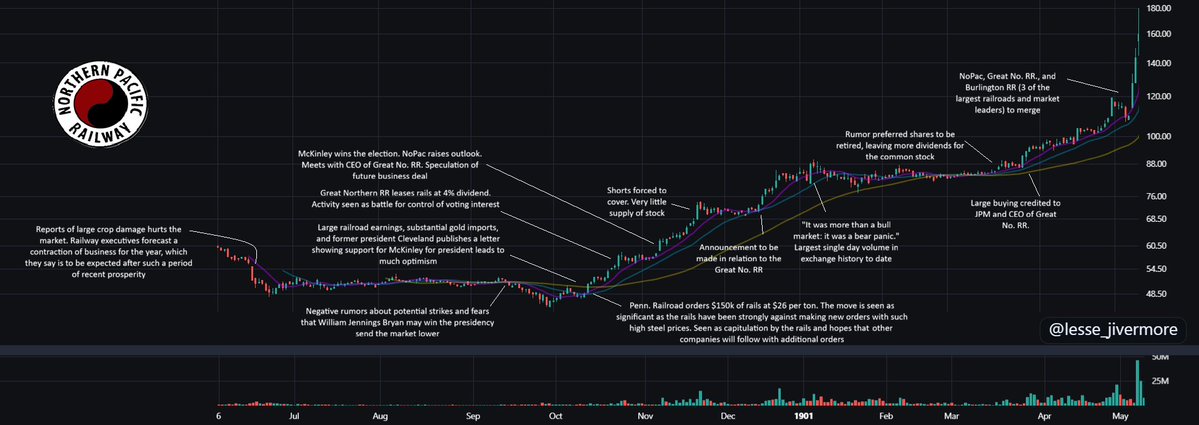
This Saturday marks the 125th anniversary of the Panic of 1901. In a rampant bull market coming out of the recovery from the panic in 1893, steel, iron, and railroad companies began to make huge advances on the exchanges.
In an effort to gain voting control of the Northern Pacific (NoPac) Railway, JP Morgan and James J. Hill, the president of the Great Northern Railroad, began buying blocks of NoPac on the open market. But they weren't the only ones looking for control of NoPac.
Edward Harriman, president of the Union Pacific Railroad, also wanted to control the company.
The result was an all out battle of attrition to see who could throw more money at the stock for ultimate control. In early May, JP Morgan and Hill won control and announced they would merge together NoPac, the Great Northern, and the Burlington railroad, three of the largest railroads of the day.
Traders had been selling the stock short on its relentless march upwards, believing the stock to be far overvalued. On May 6, 1901, they collectively saw their financial souls exit their bodies and rise up to the great brokerage in the sky when NoPac shares erupted skywards nearly 20% the day the merger was announced.
Sensing the impending doom, investors and traders sold, or were sold out of other positions in an effort to shore up capital to pay for their exorbitant losses in NoPac. But the carnage had only just begun.
The very next day, May 7, 1901, the stock rose another 12%. The day after, it reached 25% higher intraday. Then, on May 9, 1901, the wildest day that Wall Street had seen in its 100+ year history to that point caused sheer panic and pandemonium as shares of NoPac, which traded as low as $16 in 1898, and closed at $160 the prior day, reached highs between $700-$1000 in some transactions.
Short-sellers, desperate to save their financial lives, were willing to buy back their borrowed shares at almost any price. The chaos sent shares of many other stocks down violently. The higher NoPac soared, the lower other stocks fell.
US Steel, which had only began trading as the most valuable company in the world just over a month earlier, saw its value drop over 45% intraday.
While the bull market didn't completely die that day as stocks like Missouri Pacific and General Electric soon reached new highs, most stocks didn't have a significant rally for a number of years. US Steel eventually collapsed to $7 in 1904 before returning to a strong rally but it didn't make a new high until 1908.
The corner of NoPac essentially marked the end up the bull market in spectacular fashion. The bull market of 1897-1901 was also the last great railroad-driven speculative boom on the exchanges. All future bull markets would be dominated by industrials like steel, copper, automobiles, and others.



Generated by Thread Navigator
Press ⌘ + S to quick-export