
Fascinating research about slave trade in Eastern Europe. Do you know that at least 5 million people from Lviv to Moscow were captured and sold from Crimea overseas in 15-18 centuries? After West Africa, the region was the largest source of slaves in the early modern world. 1/6

Most captives were marched to Crimea and shipped to Ottoman markets in Constantinople, Cairo, Damascus via a merchant network. Survivors not ransomed were sold locally. The Crimean Khanate built its entire economy around the raids. 2/6
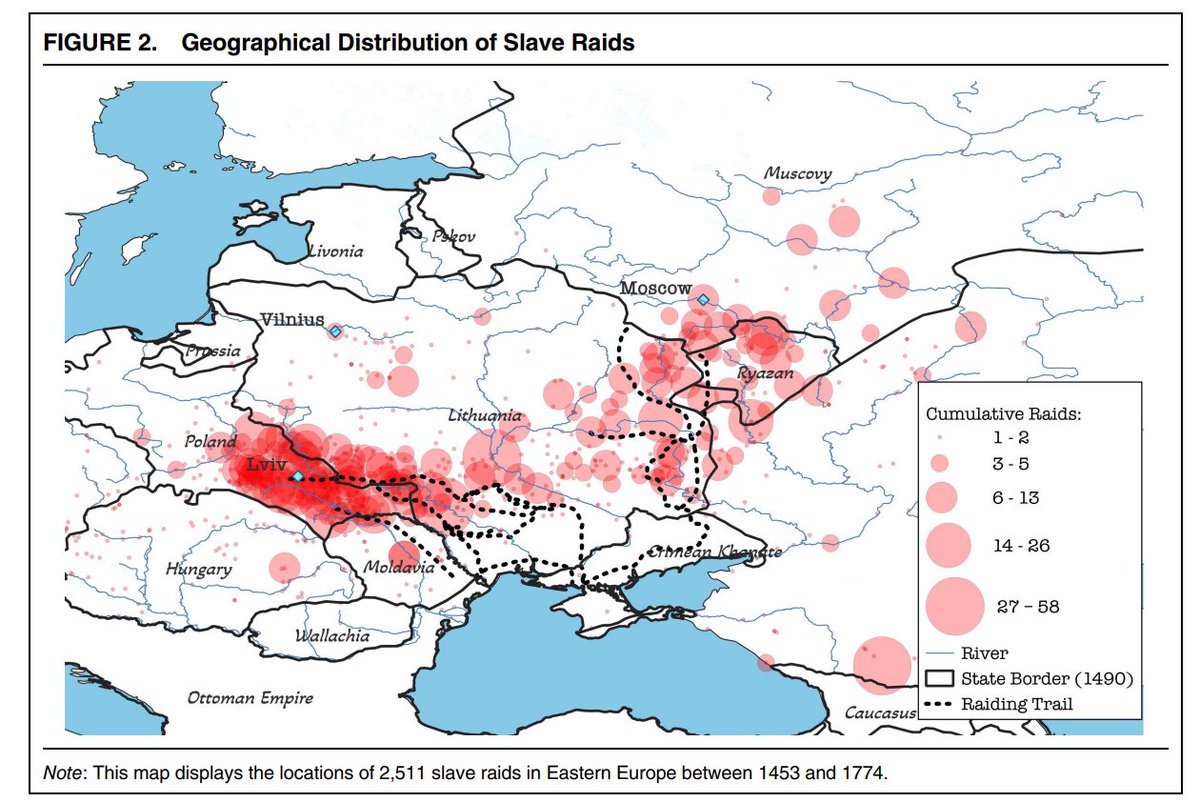
What research shows is that Eastern Europe's experience diverges sharply from West Africa's. There, European demand pushed rulers to adopt extractive institutions optimized for slave production — fueling violence, low trust and instability that stunted growth for generations. 3/6

Russia and Poland-Lithuania had already ended commercial slavery through late-medieval consolidation. Facing raids, they doubled down on defense: fortifications, standing armies, reconnaissance that were funded by stronger fiscal capacity and centralized administration. 4/6
Raided areas in EE gained enduring economic advantages. Defensive state-building pulled in labor and capital, while the area around the Crimean Khanate was basically empty ("Wild Fields"). The rise of the Russian Empire made the Khanate history 5/6

Link to this cool research 6/6: cambridge.org/core/services/…
Generated by Thread Navigator
Press ⌘ + S to quick-export