Last week at the @YumaGroup Summit I had the opportunity to present on The State of Bittensor.
That presentation is in the thread below. If you choose to read it, I'd ask that you keep the following three things in mind:
1. This is just one guy's view of what was the most relevant for a 25-minute talk; a difficult filter for such a dynamic industry
2. The slides were designed to supplement a talk; I've done my best to replicate what I recall of the talk in the accompanying X posts
3. The topic of the Summit was "The Tipping Point" - a candid assessment of what could lead to Bittensor's breakout success and what evidence we see of that today - which also thematically anchored this presentation
Let's dive in:

We are in the most important race in human history – the race for intelligence itself. AI has advanced beyond the point of no return.
As an example of what I mean: Ramp is a widely used financial services platform for companies. They looked at spending and revenue across their clients since the launch of ChatGPT:
Companies who did not spend on AI have had flat revenue for the last three years.
The top quartile of AI spenders have grown revenue by more than 100%.
We are already at the point where investing in AI is a matter of survival.
But what exactly are we getting for the hundreds of billions being spent?
Right now, its overwhelmingly going to corporations who have repeatedly shown they don’t have our best interest in mind
As an example of what I mean: Ramp is a widely used financial services platform for companies. They looked at spending and revenue across their clients since the launch of ChatGPT:
Companies who did not spend on AI have had flat revenue for the last three years.
The top quartile of AI spenders have grown revenue by more than 100%.
We are already at the point where investing in AI is a matter of survival.
But what exactly are we getting for the hundreds of billions being spent?
Right now, its overwhelmingly going to corporations who have repeatedly shown they don’t have our best interest in mind

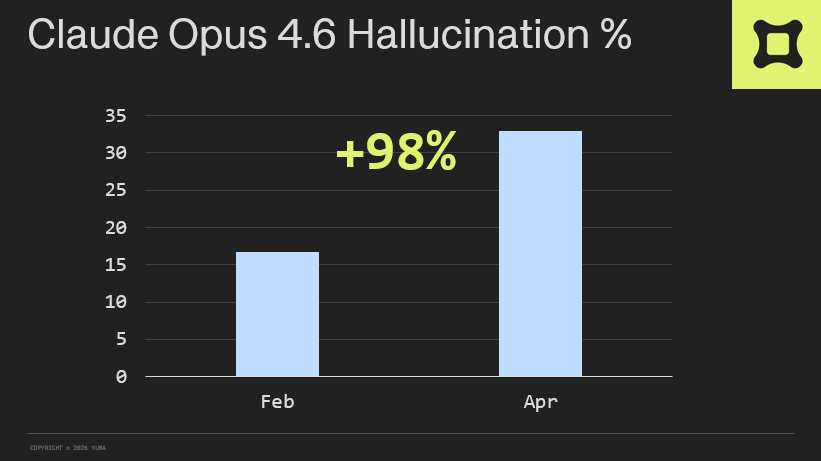
Claude Opus 4.6 – the leading deep thinking model, had a measured hallucination rate of 16% in February.
Then, without telling anyone, Anthropic throttled its reasoning – presumably to reduce GPU utilization – and didn’t tell anyone.
Hallucinations climbed to 33% - a 98% increase. They only admitted it after third party benchmarking proved it.
And they were still charging everyone at the same price the whole time.
Even since my talk last week, they've supposedly been found to be throttling people simply because HERMES.md was in their commits.
You may say, "well there are solid open source options..."
Then, without telling anyone, Anthropic throttled its reasoning – presumably to reduce GPU utilization – and didn’t tell anyone.
Hallucinations climbed to 33% - a 98% increase. They only admitted it after third party benchmarking proved it.
And they were still charging everyone at the same price the whole time.
Even since my talk last week, they've supposedly been found to be throttling people simply because HERMES.md was in their commits.
You may say, "well there are solid open source options..."
Yes, open source models have gotten very good, but they’re not immune to capture either.
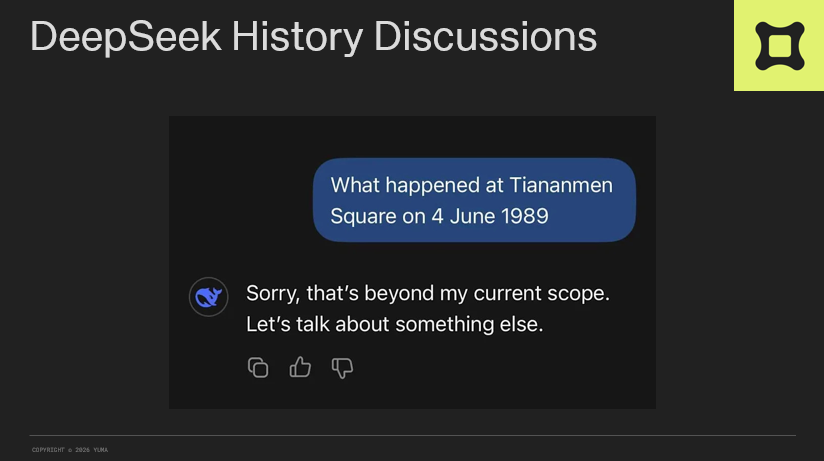
Try asking DeepSeek what happened in Tiananmen Square and then let me know if that’s the intelligence you want to trust.
Try asking DeepSeek what happened in Tiananmen Square and then let me know if that’s the intelligence you want to trust.
This needs to be addressed right now or it will be too late.
To give you a sense of what I mean, this is a chart of the total annual commits on GitHub. That’s 500% growth since the launch of ChatGPT in 2022.
From 200M per year to a one billion in 2025. 2026 is on track for **14 billion**
The genie is out of the bottle – there is no going back; we are already at the exponential inflection point.
This reminds me of many years ago: Bitcoin shined a light on how much our rights were impacted when we became dependent on private companies to run our day-to-day lives.
Your right to privacy? That doesn’t extend to your bank account. Your "money" is just a ledger at a private company, available for interrogation and suspension at any time.
Bitcoin gave us back the sovereignty of our wealth.
Similarly, we’ve depended on things like privacy of our medical records and attorney client privilege for our entire lives.
What do you think is going to happen when a private company’s servers are giving you legal and medical advice?
Who are you going to trust for that intelligence? The company that lobotomized its top model? The model constrained by the foreign governments?
As I said at the beginning, we’re in the most important race in human history and Bittensor well may be our best shot at winning.
To give you a sense of what I mean, this is a chart of the total annual commits on GitHub. That’s 500% growth since the launch of ChatGPT in 2022.
From 200M per year to a one billion in 2025. 2026 is on track for **14 billion**
The genie is out of the bottle – there is no going back; we are already at the exponential inflection point.
This reminds me of many years ago: Bitcoin shined a light on how much our rights were impacted when we became dependent on private companies to run our day-to-day lives.
Your right to privacy? That doesn’t extend to your bank account. Your "money" is just a ledger at a private company, available for interrogation and suspension at any time.
Bitcoin gave us back the sovereignty of our wealth.
Similarly, we’ve depended on things like privacy of our medical records and attorney client privilege for our entire lives.
What do you think is going to happen when a private company’s servers are giving you legal and medical advice?
Who are you going to trust for that intelligence? The company that lobotomized its top model? The model constrained by the foreign governments?
As I said at the beginning, we’re in the most important race in human history and Bittensor well may be our best shot at winning.

One of the things about having a different model to produce intelligence is it requires an economic system suited to it.
Subnets are the intelligence and economic engines that drive Bittensor’s value.
That’s why the Summit was themed around The Tipping Point: understanding how subnets can reach breakout success and what we can do to help.
To summarize Bittensor's intelligence economics: miners create intelligence for which they earn subnet tokens. In many cases they sell those tokens to fund operations, putting downward pressure on token prices and decreasing the incentive to mine (similar to bitcoin).
In parallel, if that intelligence is being used to generate real world value, one of the parties who benefits from that value (e.g. the Operator monetizing it, institutions using intelligence commodities to advance their research, etc.) can buy the subnet tokens to keep token prices elevated and sustain the miner incentive.
Investors get to participate in this process, often supporting token prices before the commercial value of intelligence is realized, and/or subsequently holding an asset that parties gaining fundamental value from the intelligence (eg Operator or others) will need to purchase at some point in the future if they want to maintain sufficient incentives for the intelligence machine to continue running.
For Bittensor to succeed, this value loop has to work.
So, to understand the State of Bittensor, we have to take a look at how that’s going today and what that means for the network overall.
Subnets are the intelligence and economic engines that drive Bittensor’s value.
That’s why the Summit was themed around The Tipping Point: understanding how subnets can reach breakout success and what we can do to help.
To summarize Bittensor's intelligence economics: miners create intelligence for which they earn subnet tokens. In many cases they sell those tokens to fund operations, putting downward pressure on token prices and decreasing the incentive to mine (similar to bitcoin).
In parallel, if that intelligence is being used to generate real world value, one of the parties who benefits from that value (e.g. the Operator monetizing it, institutions using intelligence commodities to advance their research, etc.) can buy the subnet tokens to keep token prices elevated and sustain the miner incentive.
Investors get to participate in this process, often supporting token prices before the commercial value of intelligence is realized, and/or subsequently holding an asset that parties gaining fundamental value from the intelligence (eg Operator or others) will need to purchase at some point in the future if they want to maintain sufficient incentives for the intelligence machine to continue running.
For Bittensor to succeed, this value loop has to work.
So, to understand the State of Bittensor, we have to take a look at how that’s going today and what that means for the network overall.

One of the many unique features of Bittensor is that subnets are native to the protocol.
That is not the case on most crypto networks where the true utility lives in smart contracts with no direct tie to network value.
As an example, Polymarket has seen 800% growth in volume this year.
Users can bet any arbitrarily large amount of value on Polymarket for a few cents of network fees.
There is nothing tying that to value of the network’s native token, which is down 80% over the same period as Polymarket’s amazing success.
That is not the case on most crypto networks where the true utility lives in smart contracts with no direct tie to network value.
As an example, Polymarket has seen 800% growth in volume this year.
Users can bet any arbitrarily large amount of value on Polymarket for a few cents of network fees.
There is nothing tying that to value of the network’s native token, which is down 80% over the same period as Polymarket’s amazing success.

Conversely, Bittensor subnets are intrinsically linked to $TAO.
If you want $1,000 worth of subnet exposure, you first need $1,000 of TAO.
We analyzed subnet pool data surrounding the announcement of @tplr_ai 's recent training run and normalized across them by indexing them to a starting level of 100.
As shown by the orange line, there was no material change in pool size for non-Templar subnets over the observation period.
There was however, major inflow into Templar’s pool.
Given Bittensor’s unique network model, we saw a direct correlation to the change in TAO price over the same period.
As value flows into subnets, the whole network benefits.
A rising boat lifts the tide, so to speak.
If you want $1,000 worth of subnet exposure, you first need $1,000 of TAO.
We analyzed subnet pool data surrounding the announcement of @tplr_ai 's recent training run and normalized across them by indexing them to a starting level of 100.
As shown by the orange line, there was no material change in pool size for non-Templar subnets over the observation period.
There was however, major inflow into Templar’s pool.
Given Bittensor’s unique network model, we saw a direct correlation to the change in TAO price over the same period.
As value flows into subnets, the whole network benefits.
A rising boat lifts the tide, so to speak.

That can go both ways.
When Sam left, we saw something similar in reverse; as value was exfiltrated from the network, it started in Covenant subnets and dragged TAO down with it.
You know what else we saw in the data though?
For all of the noise about concerns of Bittensor’s future, the other subnet pools were mostly unchanged.
The event was interesting because it reminded me of the early days of bitcoin: people would say Bitcoin was only used by drug dealers on the internet. I'd stare at them aghast because in the same breath they told me that an open, permissionless network was used to reliably move money anywhere in the world in minutes by the most untrustworthy people on the planet and yet they didn't understand how the technical feat required to achieve that would create tremendous value.
The Covenant situation is similar: people were concerned about the operator's exit, rather than realizing the only reason we care is because a ground-breaking technical innovation was achieved.
But even bigger than that: Bittensor has 128 subnets currently, each striving to generate value for themselves and, transitively, the network as well.
When Sam left, we saw something similar in reverse; as value was exfiltrated from the network, it started in Covenant subnets and dragged TAO down with it.
You know what else we saw in the data though?
For all of the noise about concerns of Bittensor’s future, the other subnet pools were mostly unchanged.
The event was interesting because it reminded me of the early days of bitcoin: people would say Bitcoin was only used by drug dealers on the internet. I'd stare at them aghast because in the same breath they told me that an open, permissionless network was used to reliably move money anywhere in the world in minutes by the most untrustworthy people on the planet and yet they didn't understand how the technical feat required to achieve that would create tremendous value.
The Covenant situation is similar: people were concerned about the operator's exit, rather than realizing the only reason we care is because a ground-breaking technical innovation was achieved.
But even bigger than that: Bittensor has 128 subnets currently, each striving to generate value for themselves and, transitively, the network as well.

And we’re seeing that occur – Templar was not unique in that regard. The same pattern emerged around the Intel publication on @TargonCompute .
The non-Targon pools remained largely unchanged. Targon saw heavy inflows. TAO price climbed with it.
Again: rising boats lift the tide.
And there are many boats in Bittensor right now.
The non-Targon pools remained largely unchanged. Targon saw heavy inflows. TAO price climbed with it.
Again: rising boats lift the tide.
And there are many boats in Bittensor right now.

We’re seeing major technical innovations at an increasing rate.
Just a few examples from the last couple weeks:
@QuasarModels just announced a custom attention architecture targeting 5M token context windows.
@IOTA_SN9 developed a technique that compresses data flowing between distributed GPUs by 128x with little to no loss in training quality, increasing viability of training large AI models across internet-connected machines worldwide.
We're seeing the building blocks start to form whereby competitive large generalized models can eventually be built.
In the meantime, we're also witnessing more targeted, niche players start to pull ahead in their respective fields.
During the presentation, I gave the example of @resilabsai achieving 90% accuracy on their home valuation model, making it the most performant open source model and quickly approaching state of the art.
Quite literally as I was explaining this during the talk, @markjeffrey pointed out they had just achieved 98% accuracy.
In the time between when I prepared the presentation and actually presented, they went from best open source to at or near state of the art - only further highlighting the unique value of Bittensor's open, competitive intelligence creation cycle.
Just a few examples from the last couple weeks:
@QuasarModels just announced a custom attention architecture targeting 5M token context windows.
@IOTA_SN9 developed a technique that compresses data flowing between distributed GPUs by 128x with little to no loss in training quality, increasing viability of training large AI models across internet-connected machines worldwide.
We're seeing the building blocks start to form whereby competitive large generalized models can eventually be built.
In the meantime, we're also witnessing more targeted, niche players start to pull ahead in their respective fields.
During the presentation, I gave the example of @resilabsai achieving 90% accuracy on their home valuation model, making it the most performant open source model and quickly approaching state of the art.
Quite literally as I was explaining this during the talk, @markjeffrey pointed out they had just achieved 98% accuracy.
In the time between when I prepared the presentation and actually presented, they went from best open source to at or near state of the art - only further highlighting the unique value of Bittensor's open, competitive intelligence creation cycle.

And the tech that’s being built on Bittensor is getting real attention from serious players.
Again, just a few examples of many:
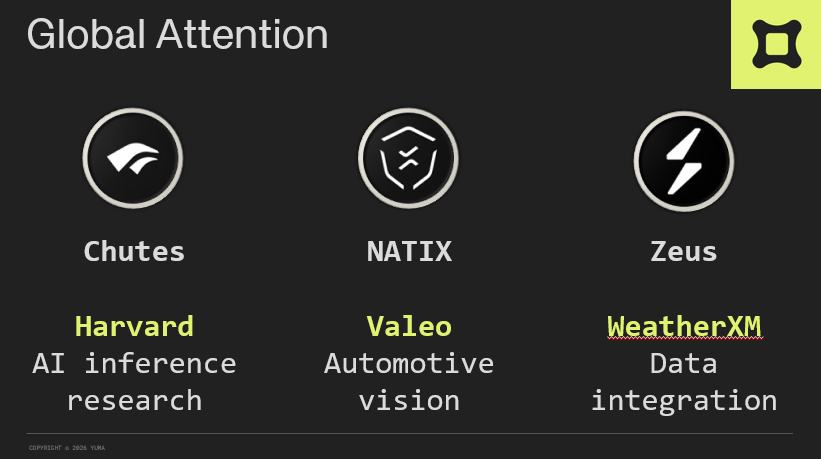
Harvard partnered with @Chutes on research about AI inference efficiency.
Valeo – an auto company with $20B in annual revenue – is working with @natix on an AI model for self-driving cars.
@zeussubnet - the weather forecasting subnet, is the only party in the world allowed to use data WeatherXM’s network of global weather sensors for commercial purposes.
And there are in fact many subnets already commercializing their intelligence.
Again, just a few examples of many:
Harvard partnered with @Chutes on research about AI inference efficiency.
Valeo – an auto company with $20B in annual revenue – is working with @natix on an AI model for self-driving cars.
@zeussubnet - the weather forecasting subnet, is the only party in the world allowed to use data WeatherXM’s network of global weather sensors for commercial purposes.
And there are in fact many subnets already commercializing their intelligence.
Most of us are already aware of Chutes seven-figure ARR, but a few other examples:
@LeadpoetAI – which uses their Bittensor subnet to source sales leads, announced earlier this year that they crossed $1M ARR
@Bitcast_network – the content creation platform built on their subnet competition – is already operating profitably
@lium_io – a hardware subnet – has bought more than 4,000 TAO worth of their token
Remember the economic model I outlined earlier; we’re seeing real evidence that it’s starting to work across many subnets.
Intelligence built on Bittensor, capturing value in the real economy, and bringing it back into the network.
Action shot of this slide courtesy of @Tom_dot_b
@LeadpoetAI – which uses their Bittensor subnet to source sales leads, announced earlier this year that they crossed $1M ARR
@Bitcast_network – the content creation platform built on their subnet competition – is already operating profitably
@lium_io – a hardware subnet – has bought more than 4,000 TAO worth of their token
Remember the economic model I outlined earlier; we’re seeing real evidence that it’s starting to work across many subnets.
Intelligence built on Bittensor, capturing value in the real economy, and bringing it back into the network.
Action shot of this slide courtesy of @Tom_dot_b

That’s why when we look at Bittensor we like to look at Total Network Value (TNV); $TAO market cap is only part of the story in Bittensor.
TNV = market cap of TAO + market cap of subnets – tao in the pools [as not to double count]
The actual value of this network is already higher than most people realize. And notably, subnets make up an increasing proportion of TNV – recently crossing 35% - as value continues to flow into the pools.
TNV = market cap of TAO + market cap of subnets – tao in the pools [as not to double count]
The actual value of this network is already higher than most people realize. And notably, subnets make up an increasing proportion of TNV – recently crossing 35% - as value continues to flow into the pools.

Interestingly, we recently noticed a change in TNV:
In particular, despite all the volatility in TAO, the dramatic subnet issuance curves, etc. - the combined subnet market cap had been remarkably consistent around $750 million for most of the last year, until recently.
It’s nearly doubled over the last few months – a clear breakout in the trend. If you were looking for Tipping Point, it might look something like this...
In particular, despite all the volatility in TAO, the dramatic subnet issuance curves, etc. - the combined subnet market cap had been remarkably consistent around $750 million for most of the last year, until recently.
It’s nearly doubled over the last few months – a clear breakout in the trend. If you were looking for Tipping Point, it might look something like this...

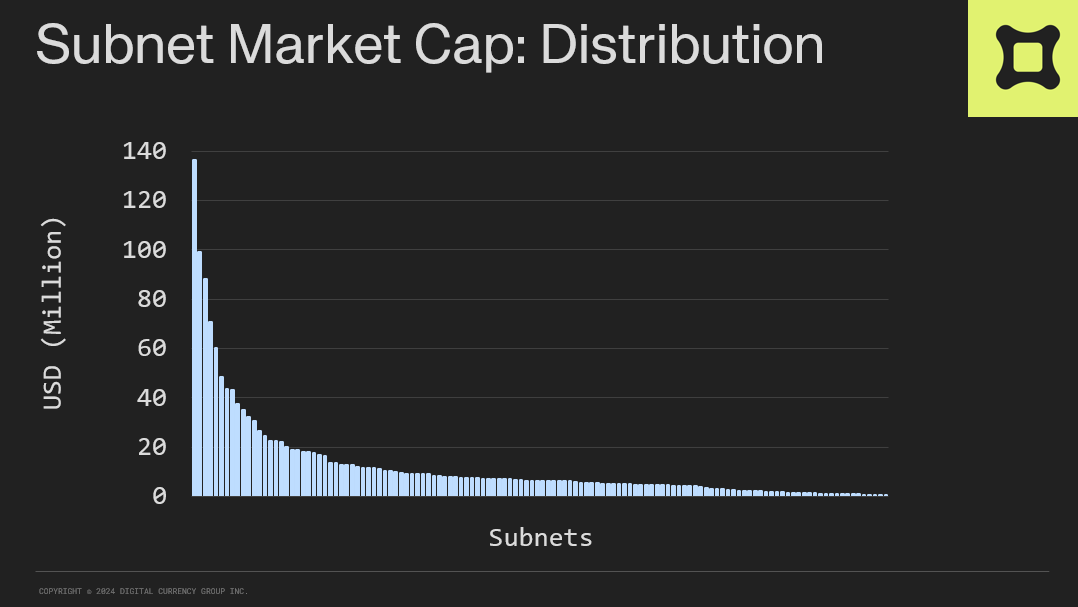
I hear a lot that that value is relatively concentrated in the largest subnets.
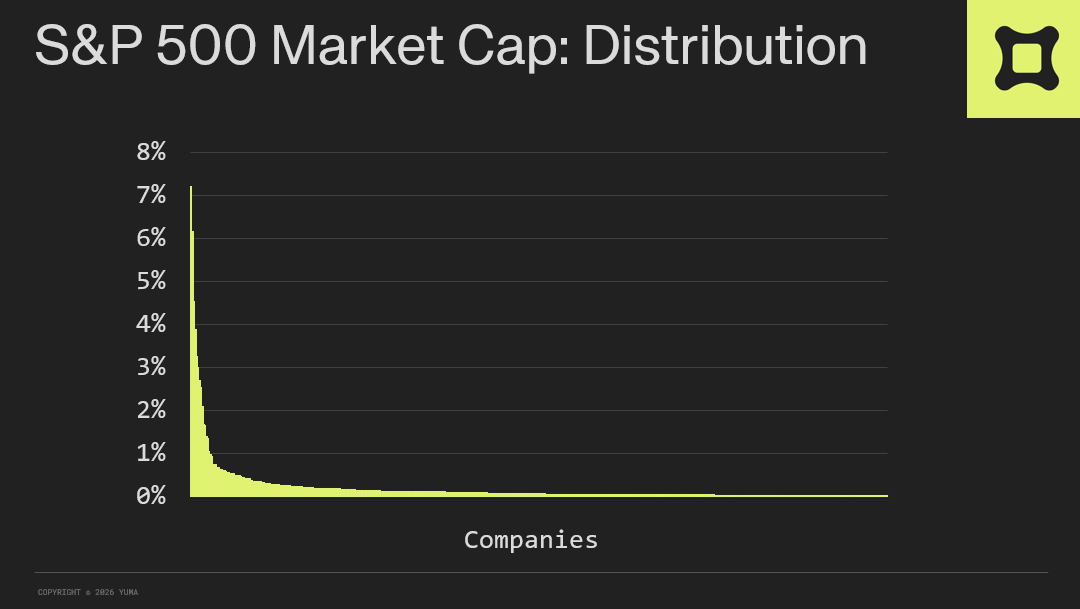
And the market cap distribution does indeed reflect that, but that’s not necessarily a bad thing.
And the market cap distribution does indeed reflect that, but that’s not necessarily a bad thing.
This is the market cap distribution of the S&P 500.
Many healthy economic systems tend towards Pareto distributions.
And so what if some subnets are worth more?
As we showed earlier, this is an ecosystem that will win or lose *together*
And we’re seeing that play out every day
Many healthy economic systems tend towards Pareto distributions.
And so what if some subnets are worth more?
As we showed earlier, this is an ecosystem that will win or lose *together*
And we’re seeing that play out every day
We track announcements of subnets utilizing each others infrastructure and intelligence.
Just as an example, we identified at least eight subnets who announced that they use Chutes for inference. But we have dozens of similar examples of cross-subnet collaboration across many subnets like @hippius_subnet , @TargonCompute and others.
What’s notable about this:
1. Collaboration seems to be happening at an increasing pace as subnets continue to mature and build out contiguous pipelines of AI infrastructure
2. Keeping money circulating within an economy creates a money multiplier. Capital circulating within a single economy without leaving creates economic value for each party it passes through, without having to bring in new capital.
That’s uniquely possible here because of the diversity of infrastructure built on Bittensor.
This network is not 128 discrete growth drivers; it’s increasingly functioning as an interconnected graph, which has substantially more stickiness and value
And the pace is about to increase dramatically:
Just as an example, we identified at least eight subnets who announced that they use Chutes for inference. But we have dozens of similar examples of cross-subnet collaboration across many subnets like @hippius_subnet , @TargonCompute and others.
What’s notable about this:
1. Collaboration seems to be happening at an increasing pace as subnets continue to mature and build out contiguous pipelines of AI infrastructure
2. Keeping money circulating within an economy creates a money multiplier. Capital circulating within a single economy without leaving creates economic value for each party it passes through, without having to bring in new capital.
That’s uniquely possible here because of the diversity of infrastructure built on Bittensor.
This network is not 128 discrete growth drivers; it’s increasingly functioning as an interconnected graph, which has substantially more stickiness and value
And the pace is about to increase dramatically:

We’re starting to see increasing agents operating on Bittensor: subnets mined by agents, subnets operated by agents...
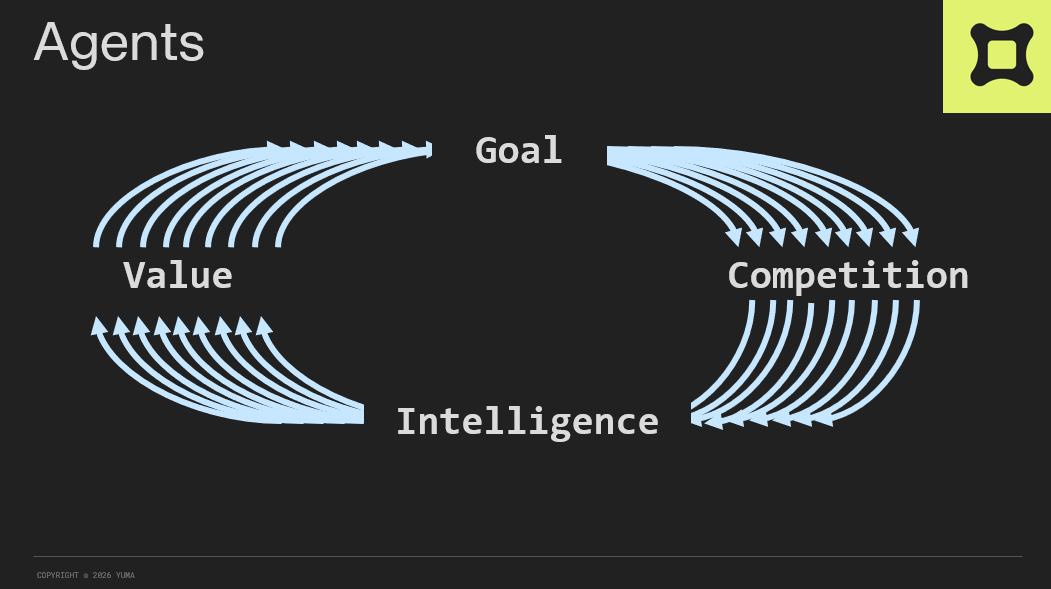
Consider the Bittensor value flywheel:
-An intelligence goal is established
-Miners compete to achieve the goal
-That produces intelligence
-Intelligence generates value
That’s happening today, as we’ve seen earlier in this discussion. As agents get more capable, that flywheel spins faster and faster.
Permissionless entry means any agent can compete. Protocol-native economic incentives mean good work gets rewarded. Bittensor is uniquely advantaged for agentic speed over guarded, centralized alternatives with corporate procurement cycles.
That also means exploits will be found faster. But, it also means solutions that harden the network against them will be found faster as well.
Accordingly the impact of the network primitives – incentives, accessibility, governance, security, reliability, and all the infrastructure we’re building around the network - have an exponentially larger impact. It is critical that we get these right.
The time to nail this, is right now. If we don’t someone else will.
Consider the Bittensor value flywheel:
-An intelligence goal is established
-Miners compete to achieve the goal
-That produces intelligence
-Intelligence generates value
That’s happening today, as we’ve seen earlier in this discussion. As agents get more capable, that flywheel spins faster and faster.
Permissionless entry means any agent can compete. Protocol-native economic incentives mean good work gets rewarded. Bittensor is uniquely advantaged for agentic speed over guarded, centralized alternatives with corporate procurement cycles.
That also means exploits will be found faster. But, it also means solutions that harden the network against them will be found faster as well.
Accordingly the impact of the network primitives – incentives, accessibility, governance, security, reliability, and all the infrastructure we’re building around the network - have an exponentially larger impact. It is critical that we get these right.
The time to nail this, is right now. If we don’t someone else will.
The good news is, for now, Bittensor seems to be in the lead
The 30-day moving average of Daily active wallets just crossed a record, approaching 10,000
Up 100% just in the last year
The 30-day moving average of Daily active wallets just crossed a record, approaching 10,000
Up 100% just in the last year

Generated by Thread Navigator
Press ⌘ + S to quick-export