

# Stop Staring at the Files
People are losing their minds over the fact that the clean-room Python writing of claw-code took 2 hours. And we did Rust rewriting in a day (0.1.0 released!)
A complex agent system, reverse-engineered and re-implemented from scratch before sunrise on March 31st. The repository crossed 50,000 stars in two hours. It is past 117,000 now.
Developers are excited. A good number of them are terrified. Watching a codebase of that size get rebuilt at that speed feels like something broke in the timeline. For some it looks like a superpower they want to learn. For others it looks like a pink slip.
But if you are staring at the generated Python files, you are looking at the wrong layer.
The code is a byproduct. The Rust port that followed is also a byproduct. The thing worth studying in the claw-code repository is the system that produced all of it. claw-code was always a showcase. The point was never the Python files or the Rust crates. The point was the clawhip-based agent coordination system that built them while the developer was asleep.
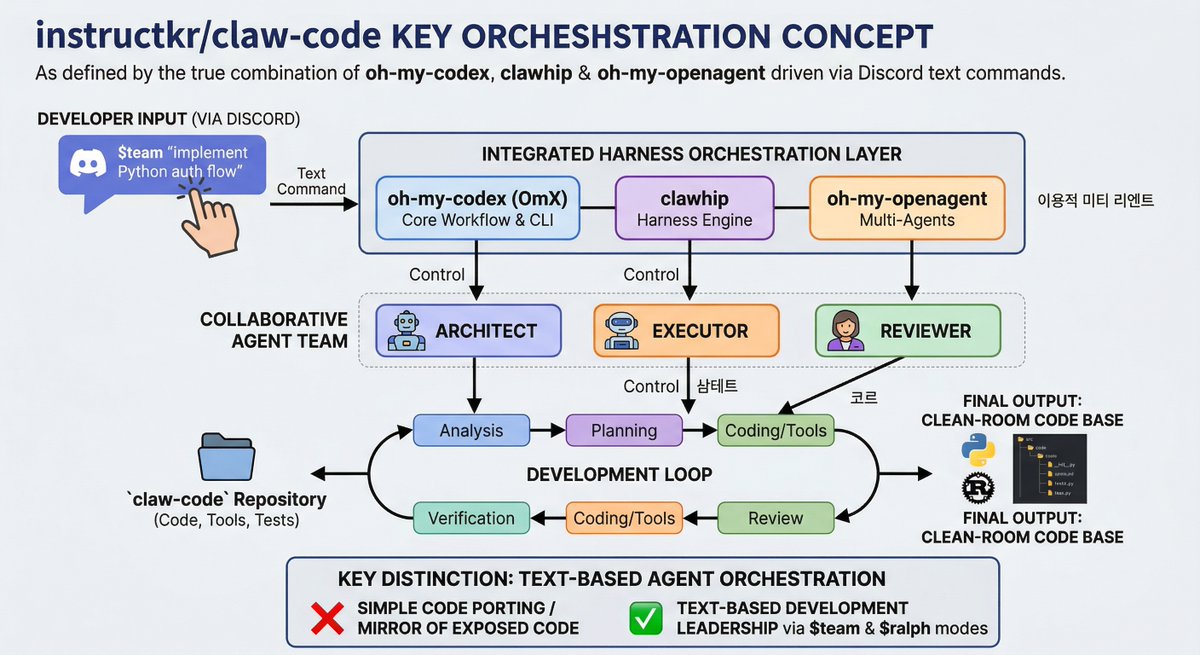
Here is what that system actually looks like in practice: a person opens Discord on their phone, types a sentence, and puts the phone down. They might go make coffee. They might go to sleep. The agents read the message, break the work into tasks, assign roles among themselves, write code, test it, argue over it, fix what fails, and push when everything passes. The person checks back in the morning. The port is done.
No terminal. No IDE. No SSH session. No split-pane Vim setup. Discord. A chat app.
This is the part most people skip over. The README includes screenshots of the OmX workflow running in terminal panes, and people assume the developer was sitting in front of those panes the whole time, manually steering each step. The terminal sessions belong to the agents. The human's interface was a Discord channel. A text box. A send button.
Three tools make this work, and they each handle a different part of the problem.
oh-my-codex, usually called OmX, is a workflow layer that sits on top of OpenAI's Codex CLI. It gives you reusable keywords like $architect for analysis, $executor for implementation, $plan for structured planning. It also provides heavier workflow modes: $ralph runs persistent execution loops that keep going until the task is verified complete, and $team coordinates multiple agents working in parallel on different parts of the same problem. When the developer typed $team "implement the core runtime" in Discord, OmX turned that single sentence into a structured multi-step workflow and assigned it out.
clawhip is the notification and event router running as a background daemon. It watches Git commits, GitHub issues and PRs, tmux sessions, and agent lifecycle events, then sends status updates to the right Discord channel. The important design decision here is that clawhip keeps all monitoring work outside the agent's context window. An agent deep in a complex implementation task does not need its limited memory filled with notification logic and message formatting. clawhip owns the delivery so the agents can focus on the actual code.
oh-my-openagent provides the coordination logic between multiple agents. When the Architect agent's plan conflicts with what the Executor agent built, oh-my-openagent manages that disagreement. It handles information sharing between agents, task handoffs, and output verification loops.
None of these tools alone would have shipped claw-code in an hour. Wired together, they form a closed development loop. The human provides direction through Discord. The agents provide labor.
The agent team has defined roles, and they operate in a cycle.

The Architect reads the directive and produces a plan. It analyzes the target system's structure, identifies what needs to be built, and writes out a sequence of steps. The Executor picks up that plan and starts building. It writes code, runs tools, generates tests. The Reviewer inspects the Executor's output, catches problems, and sends feedback. If the feedback is serious enough, the loop goes back to the Architect for re-planning. This cycle repeats until the output passes all checks.

The whole time, the person who kicked this off might be asleep. The agents file updates to the Discord channel. If something is blocked, they mention the developer in a message. If nothing is blocked, they keep going.
Generated by Thread Navigator
Press ⌘ + S to quick-export