On 23 March, two tunnel boring machines — each weighing over 2,000 tonnes, each wider than a four-lane highway — were unloaded at Mumbai's JNPT port.
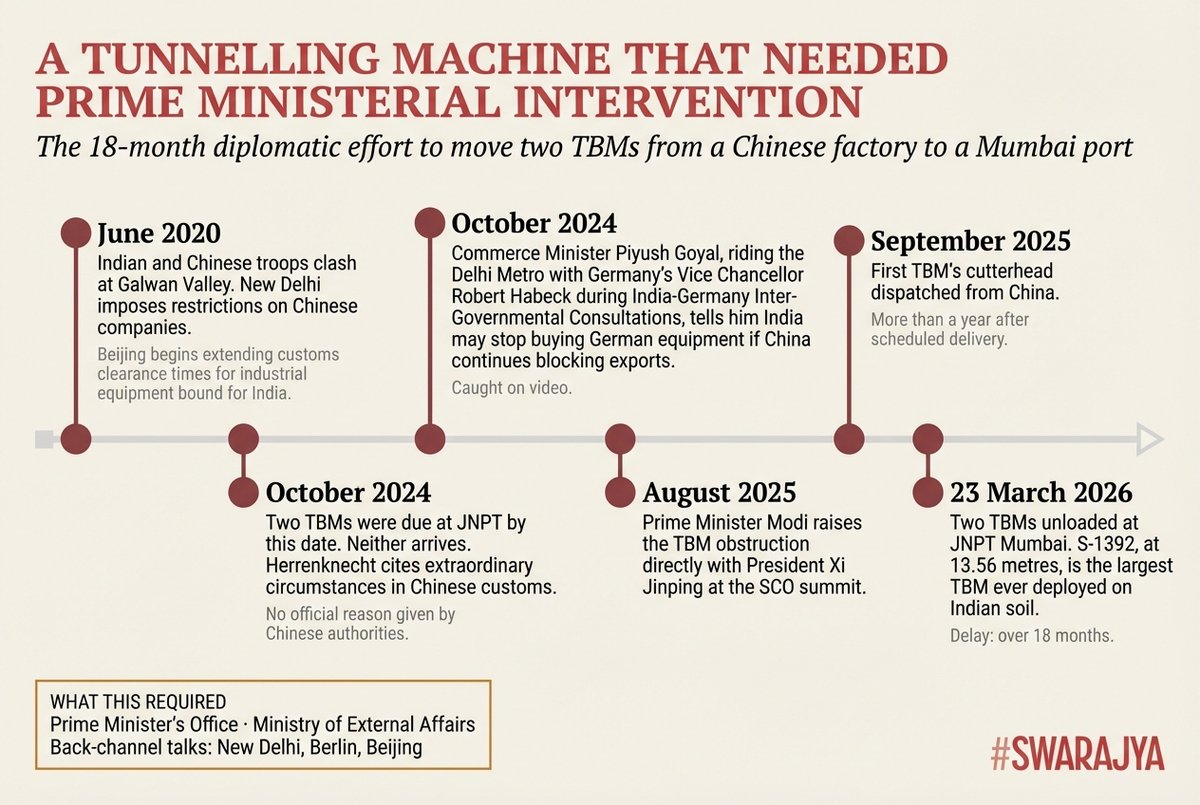
They were meant to arrive in October 2024.
This thread, and the accompanying story, is about what held them up.
📷

The machines are destined for India's first bullet train corridor - specifically its most difficult segment: a 21-kilometre underground stretch beneath Mumbai, including a seven-kilometre passage under Thane Creek.
The geology is mixed. The depth ranges from 25 to 65 metres. No machine built in India could do this job. It had to be imported from China.
The geology is mixed. The depth ranges from 25 to 65 metres. No machine built in India could do this job. It had to be imported from China.
In June 2020 though, Indian and Chinese troops had clashed at Galwan Valley.
Beijing's response: quietly delaying customs clearance for industrial equipment bound for India.
The TBMs were caught in that net. What followed was 18 months of escalating diplomatic effort.
Piyush Goyal confronted Germany's Vice Chancellor about it on a Delhi Metro train. The Prime Minister raised it directly with Xi Jinping at the SCO summit.
Beijing's response: quietly delaying customs clearance for industrial equipment bound for India.
The TBMs were caught in that net. What followed was 18 months of escalating diplomatic effort.
Piyush Goyal confronted Germany's Vice Chancellor about it on a Delhi Metro train. The Prime Minister raised it directly with Xi Jinping at the SCO summit.
India is the world's second-largest TBM market. Over 70 machines are currently deployed across 12 cities. ₹2.5 to 3 lakh crore in tunnel projects are planned over the next decade.
Yet, every single TBM is imported.
Yet, every single TBM is imported.

India's tunnelling contractors — Afcons, L&T, HCC — are genuinely world-class. Many of their engineers work on large projects globally, including for the very manufacturers whose machines India imports.
Still, India has no company that designs a TBM cutterhead from first principles.
Still, India has no company that designs a TBM cutterhead from first principles.

To understand why this matters, consider what S-1392 — the larger of the two machines that arrived this week — actually is.
At 13.56 metres in diameter, it is the largest TBM ever deployed on Indian soil. Wide enough to carry both up and down rail tracks in a single tube.
For context: standard Indian metro TBMs are 6.6 metres. The Mumbai Coastal Road's Mavala, considered enormous at the time, was 12.19 metres.
At 13.56 metres in diameter, it is the largest TBM ever deployed on Indian soil. Wide enough to carry both up and down rail tracks in a single tube.
For context: standard Indian metro TBMs are 6.6 metres. The Mumbai Coastal Road's Mavala, considered enormous at the time, was 12.19 metres.

India's tunnelling pipeline over the next two decades — metro expansions in 20+ cities, the Zoji La tunnel, 60+ NIP projects — is large enough to justify domestic manufacturing.
Herrenknecht itself is investing ₹250 crore in a new large-diameter manufacturing plant in Chennai. The market signal is there.
Herrenknecht itself is investing ₹250 crore in a new large-diameter manufacturing plant in Chennai. The market signal is there.
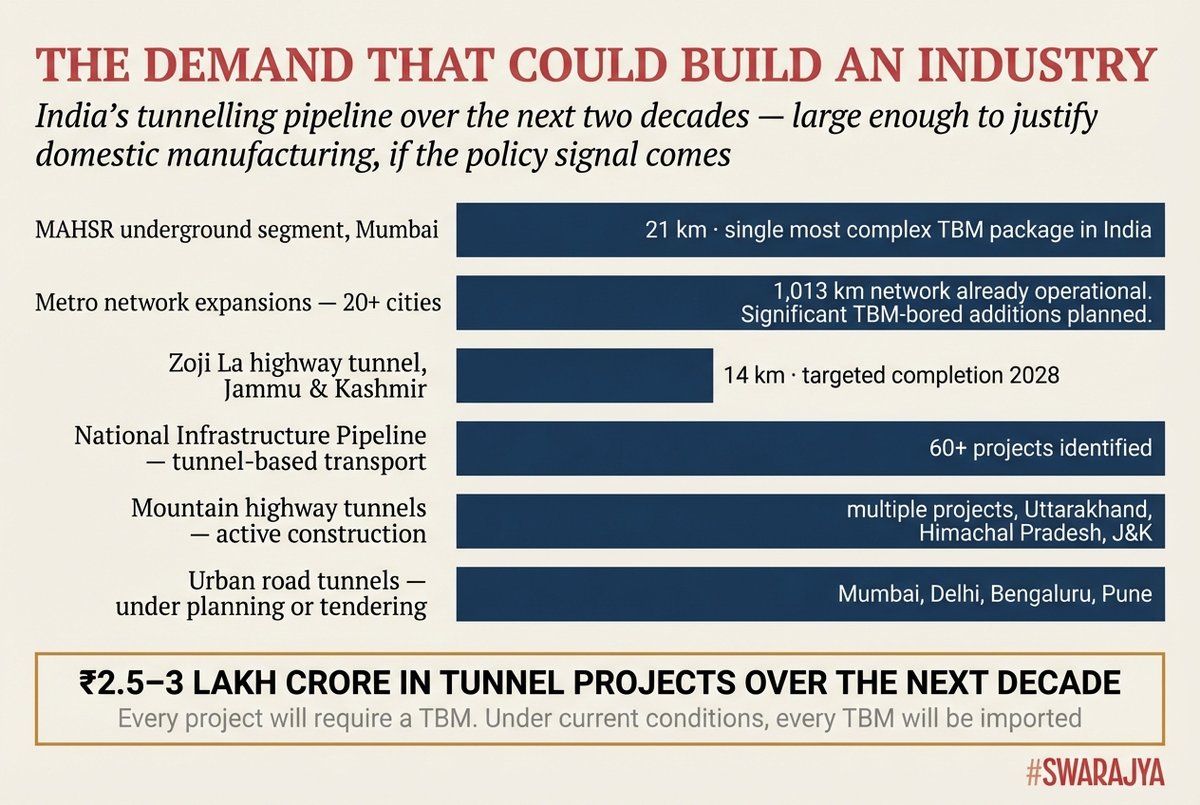
Every imported TBM means:
--foreign exchange spent,
--a supply chain India doesn't control
The machine that reached Mumbai this week arrived late—and only after months of diplomacy.
The next fifteen years of tunnelling don't have to follow the same script.
Read the full piece here:
swarajyamag.com/infrastructure…
--foreign exchange spent,
--a supply chain India doesn't control
The machine that reached Mumbai this week arrived late—and only after months of diplomacy.
The next fifteen years of tunnelling don't have to follow the same script.
Read the full piece here:
swarajyamag.com/infrastructure…
Generated by Thread Navigator
Press ⌘ + S to quick-export