OpenClaw, context limits and SEO...
I turned 16 months of Google Search Console data into a vector database. I created a repo and it's free.
Not because vector databases are trendy. Because my OpenClaw agent needed a data layer it didn't have.
OpenClaw is great at executing SEO tasks. But it doesn't know that a query cluster has been quietly declining for three months, or that two of my pages are cannibalizing each other. It only knows what I tell it in the moment. Sometimes it requires too many SQL lines or queries.

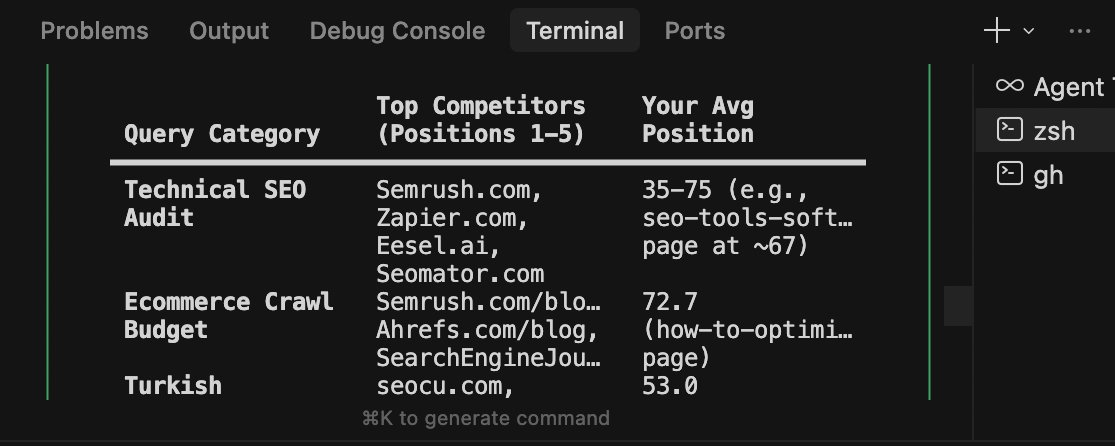

So I built a tool that fixes that:
- Pulls 16 months of GSC data via the API
- Aggregates millions of raw rows into meaningful documents with trend detection
- Embeds everything into a local ChromaDB vector database (with using Gemini's latest multimodal embedding model)
- Lets me (or any AI agent) ask questions in plain English
- Scrapes my pages and competitor pages via Parallel(.)ai to find content gaps
Three LLM providers, depending on what I need:
Gemini Flash (free tier, fast), Grok 4.1 (2M context window), Claude Opus (strategic depth).
The honest part that nobody talks about:
GSC data is structured. Rows, columns, numbers. A SQL database would handle exact filtering better than a vector DB. "Find queries with CTR below 2%" is a trivial SQL query. The vector DB does semantic text similarity instead, which is fuzzy by nature.
But the vector DB does things SQL can't. Ask "what content about AI is performing?" and it finds "neural network tutorial" and "transformer architecture" even though neither contains the word "AI." That kind of semantic discovery doesn't exist in SQL without manually building keyword lists.
- Pulls 16 months of GSC data via the API
- Aggregates millions of raw rows into meaningful documents with trend detection
- Embeds everything into a local ChromaDB vector database (with using Gemini's latest multimodal embedding model)
- Lets me (or any AI agent) ask questions in plain English
- Scrapes my pages and competitor pages via Parallel(.)ai to find content gaps
Three LLM providers, depending on what I need:
Gemini Flash (free tier, fast), Grok 4.1 (2M context window), Claude Opus (strategic depth).
The honest part that nobody talks about:
GSC data is structured. Rows, columns, numbers. A SQL database would handle exact filtering better than a vector DB. "Find queries with CTR below 2%" is a trivial SQL query. The vector DB does semantic text similarity instead, which is fuzzy by nature.
But the vector DB does things SQL can't. Ask "what content about AI is performing?" and it finds "neural network tutorial" and "transformer architecture" even though neither contains the word "AI." That kind of semantic discovery doesn't exist in SQL without manually building keyword lists.

The ideal architecture would be both. SQL for precision, vector DB for discovery. I went with vector DB because the exploratory analysis is where I get the most value.
What actually matters most isn't even the database. It's the data processing pipeline that computes trends, aggregates metrics, and turns millions of raw API rows into signal. And the Parallel(.)ai integration that scrapes what competitors actually have on their pages so the AI can tell me what I'm missing.
Open source, MIT licensed.
If you're running OpenClaw for SEO, this gives it the historical context and crawling ability it's missing. Happy to answer questions in the comments. I'm still learning.
No need to reply with anything, it's free. Full post with the GitHub repo and honest comparison here.
https://metehan.ai/blog/i-turned-16-months-of-google-search-console-data-into-a-vector-database-heres-what-i-learned/
Generated by Thread Navigator
Press ⌘ + S to quick-export