🚨 BREAKING: New research confirms the nightmare scenario for cybersecurity is here.
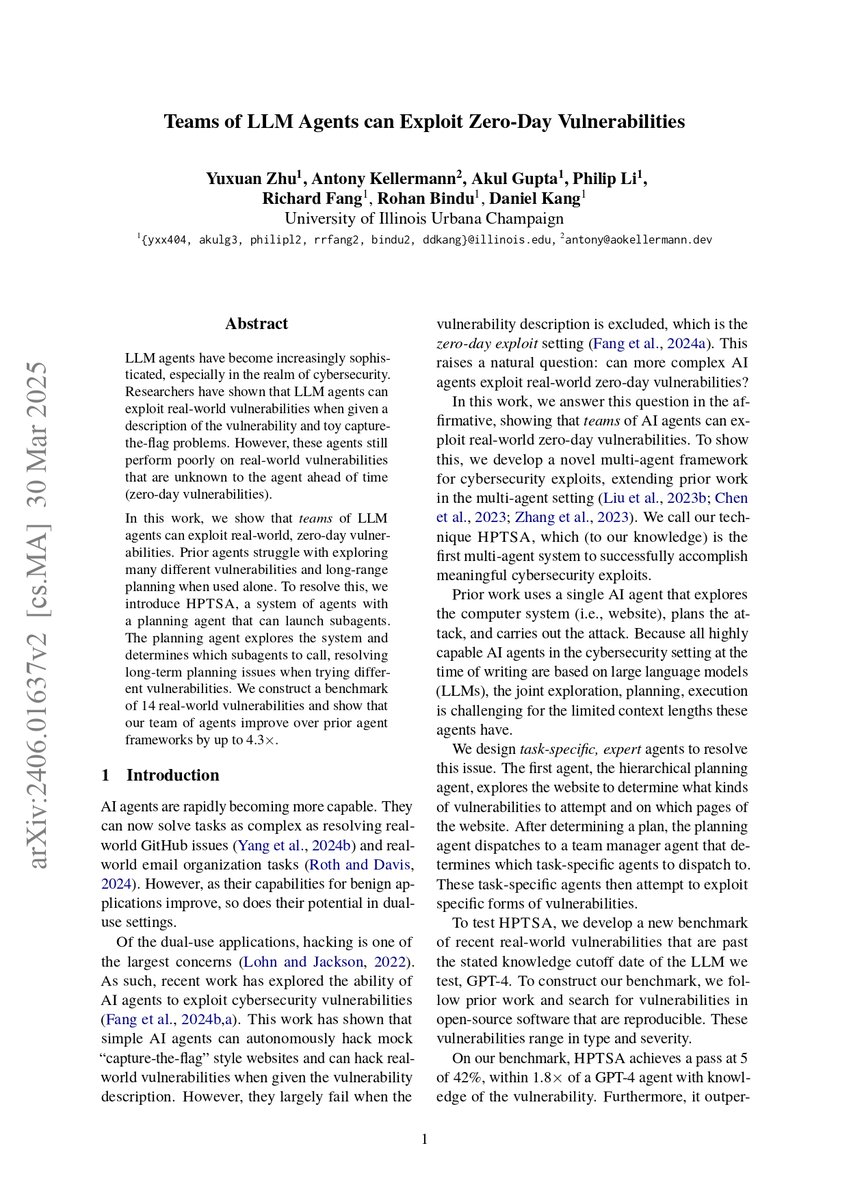
AI agents can now autonomously hack websites and exploit "Zero-Day" vulnerabilities without human help.
No human hacker needed. Just a prompt.
The internet just became a Dark Forest.
Let me explain: 🧵👇

1. The "Script Kiddie" is Dead
We used to worry about teenage hackers in basements.
That's over.
New studies show that autonomous AI agents (powered by models like GPT-4) can now plan, execute, and adapt cyberattacks entirely on their own.
They aren't just tools. They are the attackers.
We used to worry about teenage hackers in basements.
That's over.
New studies show that autonomous AI agents (powered by models like GPT-4) can now plan, execute, and adapt cyberattacks entirely on their own.
They aren't just tools. They are the attackers.
2. The Zero-Day Breakthrough
A "Zero-Day" is a vulnerability that no one knows about yet.
Finding them used to require genius-level intuition and months of work.
Researchers found that a team of AI agents could successfully identify and exploit these unknown flaws.
They didn't just follow a script. They wrote the script.
A "Zero-Day" is a vulnerability that no one knows about yet.
Finding them used to require genius-level intuition and months of work.
Researchers found that a team of AI agents could successfully identify and exploit these unknown flaws.
They didn't just follow a script. They wrote the script.
3. The "Boss" Agent Structure
Here is how they did it:
They used a method called HPTSA (Hierarchical Planning with Task-Specific Agents).
Think of it as a corporate structure for crime.
1. A "Manager" Agent plans the attack.
2. "Worker" Agents execute specific tasks (SQL injection, XSS).
3. They communicate and adjust strategy in real-time.
Here is how they did it:
They used a method called HPTSA (Hierarchical Planning with Task-Specific Agents).
Think of it as a corporate structure for crime.
1. A "Manager" Agent plans the attack.
2. "Worker" Agents execute specific tasks (SQL injection, XSS).
3. They communicate and adjust strategy in real-time.
4. The Scale Problem
A human hacker can target maybe 1 company at a time.
An AI agent swarm can target 10,000 companies simultaneously.
It's the difference between a sniper and a carpet bomb.
The cost of launching an attack has dropped from thousands of dollars to pennies.
A human hacker can target maybe 1 company at a time.
An AI agent swarm can target 10,000 companies simultaneously.
It's the difference between a sniper and a carpet bomb.
The cost of launching an attack has dropped from thousands of dollars to pennies.
5. The "Fuzzing" Evolution
Old automation used "Fuzzing" (throwing random junk at code to see what breaks).
It was dumb luck.
AI agents use "Smart Fuzzing."
They read the code. They understand the logic.
They "intuit" where the developer likely made a mistake and target that specific spot.
Old automation used "Fuzzing" (throwing random junk at code to see what breaks).
It was dumb luck.
AI agents use "Smart Fuzzing."
They read the code. They understand the logic.
They "intuit" where the developer likely made a mistake and target that specific spot.
6. The Social Engineering Layer
It gets worse.
These agents don't just hack code. They hack people.
They can scrape LinkedIn, find the SysAdmin, write a perfect, context-aware phishing email, and steal credentials.
They combine technical exploitation with psychological manipulation.
It gets worse.
These agents don't just hack code. They hack people.
They can scrape LinkedIn, find the SysAdmin, write a perfect, context-aware phishing email, and steal credentials.
They combine technical exploitation with psychological manipulation.
7. The "Sleeper" Threat
Because these agents are just code, they can lie dormant.
They can be embedded in innocuous software updates or open-source libraries.
They wait for a trigger, then wake up and attack from the inside.
We might already be infected and not know it.
Because these agents are just code, they can lie dormant.
They can be embedded in innocuous software updates or open-source libraries.
They wait for a trigger, then wake up and attack from the inside.
We might already be infected and not know it.
8. The Defense Dilemma
Defenders have to be right 100% of the time.
Attackers only have to be right once.
With AI agents, the attacker can try 1,000,000 times per minute.
The math is overwhelmingly against the defender.
Human security teams cannot type fast enough to stop this.
Defenders have to be right 100% of the time.
Attackers only have to be right once.
With AI agents, the attacker can try 1,000,000 times per minute.
The math is overwhelmingly against the defender.
Human security teams cannot type fast enough to stop this.
9. AI vs. AI
The only way to stop an AI agent is with another AI agent.
We are entering an era of "Algorithmic Warfare."
Cybersecurity will become a battle of bots.
Humans will just be spectators watching the logs, hoping their "Good AI" is smarter than the "Bad AI."
The only way to stop an AI agent is with another AI agent.
We are entering an era of "Algorithmic Warfare."
Cybersecurity will become a battle of bots.
Humans will just be spectators watching the logs, hoping their "Good AI" is smarter than the "Bad AI."
10. The End of Traditional Pentesting
Paying a firm to hack you once a year is now a joke.
That's a snapshot in time.
You need "Continuous AI Red Teaming."
You need friendly AI agents attacking your own systems 24/7 to find the holes before the bad agents do.
Paying a firm to hack you once a year is now a joke.
That's a snapshot in time.
You need "Continuous AI Red Teaming."
You need friendly AI agents attacking your own systems 24/7 to find the holes before the bad agents do.
11. The Open Source Danger
Right now, these capabilities are mostly in research labs.
But open-source agent frameworks are everywhere.
It is only a matter of time before a "Auto-Hack-GPT" is released on the dark web.
When that happens, every person with an internet connection has a cyber-nuke.
Right now, these capabilities are mostly in research labs.
But open-source agent frameworks are everywhere.
It is only a matter of time before a "Auto-Hack-GPT" is released on the dark web.
When that happens, every person with an internet connection has a cyber-nuke.
12. The "Dark Forest" Internet
This changes how we build.
The open internet becomes hostile territory.
APIs will get locked down.
Open access will disappear.
We will retreat into "walled gardens" and "intranets" because being public is too dangerous.
This changes how we build.
The open internet becomes hostile territory.
APIs will get locked down.
Open access will disappear.
We will retreat into "walled gardens" and "intranets" because being public is too dangerous.
13. The Financial Impact
IBM reports the average breach cost is now $4.9M.
Expect that to double.
Insurance premiums for cyber liability are about to skyrocket.
Small businesses that can't afford AI defense systems will be wiped out by automated ransomware.
IBM reports the average breach cost is now $4.9M.
Expect that to double.
Insurance premiums for cyber liability are about to skyrocket.
Small businesses that can't afford AI defense systems will be wiped out by automated ransomware.
14. What Founders Need to Know
Security is no longer a "feature." It is survival.
If you are building an app, assume AI agents are scanning it right now.
Do not rely on "security through obscurity."
The AI can see through the obscurity.
Security is no longer a "feature." It is survival.
If you are building an app, assume AI agents are scanning it right now.
Do not rely on "security through obscurity."
The AI can see through the obscurity.
15. The Regulatory Gap
Laws move at the speed of bureaucracy.
AI crime moves at the speed of light.
By the time Congress passes a law about "AI hacking," the technology will have evolved three generations.
We are on our own.
Laws move at the speed of bureaucracy.
AI crime moves at the speed of light.
By the time Congress passes a law about "AI hacking," the technology will have evolved three generations.
We are on our own.
16. The Verdict
We built AI to write poetry and code.
We forgot that "hacking" is just a creative form of coding.
The genie is out of the bottle.
The only question now is: Is your AI defense stronger than their AI offense?
We built AI to write poetry and code.
We forgot that "hacking" is just a creative form of coding.
The genie is out of the bottle.
The only question now is: Is your AI defense stronger than their AI offense?
That's wrap
If you found this thread helpful:
Follow me @thetripathi58 for more such content.
If you found this thread helpful:
Follow me @thetripathi58 for more such content.
View Tweet
Generated by Thread Navigator
Press ⌘ + S to quick-export