Curious how foundational System Policies impact the ownership and control of the stock market?
We follow Decisions, from the source Foundational Policies, and observe how they flow downstream through the System -- this time exploring the stock market ownership fractal..


The top 10% owns 87%+ of the stock market, up over 10% relative to 2000:

And the top 1% own almost 5x what the 'middle class' (10-50% slice) own - a ratio that was at ~parity 40 years ago

Majority of the market is held by the old -- the 55+ cohort owns 80% of the market, up from 66% only ~25 years ago
Meanwhile, under 40 (~40% of the population) holds less than 3%
Meanwhile, under 40 (~40% of the population) holds less than 3%

This is reflective of the clear trend of inflating Capital at the expense of Labor - foundational Policy Decisions that began ~25 years ago, mapped out in detail in this multi-part piece

And part of that Capital inflating financialization flywheel drove foreign ownership of US stocks from ~7% in 1980, to ~15% in ~2000 to almost 35% today

The US stock market — a ‘representation’ of and claim on the value and future of the US — is now primarily owned by foreigners and the old… Potentially the two groups whose interests are least aligned with the country’s long-term health and future.
Neither cares as much about where the US stands in 30 years as a 30-year-old does. Yet, they are the ones who own and control it.
Neither cares as much about where the US stands in 30 years as a 30-year-old does. Yet, they are the ones who own and control it.
And let's see how passive flows have re-shaped the market over the last 2 decades...
Passive > active
Passive > active

as a result, once again, of foundational System Policies @profplum99
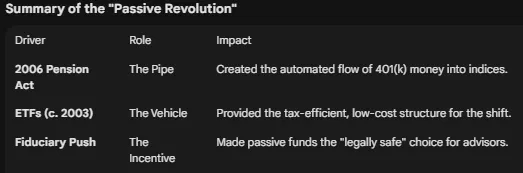
Driving outcomes like this
"Passive allocation mechanism: a pro-cyclical feedback loop where every dollar of new inflow is mathematically forced to purchase stocks in exact proportion to their current market cap — regardless of valuation — effectively turning the market into a "blind" momentum machine that pushes prices higher based on flows rather than fundamentals"
"Passive allocation mechanism: a pro-cyclical feedback loop where every dollar of new inflow is mathematically forced to purchase stocks in exact proportion to their current market cap — regardless of valuation — effectively turning the market into a "blind" momentum machine that pushes prices higher based on flows rather than fundamentals"

poor capital allocation leading to this
"All of these items — from passive flows to share buybacks to printing money to inflate Capital — feel interlinked because they are interlinked. It is a self-reinforcing vicious cycle of poor Capital allocation."
"All of these items — from passive flows to share buybacks to printing money to inflate Capital — feel interlinked because they are interlinked. It is a self-reinforcing vicious cycle of poor Capital allocation."

along with the concentration of power in the hands of the big 3

who are now the largest shareholder in almost every S&P 500 company
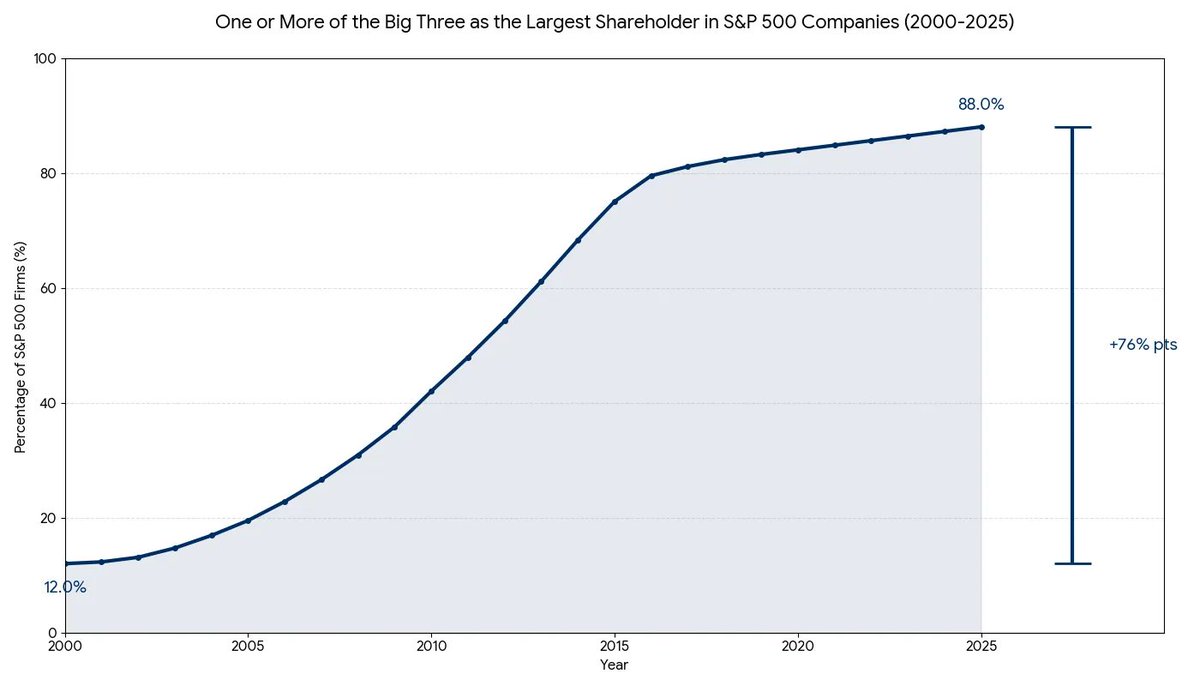
vanguard alone is the largest shareholder in over 70% of S&P 500 companies

leading to the effective control over the votes in most of those companies

enabling the continuation of trends like this


and reflecting a broader trend of diffusion of responsibility and centralization of control
"Like with many things today, many have outsourced their thinking, handing control to someone else — with the (unfortunately naive) assumption that the incentives are aligned, when they are clearly not. And this feedback loop drives further centralization and concentration."
"Like with many things today, many have outsourced their thinking, handing control to someone else — with the (unfortunately naive) assumption that the incentives are aligned, when they are clearly not. And this feedback loop drives further centralization and concentration."
We follow Decisions, from the source Foundational Policies, and observe how they flow downstream through the System into outputs — unsurprisingly looking like self-similar patterns (fractals) that reflect the source.
The point of this piece is not the specifics. It is the observable extremes — the pendulums that have been pushed wildly out of balance. The links and feedback mechanisms that have been broken. And a related wake up call to re-take control of your decisions, notably your money and its ‘vote.’
The point of this piece is not the specifics. It is the observable extremes — the pendulums that have been pushed wildly out of balance. The links and feedback mechanisms that have been broken. And a related wake up call to re-take control of your decisions, notably your money and its ‘vote.’

Generated by Thread Navigator
Press ⌘ + S to quick-export