We have a crisis.
We can't (and don't) read deeply anymore.
We skim, swipe, scroll.
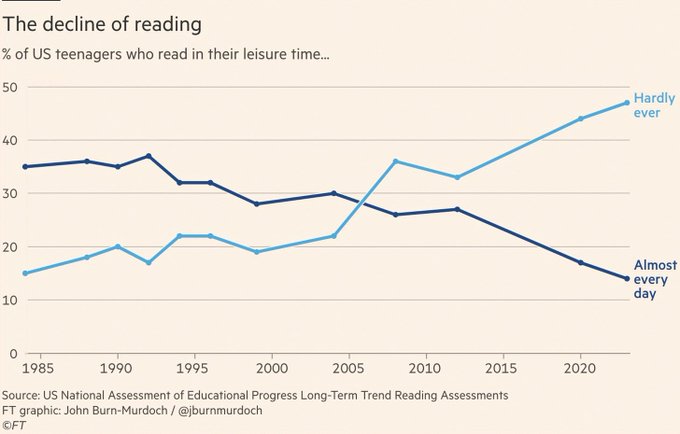
Less than half of all adults read one book last year. For teens, the trend is even worse.
We're losing something essential: the ability to think deeply:

Reading isn’t just about consuming information.
It's an act of thinking. The magic is in the processing and reflecting. The notes. The conversation you have in your head and on the page.
When we read long-form content, our brains engage in focused, deliberate thought.
When we scroll, we fragment our attention.
And over time, that becomes the default way our brain thinks...
It's an act of thinking. The magic is in the processing and reflecting. The notes. The conversation you have in your head and on the page.
When we read long-form content, our brains engage in focused, deliberate thought.
When we scroll, we fragment our attention.
And over time, that becomes the default way our brain thinks...
Researchers discovered that too much screen reading has pushed us to a new type of 'reading', the F-pattern.
Instead of reading line-by-line (deep processing), our eyes scan down the left side and read only the first few words of lines (the "F" shape).
This trains the brain to spot keywords rather than process complex arguments.
Instead of reading line-by-line (deep processing), our eyes scan down the left side and read only the first few words of lines (the "F" shape).
This trains the brain to spot keywords rather than process complex arguments.
This isn’t just about books. It’s about regaining control of your attention in a world designed to hijack it.
Reading is one of the few practices that strengthens focus, builds empathy, and slows down a world obsessed with speed.
If we scroll 90% of the time, the "deep reading" circuits atrophy, making focused thought physically harder to access.
We don't build the neural pathways for contemplation.
Reading is one of the few practices that strengthens focus, builds empathy, and slows down a world obsessed with speed.
If we scroll 90% of the time, the "deep reading" circuits atrophy, making focused thought physically harder to access.
We don't build the neural pathways for contemplation.
Other work found that reading doesn't transports you into the body and mind of another.
When researchers scanned the brains of people reading a novel, they discovered that the books left a kind of shadow activity, or "muscle memory."
Connectivity in key areas were active when they subjects were resting.
It created a biological footprint that persisted for days.
When researchers scanned the brains of people reading a novel, they discovered that the books left a kind of shadow activity, or "muscle memory."
Connectivity in key areas were active when they subjects were resting.
It created a biological footprint that persisted for days.
The medium is the message to the cortex.
As reading researcher Maryanne Wolf put it:
"The reading brain circuit needs an environment to develop. Further, it will adapt to that environment's requirements—from different writing systems to the characteristics of whatever medium is used."
We either adapt for depth...or for superficiality and skimming...
As reading researcher Maryanne Wolf put it:
"The reading brain circuit needs an environment to develop. Further, it will adapt to that environment's requirements—from different writing systems to the characteristics of whatever medium is used."
We either adapt for depth...or for superficiality and skimming...
So what can you do?
→ Rebuild your reading habit, even if it’s just 10 minutes a day.
→ Choose physical books or distraction-free formats when possible.
→ Embrace boredom. Let your mind wander without a screen.
→ Make it a ritual: same time, same place, no distractions.
→ Use friction in your favor: leave the phone in another room, books on the nightstand, book app only one available on your phone.
→ Take notes. Interact with the material. Have a conversation with the page.
Attention is a skill. It needs reps.
→ Rebuild your reading habit, even if it’s just 10 minutes a day.
→ Choose physical books or distraction-free formats when possible.
→ Embrace boredom. Let your mind wander without a screen.
→ Make it a ritual: same time, same place, no distractions.
→ Use friction in your favor: leave the phone in another room, books on the nightstand, book app only one available on your phone.
→ Take notes. Interact with the material. Have a conversation with the page.
Attention is a skill. It needs reps.
Books are the ultimate "hack..."
You get an experts lifetime of work poured onto the page in a way to help you understand.
It's the closest we can get to peer into the geniuses of our world.
It's why the impact of a powerful book sticks with us decades later...
They can change lives.
You get an experts lifetime of work poured onto the page in a way to help you understand.
It's the closest we can get to peer into the geniuses of our world.
It's why the impact of a powerful book sticks with us decades later...
They can change lives.
In a world built on speed, depth becomes a superpower.
Reading trains the part of us that slows down, considers, and connects the dots.
And the less we do it, the more we lose that part of ourselves.
Pick up the book. Your future self will thank you.
Reading trains the part of us that slows down, considers, and connects the dots.
And the less we do it, the more we lose that part of ourselves.
Pick up the book. Your future self will thank you.
Generated by Thread Navigator
Press ⌘ + S to quick-export