
My first year at Michigan, I found a catalogue entry for an unpublished papyrus preserving portions of Odyssey 4.380-90:
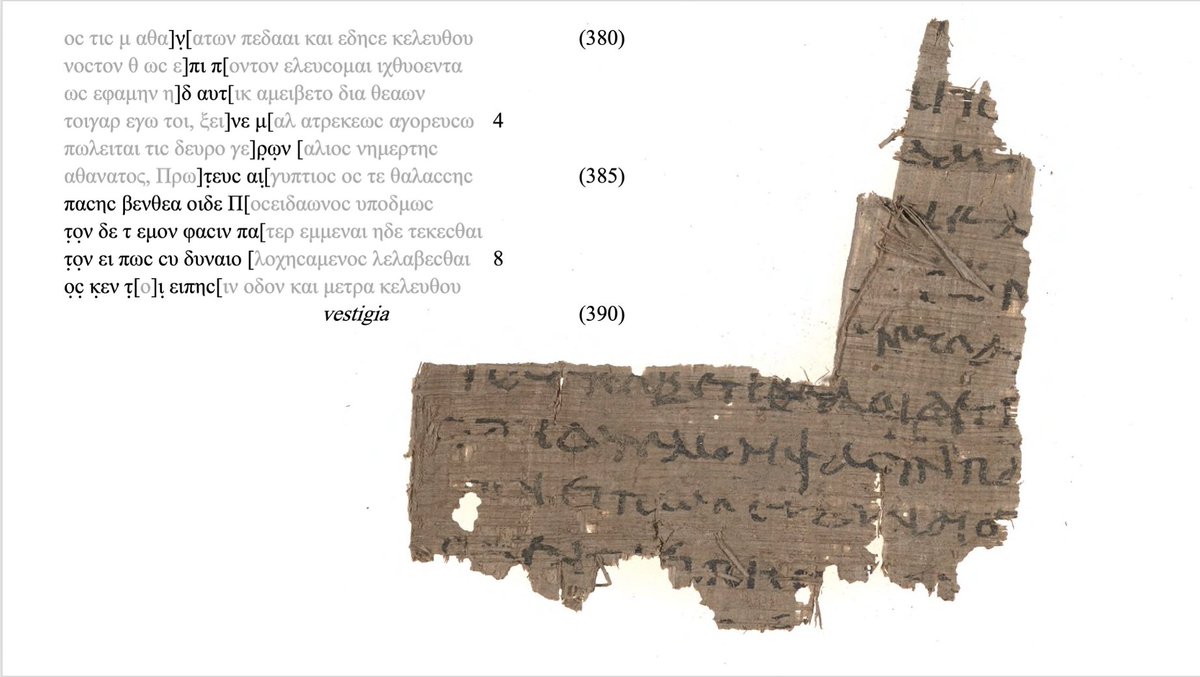
It wasn't big, but it did have an interesting reading at the beginning of 4.388:
modern editions: τόν γ’ εἴ πως σὺ δύναιο λοχησάμενος λελαβέσθαι
P.Mich.inv. 3390 + 7169: τ̣ὸ̣ν εἴ πως σὺ δύναιο [λοχ]η̣σ̣άμε[νος
modern editions: τόν γ’ εἴ πως σὺ δύναιο λοχησάμενος λελαβέσθαι
P.Mich.inv. 3390 + 7169: τ̣ὸ̣ν εἴ πως σὺ δύναιο [λοχ]η̣σ̣άμε[νος
While working on it, I also realised that there was another Michigan papyrus with a very suspicious void at the bottom:
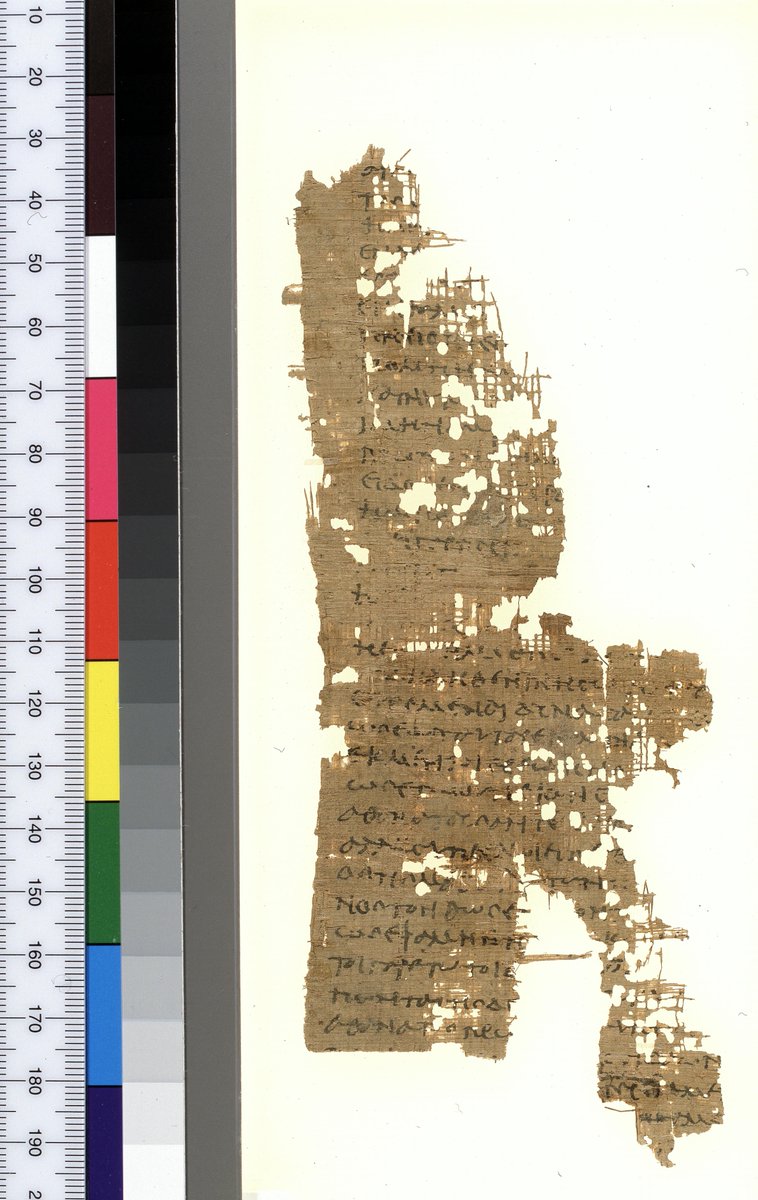
Using high-tech photo editing software (Microsoft Powerpoint) I was able to confirm that the two pieces should join:

The excellent conservators in the papyrus collection were then able to re-unite the two pieces:

It was a complete coincidence that Michigan owned own both pieces: the smaller piece was purchased in 1920, the larger not until 1925, and the connection was never previously noted.
The larger piece was already published, but only from a photograph, and there was obviously much more evidence for the readings in its final lines now. Nothing for it but to re-edit the whole piece.
But 4.388 was still the main attraction. What to make of a line that beings with what ought to be a short syllable?
τ̣ὸ̣ν εἴ πως σὺ δύναιο [λοχ]η̣σ̣άμε[νος
τ̣ὸ̣ν εἴ πως σὺ δύναιο [λοχ]η̣σ̣άμε[νος
The really interesting part was that this was not actually a new reading: it was preserved in a few manuscripts, including the oldest, and also in ancient quotations. It might even be the best supplement of a different papyrus, depending on how much space you think you have.

In spite of this, no editor had been bold enough to print it. But now we have positive evidence that this reading was ancient, and that the accepted reading τόν γ’ εἴ πως is not attested before the middle ages. That's not great.
But it's unmetrical! Well, maybe not... Let's check West's Greek Metre:

In hexameter verse, continuants (*ϝ, λ, μ, ν, ρ, σ) do all kinds of weird things: sometimes because of historical developments, sometimes because they just decide to act like vowels.
It turns out, a sequence of vowel + continuant could be treated the same as a diphthong, as in the famous accentuation of ἄνδρά μοι at Odyssey 1.1 as though it were ᾶνδρά μοι.

So, at Odyssey 4.388, we can syllabify τὸν εἰ not το-νει, as would be expected and yield an unmetrical first short syllable, but τον-ει, with a perfectly metrical closed first syllable.
This is the easiest explanation for why there is so much good evidence for this 'unmetrical' reading: it was never actually in error! It was just mediaeval scribes who tried to 'save' it by inserting γέ.
As a result, we can now recognise τόν γ’ εἴ as a mediaeval variant of no real value, and restore the ancient reading τὸν εἴ.
The complete argument can now be read in BASP 62: feel free to DM if you don't have access!
View Tweet
Generated by Thread Navigator
Press ⌘ + S to quick-export