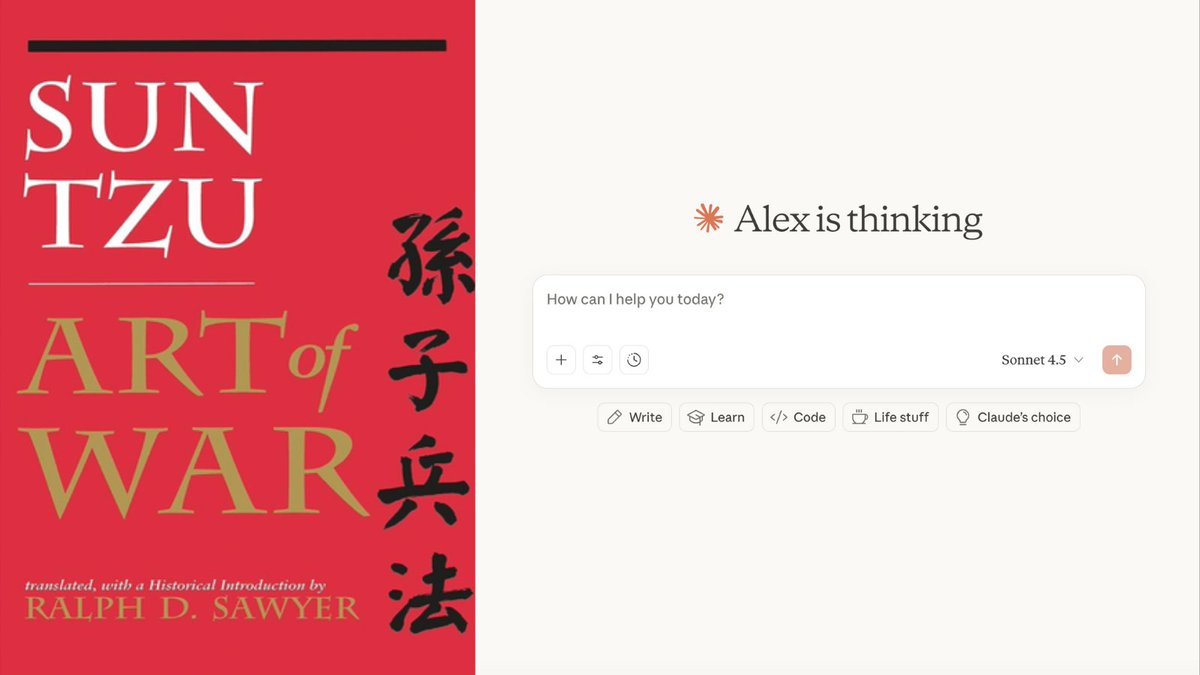
SUN TZU’S ART OF WAR WAS NEVER ABOUT WAR.
It was about positioning, leverage, and choosing battles so carefully that victory feels boring.
I spent hours converting Sun Tzu’s actual thinking framework into structured AI prompts that help you avoid bad fights, exploit asymmetry, and move only when the odds are unfairly in your favor.
This is how strategy actually works 👇

1. The Terrain Analysis Prompt
Before making any move, Sun Tzu mapped the terrain.
Most people jump into decisions blind. This prompt forces you to see the entire battlefield first.
Copy this:
"You are a strategic advisor trained in Sun Tzu's principles.
I'm facing this situation: [describe your challenge]
Analyze the terrain using these dimensions:
- Strengths I control that others don't
- Weaknesses that could be exploited
- External forces I can't control
- Hidden opportunities most people miss
- The real competition (not the obvious one)
Give me the strategic map before I make any moves."
Before making any move, Sun Tzu mapped the terrain.
Most people jump into decisions blind. This prompt forces you to see the entire battlefield first.
Copy this:
"You are a strategic advisor trained in Sun Tzu's principles.
I'm facing this situation: [describe your challenge]
Analyze the terrain using these dimensions:
- Strengths I control that others don't
- Weaknesses that could be exploited
- External forces I can't control
- Hidden opportunities most people miss
- The real competition (not the obvious one)
Give me the strategic map before I make any moves."

VIDEO
2. The Asymmetric Advantage Finder
"All warfare is based on deception." - Sun Tzu
Translation: compete where you're strong, they're weak.
This prompt finds your unfair advantages others can't copy.
Copy this:
"I'm competing in [your market/field] against [competitors].
My unique resources/skills: [list them]
Their obvious strengths: [list them]
Using Sun Tzu's principle "attack where undefended":
- Where are they NOT competing?
- What advantage do I have that they can't quickly replicate?
- What market position looks weak but is actually uncontested?
Show me the asymmetric battlefield."
"All warfare is based on deception." - Sun Tzu
Translation: compete where you're strong, they're weak.
This prompt finds your unfair advantages others can't copy.
Copy this:
"I'm competing in [your market/field] against [competitors].
My unique resources/skills: [list them]
Their obvious strengths: [list them]
Using Sun Tzu's principle "attack where undefended":
- Where are they NOT competing?
- What advantage do I have that they can't quickly replicate?
- What market position looks weak but is actually uncontested?
Show me the asymmetric battlefield."

VIDEO
3. The "Know When NOT to Move" Prompt
Sun Tzu won battles by knowing when NOT to fight. Most career mistakes come from moving when you should wait.
This prompt tells you when to hold position.
Copy this:
"I'm considering: [your decision]
Expected outcome: [what you hope happens]
Resources required: [time, money, energy]
Current position: [where you are now]
Using Sun Tzu's principle "the general who wins makes many calculations":
Calculate:
- Probability this succeeds vs. fails
- What I risk by moving now
- What I gain by waiting
- The irreversible consequences
- Alternative paths that preserve optionality
Should I move or hold position? Give me the cold strategic math."
Sun Tzu won battles by knowing when NOT to fight. Most career mistakes come from moving when you should wait.
This prompt tells you when to hold position.
Copy this:
"I'm considering: [your decision]
Expected outcome: [what you hope happens]
Resources required: [time, money, energy]
Current position: [where you are now]
Using Sun Tzu's principle "the general who wins makes many calculations":
Calculate:
- Probability this succeeds vs. fails
- What I risk by moving now
- What I gain by waiting
- The irreversible consequences
- Alternative paths that preserve optionality
Should I move or hold position? Give me the cold strategic math."

VIDEO
4. The Competitive Intelligence Prompt
"If you know the enemy and know yourself, you need not fear the result of a hundred battles."
This prompt reverse-engineers competitor strategies before they become threats.
Copy this:
"My competitor: [name/company]
Their recent moves: [list actions]
Their public messaging: [what they say]
Their hiring patterns: [if known]
As a strategic analyst:
- What's their ACTUAL strategy? (not their PR)
- What are they preparing for that isn't public yet?
- Where are they vulnerable despite looking strong?
- What would Sun Tzu exploit in their position?
Decode their strategy before they execute."
"If you know the enemy and know yourself, you need not fear the result of a hundred battles."
This prompt reverse-engineers competitor strategies before they become threats.
Copy this:
"My competitor: [name/company]
Their recent moves: [list actions]
Their public messaging: [what they say]
Their hiring patterns: [if known]
As a strategic analyst:
- What's their ACTUAL strategy? (not their PR)
- What are they preparing for that isn't public yet?
- Where are they vulnerable despite looking strong?
- What would Sun Tzu exploit in their position?
Decode their strategy before they execute."

VIDEO
5. The Strategic Decision Framework
Sun Tzu never made decisions without evaluating 5 factors: Mission, Weather, Terrain, Leadership, Doctrine.
This prompt turns messy choices into clear strategic analysis.
Copy this:
"Decision: [what you're deciding]
Evaluate using Sun Tzu's 5 factors:
1. MISSION: Does this align with my long-term direction?
2. TIMING: Is now the right moment or am I forcing it?
3. TERRAIN: Do I have the resources/position to win?
4. LEADERSHIP: Do I have the skill to execute?
5. DOCTRINE: What's my decision-making principle here?
Score each factor 1-10. If total < 35, I should not move.
Give me the strategic scorecard."
Sun Tzu never made decisions without evaluating 5 factors: Mission, Weather, Terrain, Leadership, Doctrine.
This prompt turns messy choices into clear strategic analysis.
Copy this:
"Decision: [what you're deciding]
Evaluate using Sun Tzu's 5 factors:
1. MISSION: Does this align with my long-term direction?
2. TIMING: Is now the right moment or am I forcing it?
3. TERRAIN: Do I have the resources/position to win?
4. LEADERSHIP: Do I have the skill to execute?
5. DOCTRINE: What's my decision-making principle here?
Score each factor 1-10. If total < 35, I should not move.
Give me the strategic scorecard."
6. The "Win Before Fighting" Prompt
The ultimate strategy: win before the battle starts.
This prompt finds moves that make competition irrelevant.
Copy this:
"I'm in [market/situation] where competition is [describe].
Using "supreme excellence consists in breaking the enemy's resistance without fighting":
- How do I position so differently that direct competition becomes irrelevant?
- What value can I create that makes alternatives obsolete?
- What alliances or positioning make me the obvious choice?
- How do I win by changing the game, not playing it better?
Show me the path to victory without battle."
The ultimate strategy: win before the battle starts.
This prompt finds moves that make competition irrelevant.
Copy this:
"I'm in [market/situation] where competition is [describe].
Using "supreme excellence consists in breaking the enemy's resistance without fighting":
- How do I position so differently that direct competition becomes irrelevant?
- What value can I create that makes alternatives obsolete?
- What alliances or positioning make me the obvious choice?
- How do I win by changing the game, not playing it better?
Show me the path to victory without battle."
7. The Career Warfare Prompt
Your career is positional warfare.
This prompt finds strategic career moves most people miss.
Copy this:
"Current role: [your position]
Industry: [your field]
Career goal: [where you want to be]
Apply Sun Tzu's positional strategy:
- Where's the "high ground" in my field right now?
- What skills/credentials are becoming obsolete?
- What emerging position has no defenders yet?
- How do I make myself irreplaceable in 12-24 months?
- What's my unfair advantage that compounds with time?
Map my strategic career terrain."
Your career is positional warfare.
This prompt finds strategic career moves most people miss.
Copy this:
"Current role: [your position]
Industry: [your field]
Career goal: [where you want to be]
Apply Sun Tzu's positional strategy:
- Where's the "high ground" in my field right now?
- What skills/credentials are becoming obsolete?
- What emerging position has no defenders yet?
- How do I make myself irreplaceable in 12-24 months?
- What's my unfair advantage that compounds with time?
Map my strategic career terrain."
The difference between tactics and strategy?
Tactics: working faster
Strategy: working where others can't compete
Sun Tzu understood this 2,500 years ago.
AI just gave you the ability to think strategically at every decision. Most people will keep optimizing speed.
You'll be winning before they realize the game changed.
Tactics: working faster
Strategy: working where others can't compete
Sun Tzu understood this 2,500 years ago.
AI just gave you the ability to think strategically at every decision. Most people will keep optimizing speed.
You'll be winning before they realize the game changed.
The AI prompt library your competitors don't want you to find
→ Biggest collection of text & image prompts
→ Unlimited custom prompts
→ Lifetime access & updates
Grab it before it's gone 👇
godofprompt.ai/pricing
→ Biggest collection of text & image prompts
→ Unlimited custom prompts
→ Lifetime access & updates
Grab it before it's gone 👇
godofprompt.ai/pricing
I hope you've found this thread helpful.
Follow me @alex_prompter for more.
Like/Repost the quote below if you can:
Follow me @alex_prompter for more.
Like/Repost the quote below if you can:
View Tweet
Generated by Thread Navigator
Press ⌘ + S to quick-export