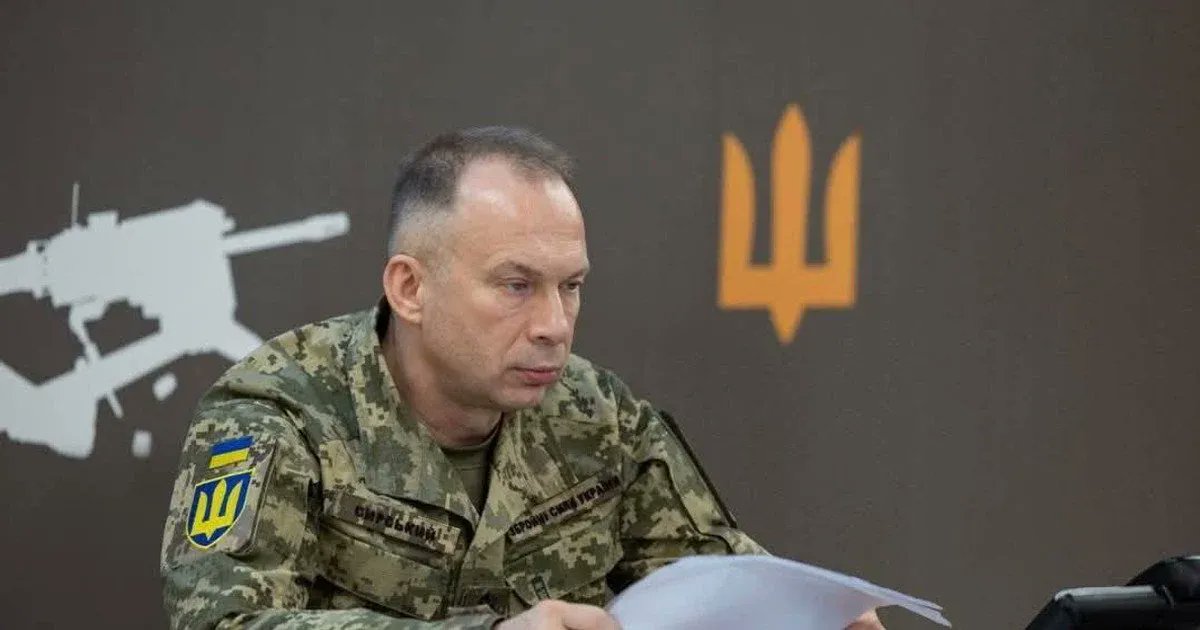
General Syrskyi on the transformation of modern warfare:
We are witnessing a rapid and fundamental shift in the very paradigm of warfare. 1/15

At the beginning of the full-scale invasion, combat was conducted in a largely traditional manner: battalion tactical groups, armored columns, and large concentrations of infantry. Today, the battlefield has been transformed by the mass introduction of drones of every type. 2/15
It is now impossible to imagine warfare without drones, or to imagine commanders and headquarters making decisions without accounting for them. Countering drones, destroying enemy drones and their launch sites, has become the number-one task for any commander. 3/15
This factor has moved to the forefront of the war. At present, drones account for roughly 60% of all firepower on the battlefield. Previously, artillery was responsible for up to 80% of enemy losses. 4/15
Now artillery has been pushed into second place, providing about 40%, while drones generate the remaining 60%. Drone technology continues to evolve rapidly. 5/15
Many systems already incorporate elements of artificial intelligence, including automatic target detection, tracking, and engagement. We are also seeing the expansion of the electromagnetic spectrum used to control drones and transmit signals. 6/15
Another major development is the rise of fiber-optic-guided drones. These drones are completely immune to electronic warfare systems that would normally suppress conventional UAVs. 7/15
This represents a revolutionary leap. Ground robotic platforms are also becoming increasingly important. Almost everything is now delivered by air or ground drones — a shift that saves soldiers’ lives. 8/15
And when drones can surveil entire areas at depths of 20–30 km, and certain tactical models reach 50 km or more, the zones under constant drone control become enormous. 9/15
For the infantry soldier, everything has changed. Every infantryman now carries a shotgun — a simple mechanical weapon used to shoot down close-range drones, including FPV and fiber-optic models. 10/15
Assault groups require drone detectors to identify incoming UAVs early, as well as individual electronic warfare devices. 11/15
Training has also changed: every soldier must know how to operate these devices, how to replace batteries, and how to respond to the appearance of a drone — whether it is a strike drone, a drone dropping munitions, or an FPV drone. 12/15
Fortifications have likewise been transformed. A dugout or shelter is no longer sufficient. It must be equipped with anti-drone nets and protective walls designed to block UAV penetration. 13/15
Nets and barriers are essential, especially against fiber-optic drones, which are not limited by radio horizons and can bypass most obstacles. 14/15
The large-scale use of heavy equipment has diminished sharply. Any vehicle must be equipped with full protection — dynamic and mechanical — yet even then its life cycle on the battlefield is extremely short. 15/15
Check out the detailed assessment of the current state of war by General Syrskyi on my Substack - Russia Analyzed - shorturl.at/sFbVw

Generated by Thread Navigator
Press ⌘ + S to quick-export