Depth jumps are a unique hybrid of plyometric & jump training, making them a uniquely effective & powerful training stimulus
They're ideal for developing "fast dynamic" & "explosive strength" by stressing eccentric strength at high speed
Here's everything you need to know 👇


VIDEO
At appropriate drop heights, in well trained athletes, depth jumps enable greater impulse production in shorter timeframes (compared to standard jumps & loaded jump variations)
Depth jumps increase rate of eccentric force production & encourage greater total eccentric impulse
Depth jumps increase rate of eccentric force production & encourage greater total eccentric impulse
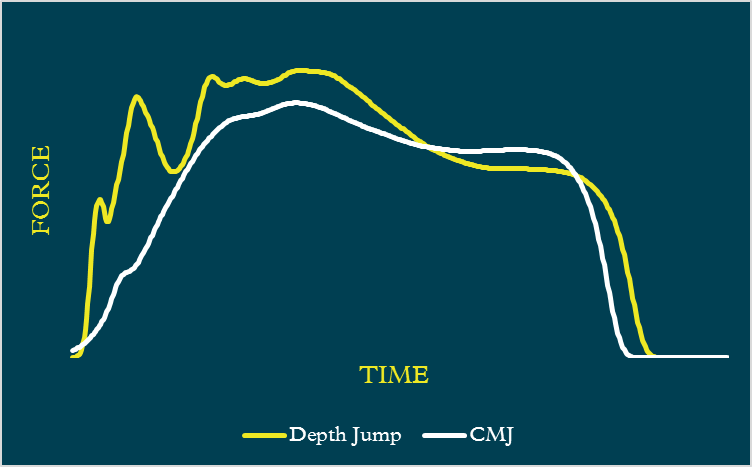
More force in less time is always a clear win for physical performance development.
Even when compared to accentuated eccentric loaded jumps (which are a great stimulus in their own right), depth jumps show much higher eccentric RFD and total eccentric impulse.
Even when compared to accentuated eccentric loaded jumps (which are a great stimulus in their own right), depth jumps show much higher eccentric RFD and total eccentric impulse.

To start, use a drop height approx 5cm below athlete’s average CMJ height. The athlete drops, yields into hip/knee flexion & accelerates upward w/ max intent.
Well prepared, strong athletes should be able to achieive jump heights within 5-10% of their usual CMJ height or beyond
Well prepared, strong athletes should be able to achieive jump heights within 5-10% of their usual CMJ height or beyond
Well prepped athletes will progress to drop heights of CMJ +5cm quickly.
If they can't get within 8-10% of CMJ height in these drop height ranges, depth jumps may not be an appropriate tool.
Consider regressing to repeat jumps.
If they can't get within 8-10% of CMJ height in these drop height ranges, depth jumps may not be an appropriate tool.
Consider regressing to repeat jumps.

VIDEO
Build up depth jump drop height over time:. Dropping from 60-70 cm and producing comparable jump heights to CMJ is not uncommon.
A suitable starting point is 3–4 sets of 3–6 reps, with generous recovery between sets.
A suitable starting point is 3–4 sets of 3–6 reps, with generous recovery between sets.
Using too great a drop height initially can lead to poor preactivation patterns, inhibition and elevated risk for the athletes.
Start conservatively (just abov CMJ jump height), watch for smooth fluid movement (no "hitting" the ground) and compare DJ heights to CMJ.
Start conservatively (just abov CMJ jump height), watch for smooth fluid movement (no "hitting" the ground) and compare DJ heights to CMJ.

Force traces can be reviewed for early "spikes". These are indicative of "braking" & inefficient utilisation of SSC.
Ideally peak force will occur between 40-50% of ground contact time.
If its consistently spiking early (<30% of contact time) consider regressing drop height.
Ideally peak force will occur between 40-50% of ground contact time.
If its consistently spiking early (<30% of contact time) consider regressing drop height.

Depth jumps are for athletes with a strong foundation of physical preparation.
Athletes should have good movement competence in jumping & landing tasks, along w/ high max. strength, before undertaking DJs.
But in well prepared, strong athletes, they can be a powerful tool
Athletes should have good movement competence in jumping & landing tasks, along w/ high max. strength, before undertaking DJs.
But in well prepared, strong athletes, they can be a powerful tool
Training depth jumps can maintain max. strength qualities in the absence of typical strength training (ie back squat)
Depth jumps have strong dynamic correspondence: joint angles, time of force application & have high eccentric loading.
Mkae space for them in the program
Depth jumps have strong dynamic correspondence: joint angles, time of force application & have high eccentric loading.
Mkae space for them in the program
Generated by Thread Navigator
Press ⌘ + S to quick-export