Someone asked me to do a comparison of capabilities between F-35A and JAS-39E Gripen. A ton of material is classified but I will do my best here.
In short, Gripen is not even in the same class as F-35A. It isn't awful, but it is not a competitor with F-35.


Let's start with one of the greatest advantages of the Gripen: its electronic warfare systems. The Gripen has a relatively robust signal receiver network across the aircraft, with several antennas capable of electronic attack, such as the wingtip pods and external jammers.


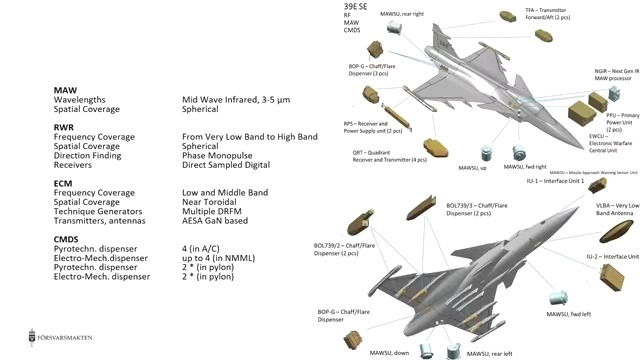

The Gripen's wingtip pods provide an uncommon capability called "crosseye jamming." Crosseye jamming can create a positional false target in the horizontal or vertical plane, rather than just range.

Gripen uses Digital Radio Frequency Memory processors to take incoming radar signals, modify them, and emit them with an extremely minimal delay.
These modified signals are emitted through apertures such as the wingtip arrays or a towed decoy fed by a fiber-optic cable.
These modified signals are emitted through apertures such as the wingtip arrays or a towed decoy fed by a fiber-optic cable.

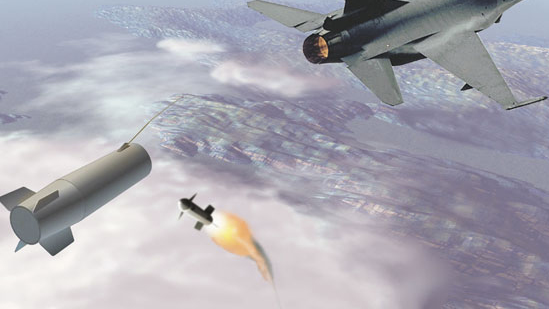
But this is not unique to the Gripen. The F-35 has equal coverage to Gripen for its ESM suite, it contains DRFM processors, and utilizes towed decoys. The radar itself is a "Multi-Function Array," capable of using the radar to jam airborne or ground-based emitters.


Both aircraft are also capable of using the expendable "Britecloud" decoy. This is a self-contained DRFM decoy dropped from aircraft to create a false radar return to guide a missile away from the original target aircraft.


While it is unclear, Gripen may not be able to use its ES-05 AESA to jam emitters.
Unlike other western AESAs, there is no discussion of this capability from the radar manufacturer, or anyone else online. It would be so stupid for it not to that I hesitate to say it does not.
Unlike other western AESAs, there is no discussion of this capability from the radar manufacturer, or anyone else online. It would be so stupid for it not to that I hesitate to say it does not.

One of the bigger advantages that the Gripen has is the ability to turn its radar antenna. The ES-05 of the Gripen is mounted on a rotating platform that allows the electronically steered radar to also physically steer, allowing it to look beyond 90 degrees sideways.
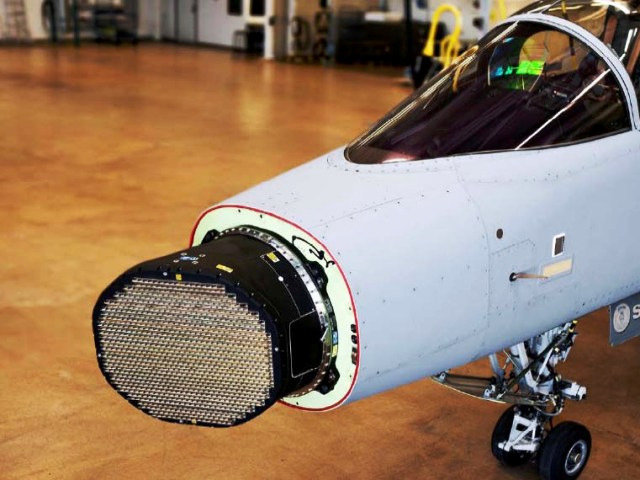
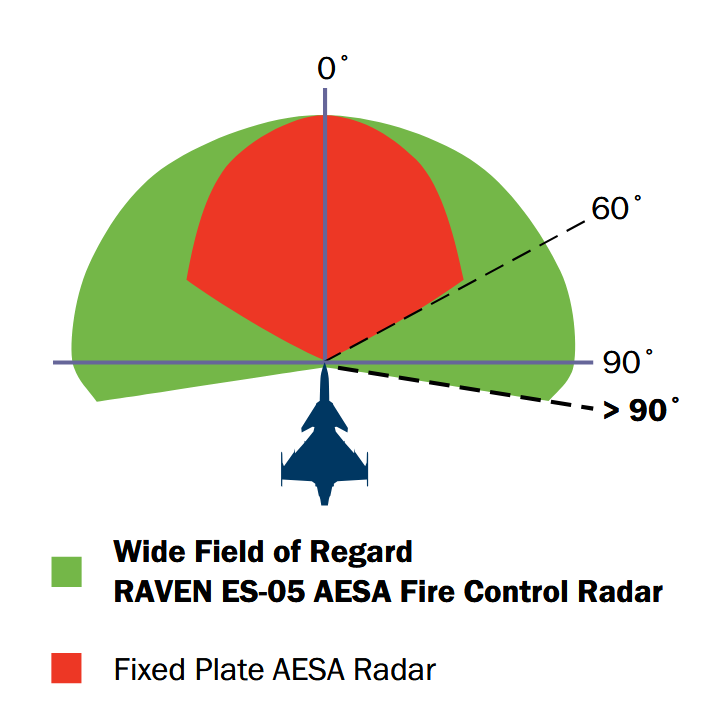
While the F-35's AESA is fixed, it does have an unusually wide field of regard, wider than the 60 degree limit claimed by the Gripen radar's manufacturer for a "standard" fixed plate AESA.
One major difference between Gripen and F-35A are the datalinks.
Link 16, Joint Tactical Information Distribution System (JTIDS) is a common datalink from the 1980s shared by NATO aircraft.
Both JAS-39E and F-35A support link 16. But their proprietary datalinks are different.
Link 16, Joint Tactical Information Distribution System (JTIDS) is a common datalink from the 1980s shared by NATO aircraft.
Both JAS-39E and F-35A support link 16. But their proprietary datalinks are different.
Saab, using their decades of experience building fighter datalinks, designed a new protocol called "TIDLS," utilizing modified hardware for link 16 to allow for better fighter-to-fighter communication than is possible with Link 16, including basic fighter-to-fighter cooperation.

However, the F-35 datalink, called Multifunction Advanced Data Link or MADL, uses its own hardware and totally different transmission techniques to accomplish much more.
Instead of lower frequency omnidirectional antennas, MADL uses directional antennas with high data throughput.
Instead of lower frequency omnidirectional antennas, MADL uses directional antennas with high data throughput.
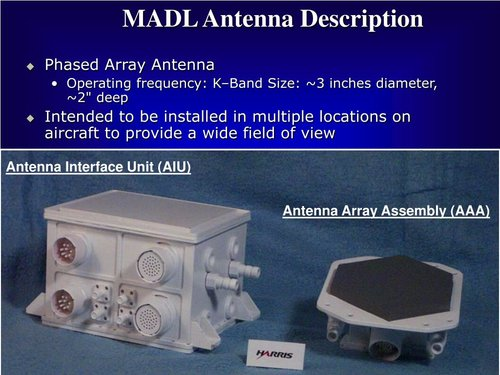
MADL also uses Low Probability of Intercept techniques, or LPI, to decrease the possibility of detection by other aircraft.
MADL is capable of transmitting high resolution information between aircraft through larger data packets, something TIDLS cannot.
MADL is capable of transmitting high resolution information between aircraft through larger data packets, something TIDLS cannot.

A four-ship flight of F-35s can use one aircraft to emit while the four other members of the flight use their radars in a passive mode to detect as much electronic information as they can and transmit it by MADL.
If it is required, one F-35 can jam an emitter detected by another.
If it is required, one F-35 can jam an emitter detected by another.

To accomplish this technically difficult feat, F-35s use atomic clocks to perfectly synchronize data transmission across multiple aircraft.

Either way, the effectiveness of electronic equipment is limited by thermal capacity & power generation.
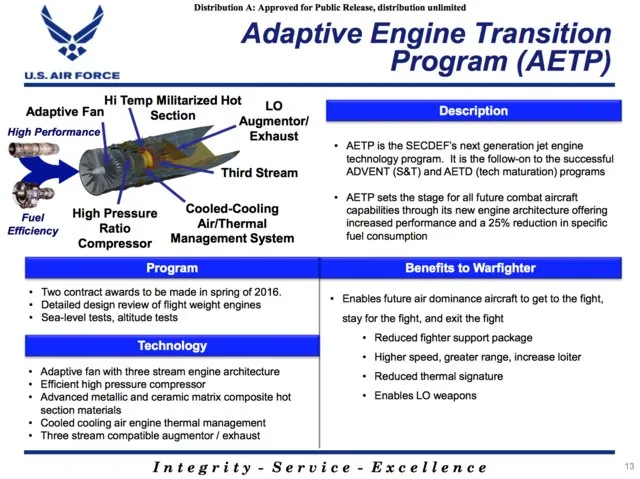
The power for an aircraft is generated by the engine, and the F414 that powers the Gripen is half of what an F/A-18E is powered by, and far less capable than the F-35's F135.
The power for an aircraft is generated by the engine, and the F414 that powers the Gripen is half of what an F/A-18E is powered by, and far less capable than the F-35's F135.

The F135 is admittedly overtaxed, as is seen in the above quote, but the potential upgrades of GE's XA-100 or the Raytheon EPACS would approximately double the cooling capacity and increase range and thrust.


The ES-05 AESA is smaller and has about 600 fewer Transmit/Receive modules than APG-81, and both are reliant on GaAs Monolithic Microwave Integrated Circuits(MMIC) for their T/R modules. All things equal, more T/Rs limited by the same material is better.
View Tweet
Now what about infrared systems?
The Gripen contains a long-range infrared search and track system, and missile warning systems based on infrared technology. These alert the pilot when the IR or UV signature of a missile is detected, and automatically deploy countermeasures.
The Gripen contains a long-range infrared search and track system, and missile warning systems based on infrared technology. These alert the pilot when the IR or UV signature of a missile is detected, and automatically deploy countermeasures.


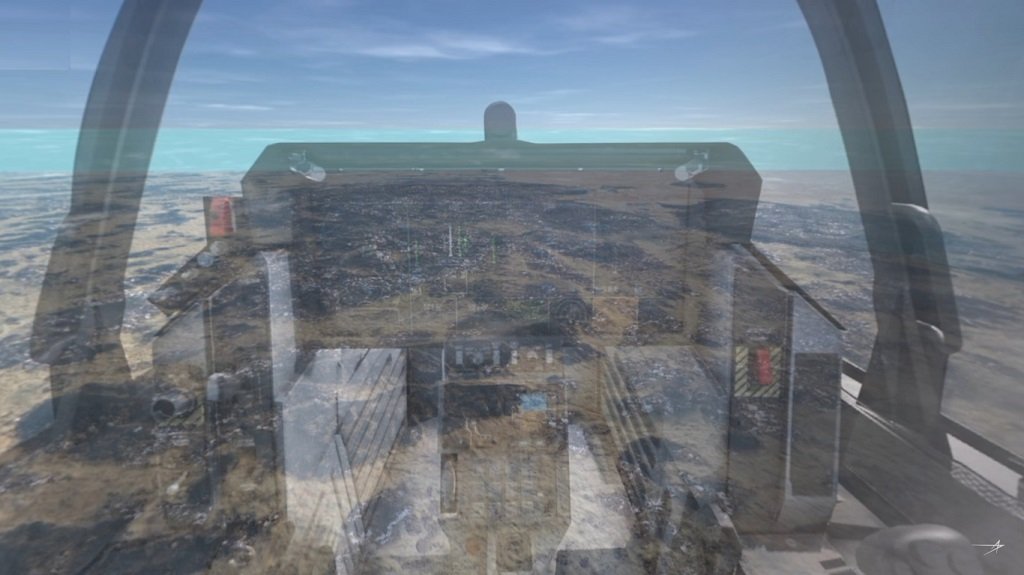
But the F-35 has this too. In this case, missile warning is a secondary function. The Distributed Aperture System(DAS) of F-35 provides external views of the entire surroundings of the jet.
This allows the pilot to use his HMD to look through the cockpit.
This allows the pilot to use his HMD to look through the cockpit.

Generated by Thread Navigator
Press ⌘ + S to quick-export