There's a popular myth that when men get promoted, it causes marriage stability, but when women get promoted, it causes divorce.
This turns out to be wrong, but understanding why it's wrong is surprisingly complicated!

So to start with we have to understand something: men usually earn more than women, and this gets more true as marriages go on, as women exit the workforce to raise kids more than men do.
Thus, it's just usually the case that families depend more on a husband's income. And it's less commonly the case that income is lopsided towards a female partner.
Imagine a scenario where 80% of couples are male-breadwinner and 20% are female-breadwinner, and where breadwinner-promotions strengthen marriages, but non-breadwinner-promotions weaken marriages.
Basically, in this scenario "If a promotion ratifies existing income distributions, divorce isn't an issue. If a promotion scrambles existing income distributions, divorce is an issue."
If this is true, we would find that ***80%*** of women's promotions would lead to MORE DIVORCE, because women are only the breadwinners in 20% of cases.
Even if promoting a breadwinner woman causes LESS divorce, it would SEEM like promoting women causes MORE divorce, since most women aren't breadwinners.
Even if promoting a breadwinner woman causes LESS divorce, it would SEEM like promoting women causes MORE divorce, since most women aren't breadwinners.
So we actually want to know, what happens to divorce when promotions go to:
Primary-earner husbands
Primary-earner wives
Secondary-earner husbands
Secondary-earner wives
Primary-earner husbands
Primary-earner wives
Secondary-earner husbands
Secondary-earner wives
The "gender essentialist" theory suggests:
Promotions to husbands reduce divorce, promotions to wives increase divorce, and this is true regardless of primary or secondary earner status.
The alternative "marriage bargaining" theory suggests:
Promotions to primary earners reduce divorce, promotions to secundary earners increase divorce, and this is true regardless of gender of earner.
Promotions to husbands reduce divorce, promotions to wives increase divorce, and this is true regardless of primary or secondary earner status.
The alternative "marriage bargaining" theory suggests:
Promotions to primary earners reduce divorce, promotions to secundary earners increase divorce, and this is true regardless of gender of earner.
No study fully tests this dynamic, but one comes close:

This paper is a classic case where the abstract does not help lay people correctly understand what the paper actually found.
So to begin with, this paper uses a fun experiment: they compare the divorces of people who ran for mayoral roles in Sweden and lost vs. people who ran and won, and in particular they compare close elections.
Both men and women run for mayoral roles, and are married, and "promotion" in the sense of winning a mayoral role is plausibly somewhat random.
Moreover, the promotions are HUGE: for women, the effect of winning a mayoral role is a 140% increase in average annual income over the next 8 years, and for men a 53% increase!
Moreover, the promotions are HUGE: for women, the effect of winning a mayoral role is a 140% increase in average annual income over the next 8 years, and for men a 53% increase!
So what happened? The robustness tests tell the story!
When the politician was much younger than their spouse, marriage durability CRASHED. This was true for men AND women. For age-equal/older politicians, zero effect of promotion on divorce!
When the politician was much younger than their spouse, marriage durability CRASHED. This was true for men AND women. For age-equal/older politicians, zero effect of promotion on divorce!
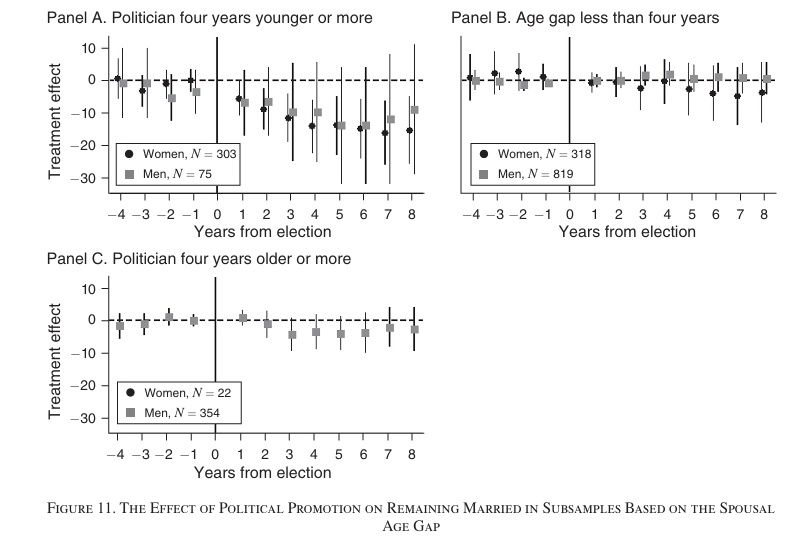
This is super important! Younger spouses usually earn less and have a weaker "bargaining position" vs. their older partner. So this tells us that divorce ONLY rose when a promotion accrued to a younger/weaker/poorer partner, and this divorce effect occurred for MEN AND WOMEN.
If we look at the subsample of couples with kids, we can see how maternity leave was split as another predictor. For women who took 90%+ of mat leave, if they won elections, divorces rose: so when a housewife gets elected she gets divorced.
But look! Second panel! When a husband who took atypically high parental leave got elected, HIS divorce odds rose too!
But look! Second panel! When a husband who took atypically high parental leave got elected, HIS divorce odds rose too!
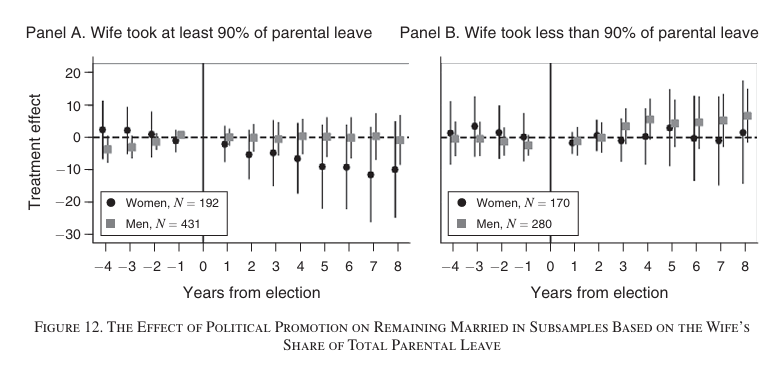
So basically, any time the "house-spouse" got a promotion at work, divorce rose, REGARDLESS OF GENDER!
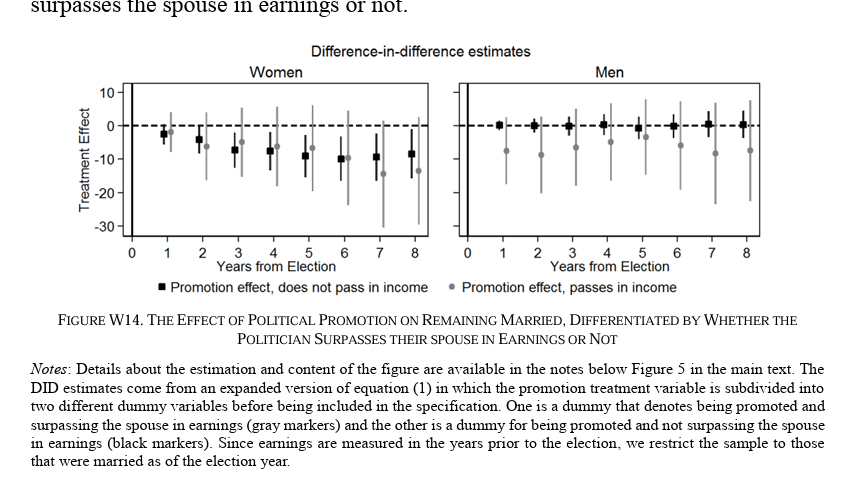
The appendix also shows some (noisy) evidence that this is true if we just look at relative income shares: when men's income share was below their wife's before elections but surpasses after, yeah, marital duration falls similarly to what we observe for women!
Same if we code families as traditional or reverse traditional. When traditional wives get a promotion, they get divorced. But when "reverse traditional" husbands get a promotion, they get divorced!
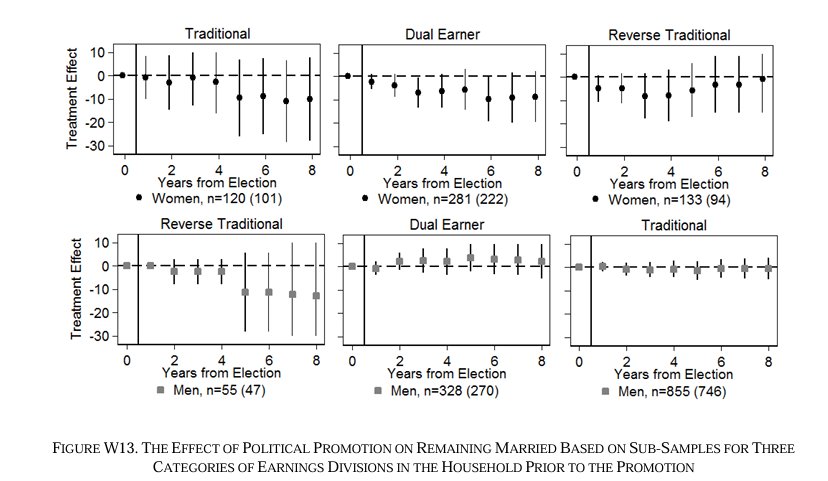
This study offers a strong confirmation of the "bargaining" hypothesis and a refutation of the "gender" hypothesis.
Marriages are contracts. When couples agree to a marriage, they often explicitly or implicitly "agree" to a division of labor and a way of sharing life together.
Marriages are contracts. When couples agree to a marriage, they often explicitly or implicitly "agree" to a division of labor and a way of sharing life together.
When something happens to "shock" this division of labor, it is a challenge to marriages. Some couples are able to effectively complete a renegotiation of terms after a shock, but many cannot, and get divorced.
And crucially, this isn't about gender. Men's income isn't magical.
And crucially, this isn't about gender. Men's income isn't magical.
Generated by Thread Navigator
Press ⌘ + S to quick-export