Compared to twenty years ago, kids are eating some types of ultraprocessed foods more and some types less🧵
For example, one thing there's proportionally less of is sugar-sweetened beverage consumption. Meanwhile, there's relatively greater sweet snack consumption.


Overall, the ultraprocessed food (UPF) consumption share is up across young ages to similar degrees.
The increase is definitely there, but it isn't dramatic. For example, going from 61% to 67.5% is an 11% increase in twenty years.
The increase is definitely there, but it isn't dramatic. For example, going from 61% to 67.5% is an 11% increase in twenty years.

The increase in consumption is not differentiated by the sex of children.
In other words, boys and girls are both eating a bit more ultraprocessed food.
In other words, boys and girls are both eating a bit more ultraprocessed food.

Trends are also not meaningfully differentiated by race. That p = 0.04 is marginally significant, and among all these other tests, it wouldn't hold up if we took the number of comparisons into account.
Notably, Mexican Americans eat less ultraprocessed food.
Notably, Mexican Americans eat less ultraprocessed food.
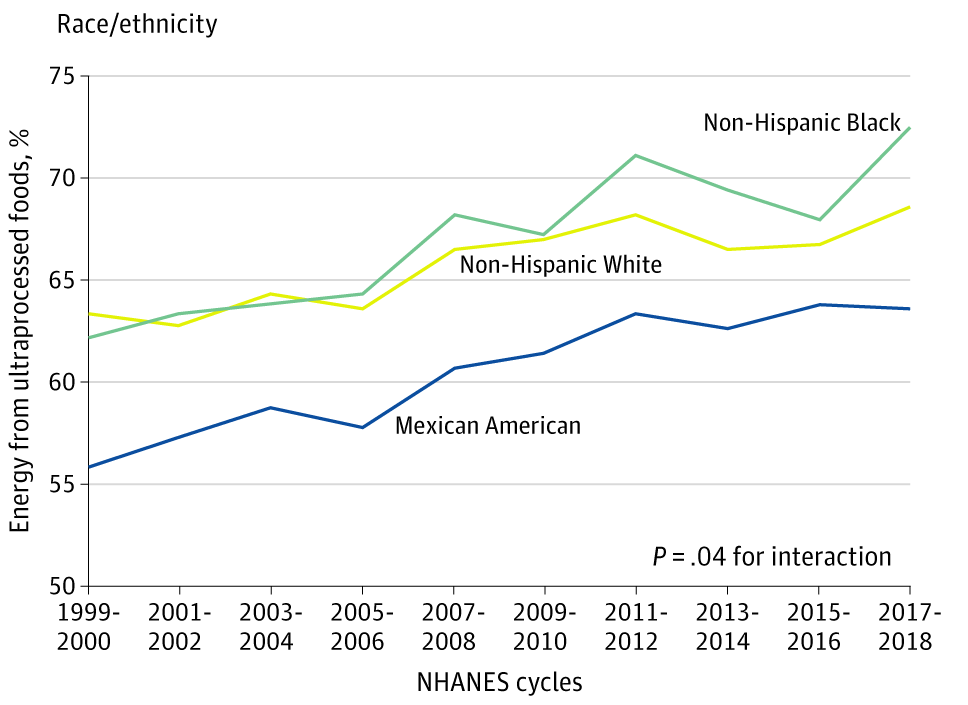
Why is that last part notable? Because Hispanic kids still have higher obesity rates.
Seems their less ultraprocessed diet is worse!
Seems their less ultraprocessed diet is worse!

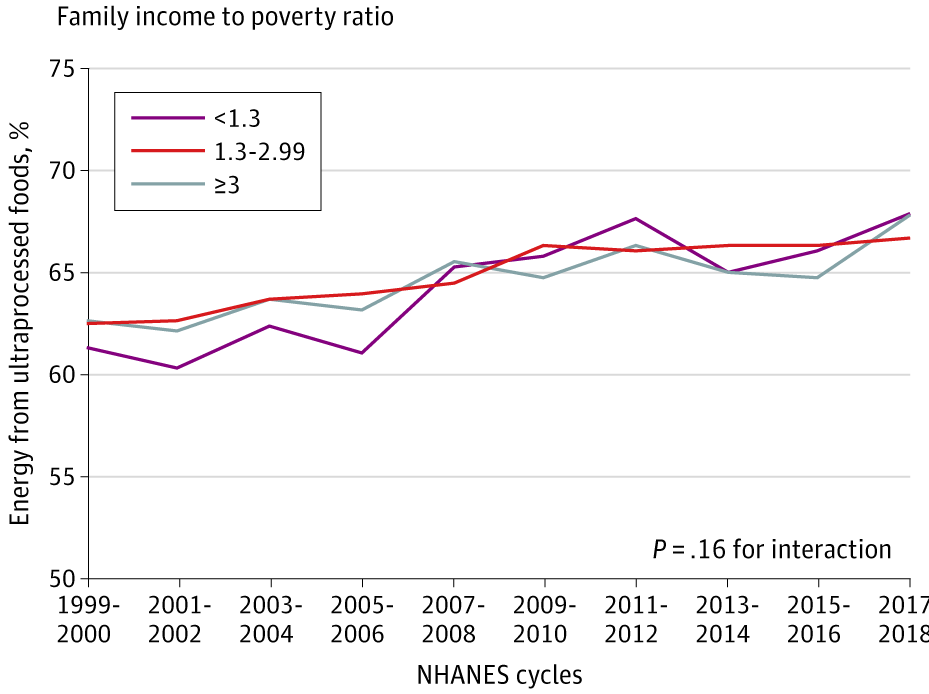
Contrary to popular perception, there isn't much of a class difference in ultraprocessed food consumption.
The scale of the differences here and the differences in trend are not meaningfully differentiated, even though, along the same strata, kids' health is.
The scale of the differences here and the differences in trend are not meaningfully differentiated, even though, along the same strata, kids' health is.

Similarly, families who are poor and families whose income exceeds the poverty level by at least 3x do not consume different levels of ultraprocessed foodstuffs, even though you might think they do, because wealthier families have healthier kids.
Nutritionally, what are the consequences of this change?
Higher caloric consumption is the biggest thing, but otherwise, the switch to more ultraprocessed food has boosted the carbohydrate share by about 1%, reduced the protein share by about 1%, not affected the fat share...
Higher caloric consumption is the biggest thing, but otherwise, the switch to more ultraprocessed food has boosted the carbohydrate share by about 1%, reduced the protein share by about 1%, not affected the fat share...
And otherwise had very little meaningful impact on other nutrients, with the most meaningful change for public health being that ultraprocessed food has benefitted folate levels enough to prevent a bunch of birth defects.
Otherwise, eh! Added sugar intake up ~1.5% is shruggable.
Otherwise, eh! Added sugar intake up ~1.5% is shruggable.
One of the big issues with considering ultraprocessed food a health issue is that there's so little work demonstrating its harms
Even cross-sectionally, it's not clear that it matters. For example, among three-year-olds, there's clear confounding in its association with obesity:
Even cross-sectionally, it's not clear that it matters. For example, among three-year-olds, there's clear confounding in its association with obesity:

Also, plenty of ultraprocessed food is just fine!
UPF is not necessarily bad, it's just a food handling thing.
Its main source of association with obesity and the downstream consequences of obesity is due to UPF just increasing caloric consumption, as in this Swedish data.
UPF is not necessarily bad, it's just a food handling thing.
Its main source of association with obesity and the downstream consequences of obesity is due to UPF just increasing caloric consumption, as in this Swedish data.

Does it increase it because it's harder to be satisfied on it for chemical reasons?
Widely believed, not actually established.
There's better evidence that UPF just presents additional dietary variety, and that drives more eating.
Widely believed, not actually established.
There's better evidence that UPF just presents additional dietary variety, and that drives more eating.
Regardless, UPF cannot be a primary cause of the increase in poor health lately because the trend in UPF consumption is too modest, and even its confounded, inflated, cross-sectional effect sizes are too small.

re: post one. I don't count the "pizza" and "sandwiches or hamburgers" categories as showing a big increase since they were redistributed among categories between NHANES cycles, and they weren't given in a discrete category in 2000.
Sources:
jamanetwork.com/journals/jama/…
salud-america.org/the-state-of-o…
jamanetwork.com/journals/jaman…
cambridge.org/core/journals/…
sciencedirect.com/science/articl…
Sources:
jamanetwork.com/journals/jama/…
salud-america.org/the-state-of-o…
jamanetwork.com/journals/jaman…
cambridge.org/core/journals/…
sciencedirect.com/science/articl…
Generated by Thread Navigator
Press ⌘ + S to quick-export