You don't need elite writers to dominate search.
You need the right AI systems.
After analyzing 1,000+ successful AI blogs…
I've built a framework that turns mediocre writers into SEO content machines.
Here's the exact process I use with my clients:

1/ The problem with most content teams:
• Writers create "pretty" content that never ranks
• SEO recommendations get ignored or misunderstood
• Content briefs are vague or too technical
• Writers hate keyword-stuffing (and they should!)
• Writers create "pretty" content that never ranks
• SEO recommendations get ignored or misunderstood
• Content briefs are vague or too technical
• Writers hate keyword-stuffing (and they should!)
2/ Step 1: Create a Claude AI project for your content team
• Upload your top-performing content
• Add competitor articles that rank well
• Include your brand voice guidelines
• Share industry PDFs/research
• Define your target audience
Now AI knows your niche AND voice!
• Upload your top-performing content
• Add competitor articles that rank well
• Include your brand voice guidelines
• Share industry PDFs/research
• Define your target audience
Now AI knows your niche AND voice!

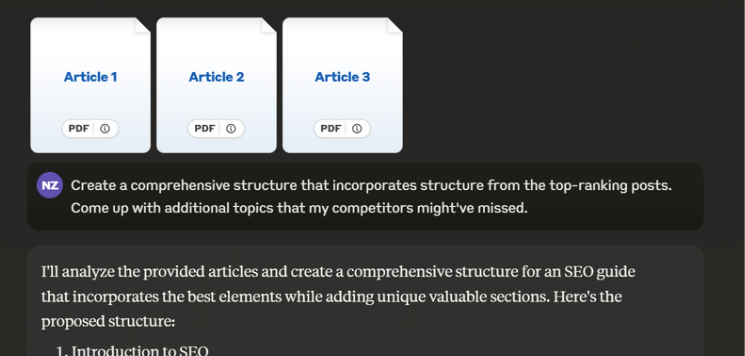
3/ Step 2: Generate search-intent matching outlines
Instead of giving writers vague direction, use AI to:
• Analyze top 3 ranking posts
• Extract their structure
• Find content gaps
• Create detailed H2/H3 outlines
• Include questions from "People Also Ask"
Instead of giving writers vague direction, use AI to:
• Analyze top 3 ranking posts
• Extract their structure
• Find content gaps
• Create detailed H2/H3 outlines
• Include questions from "People Also Ask"
4/ Step 3: Train writers to use AI section-by-section
Don't say: "Write about email marketing"
Instead teach them to prompt:
"Write the section about email segmentation. Include:
• Industry benchmarks
• 2-3 real examples
• Step-by-step process
• Common mistakes"
Don't say: "Write about email marketing"
Instead teach them to prompt:
"Write the section about email segmentation. Include:
• Industry benchmarks
• 2-3 real examples
• Step-by-step process
• Common mistakes"
5/ Step 4: Create an AI editing checklist for writers
Most AI content fails because writers don't edit properly.
Train them to:
• Kill generic intros
• Add real examples
• Insert screenshots
• Include data points
• Fix awkward transitions
• Remove fluff words
Most AI content fails because writers don't edit properly.
Train them to:
• Kill generic intros
• Add real examples
• Insert screenshots
• Include data points
• Fix awkward transitions
• Remove fluff words
6/ Step 5: Build a PAS formula template
Problem-Agitate-Solution hooks readers instantly.
Create a template:
"Problem: [Target audience pain point]
Agitate: [Consequences of not solving]
Solution: [How your article helps]"
Writers can use AI to generate these for every post!
Problem-Agitate-Solution hooks readers instantly.
Create a template:
"Problem: [Target audience pain point]
Agitate: [Consequences of not solving]
Solution: [How your article helps]"
Writers can use AI to generate these for every post!
7/ Step 6: Implement a content QA process
Before publishing, have writers run content through this AI-assisted checklist:
• Search intent match
• Keyword placement
• Internal linking
• Real examples
• Featured snippet optimization
• Mobile formatting
Before publishing, have writers run content through this AI-assisted checklist:
• Search intent match
• Keyword placement
• Internal linking
• Real examples
• Featured snippet optimization
• Mobile formatting
The bottom line:
AI isn't replacing your writers.
It's upgrading them.
By implementing these systems, you'll transform mediocre writers into SEO content machines that consistently produce content that actually ranks.
AI isn't replacing your writers.
It's upgrading them.
By implementing these systems, you'll transform mediocre writers into SEO content machines that consistently produce content that actually ranks.
Generated by Thread Navigator
Press ⌘ + S to quick-export