Does sugar make people fat?
That's the thesis of tons of books, articles, and bits of popular writing, but is it true?
The answer seems to be "no", but the cross-sectional evidence suggests it's "yes". Why? Because people believe the answer is "yes"!🧵
Consider this data:


In 2000, the U.S. government began warning people against consuming foods containing added sugars.
In 2011-12, Gary Taubes started promoting his view that sugar "sets the stage for epidemic levels of obesity and diabetes".
When people heard this, they changed habits.
In 2011-12, Gary Taubes started promoting his view that sugar "sets the stage for epidemic levels of obesity and diabetes".
When people heard this, they changed habits.
The sugar share of people's carbohydrate intake fell, as my graph shows, and then everything got better...
Scratch that. It kept getting worse.
But more interestingly, sugar consumption became associated with worse socioeconomic status and health habits:
Scratch that. It kept getting worse.
But more interestingly, sugar consumption became associated with worse socioeconomic status and health habits:
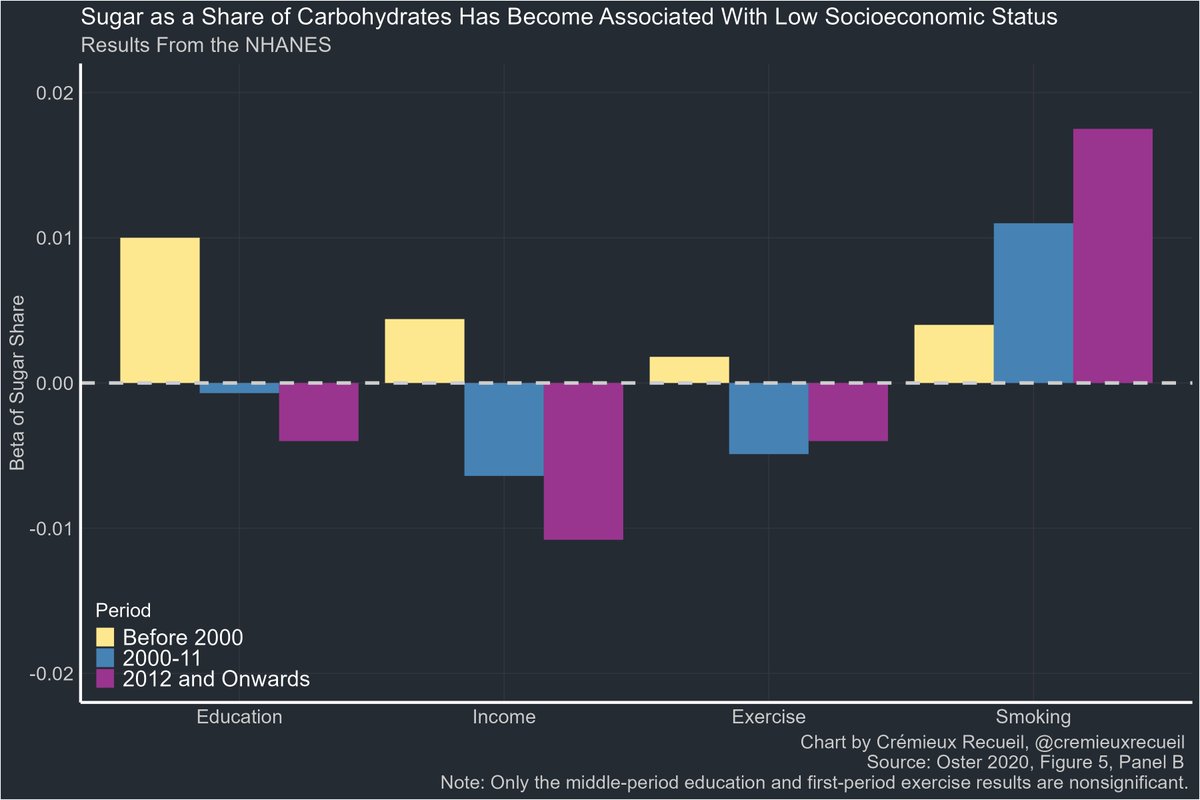
Once people got word that sugar was bad, they flipped over to consuming less of it. But this flip was selective: Already-healthy people disproportionately reduced their sugar consumption.
Before this shift towards a healthy user bias, it wasn't even associated with higher BMIs!
Before this shift towards a healthy user bias, it wasn't even associated with higher BMIs!

This should come as a surprise if you've imbibed the last quarter-century of anti-sugar, anti-sweetener arguments, but it's no surprise if you've just calmly kept asking "Why is sugar so bad?" and waiting for the causal evidence.
If cross-sectional data is enough for you, you're likely sold. You probably see the modern, self-selection driven association between sugar and BMI and think 'That's bad. Avoid sugar!'
But what about vitamin E? In 1993, we 'learned' it was good. In 2004, we 'learned' it was bad.
But what about vitamin E? In 1993, we 'learned' it was good. In 2004, we 'learned' it was bad.

Different, popular articles changed how much the general population (NHANES) and even select populations like nurses (NHS) supplemented vitamin E.
In this case, we have a pretty clean experiment in self-selection.
As with sugar, we see a health consciousness bias:
In this case, we have a pretty clean experiment in self-selection.
As with sugar, we see a health consciousness bias:

Also as with sugar, we see that vitamin E becomes better for health during the time in which it's popularly understood to be good for health, and then it returns to normal healthy people switch away.

We see the same thing for tons of stuff, from breastfeeding, to vitamins C and D, to the Mediterranean diet, to engaging in workplace wellness programs!
Cross-sectionally, it's the users; causally, there's not much going on.
Cross-sectionally, it's the users; causally, there's not much going on.

So many trends in foods being 'healthy' are self-fulfilling, in that when healthy people learn about them, they pick them up, and then it appears that those things actually are good for you.
But it's selection, and we have no problem seeing it play out in different directions.
But it's selection, and we have no problem seeing it play out in different directions.
All of this is to say, I think people's nutrition beliefs are much more about selection and the stories they tell to explain those beliefs are "just-so", rather than true descriptions of reality.
In most cases, I'm right, even when it comes to things as maligned as sugar.
In most cases, I'm right, even when it comes to things as maligned as sugar.
If you want to learn more about this topic, check out my latest article, sponsored by my favorite payroll software company @joinwarp: cremieux.xyz/p/nutrition-be…
Generated by Thread Navigator
Press ⌘ + S to quick-export